Major overhaul to Fender AA763 Vibrolux amp

April 23, 2012

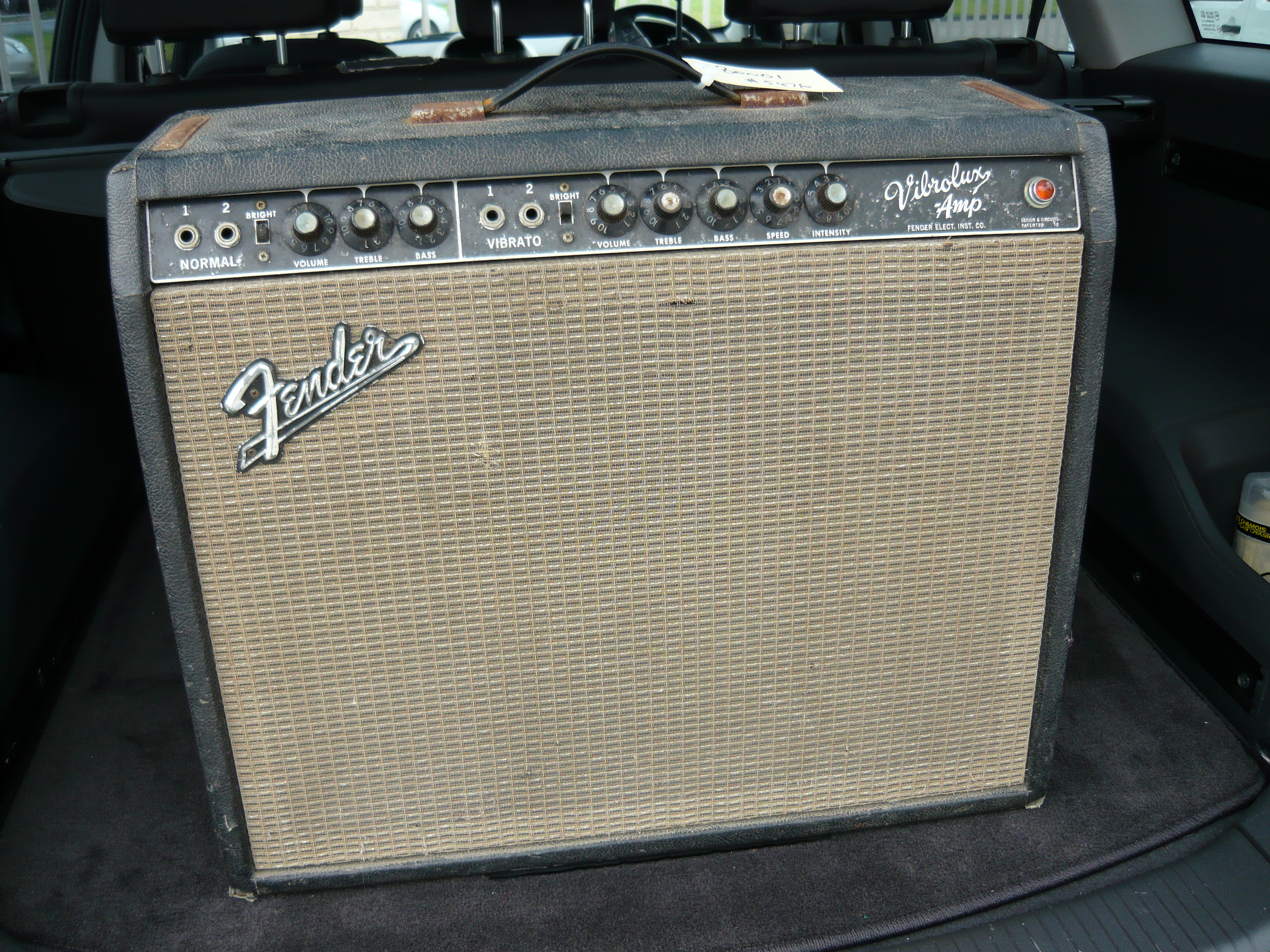
Here is another rarity, send to us for a complete overhaul by Bondi Intermusic – the Fender Blackface AA763 Vibrolux amplifier. Manufactured in 1963 ?? This model features normal & vibrato channels (it’s actually tremolo), with a valve (tube) complement of 3 x 12AX7/7025/ECC83, 1 x 12AT7/ECC81, a pair of 6L6GC output valves, plus a GZ34/5AR4 rectifier.

The speaker in this combo does not appear to be original, and has no apparent identifying codes/numbers, so is a bit of a mystery. The amp was in a filthy state as delivered, plus the chassis and front panel have a corrosion problem, so the amp has probably been stored somewhere damp for years on end. This amp has the potential to sound fabulous with a good speaker unit on board, and at 40 watts is ideal for today’s lounge gigs.

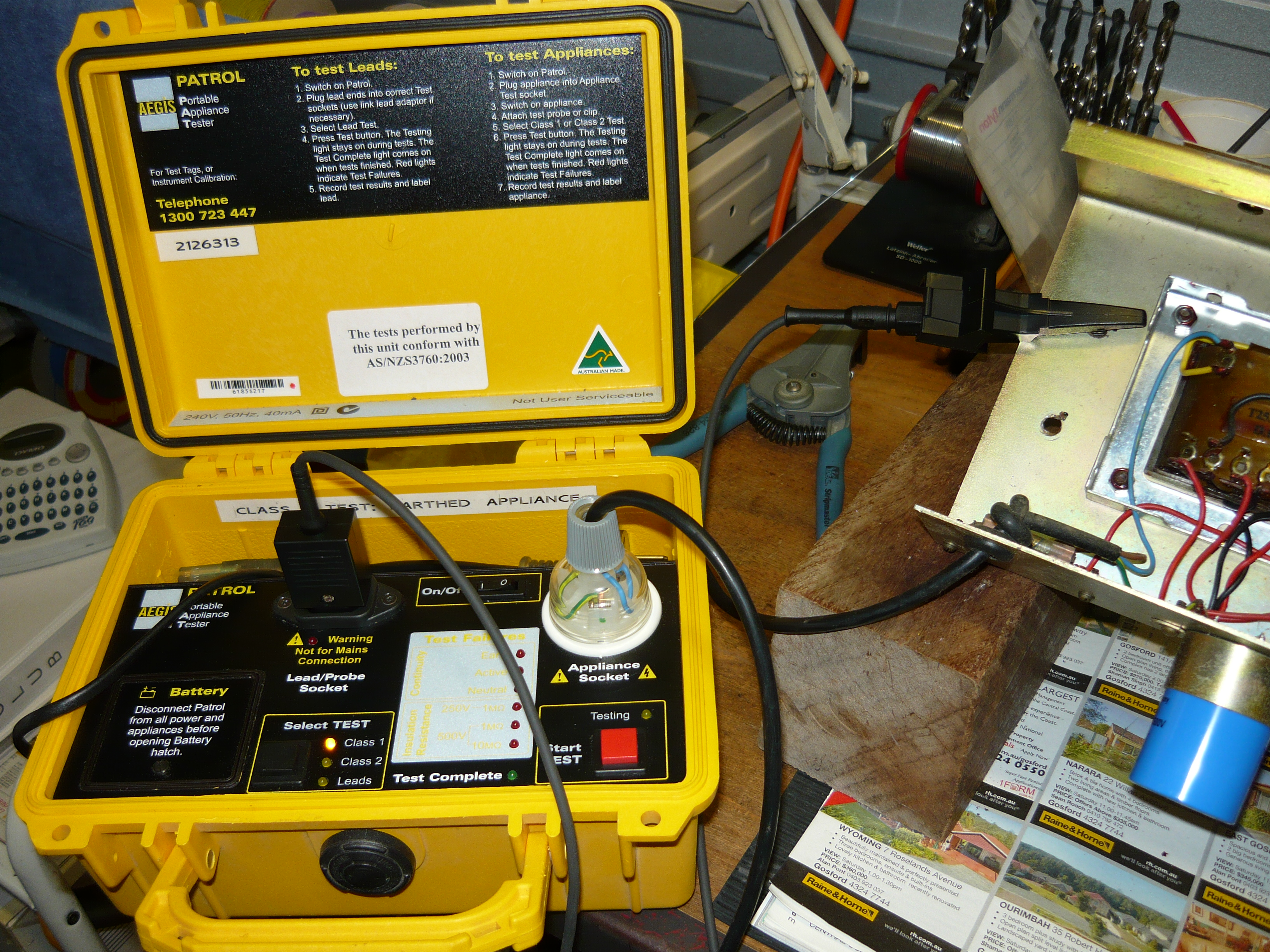
After a bit of a clean up, the first and most significant problems to be resolved are all about electrical safety ! This amp was brought into the land of Australia many years back, with a chassis wired for the USA mains voltage only. Somebody mounted a stepdown transformer in the bottom of the cabinet and wired up a pretty dodgy earth connection to this transformer – the whole arrangement would never pass the Workcover NSW electrical safety inspection, and quite frankly was an accident waiting to happen.
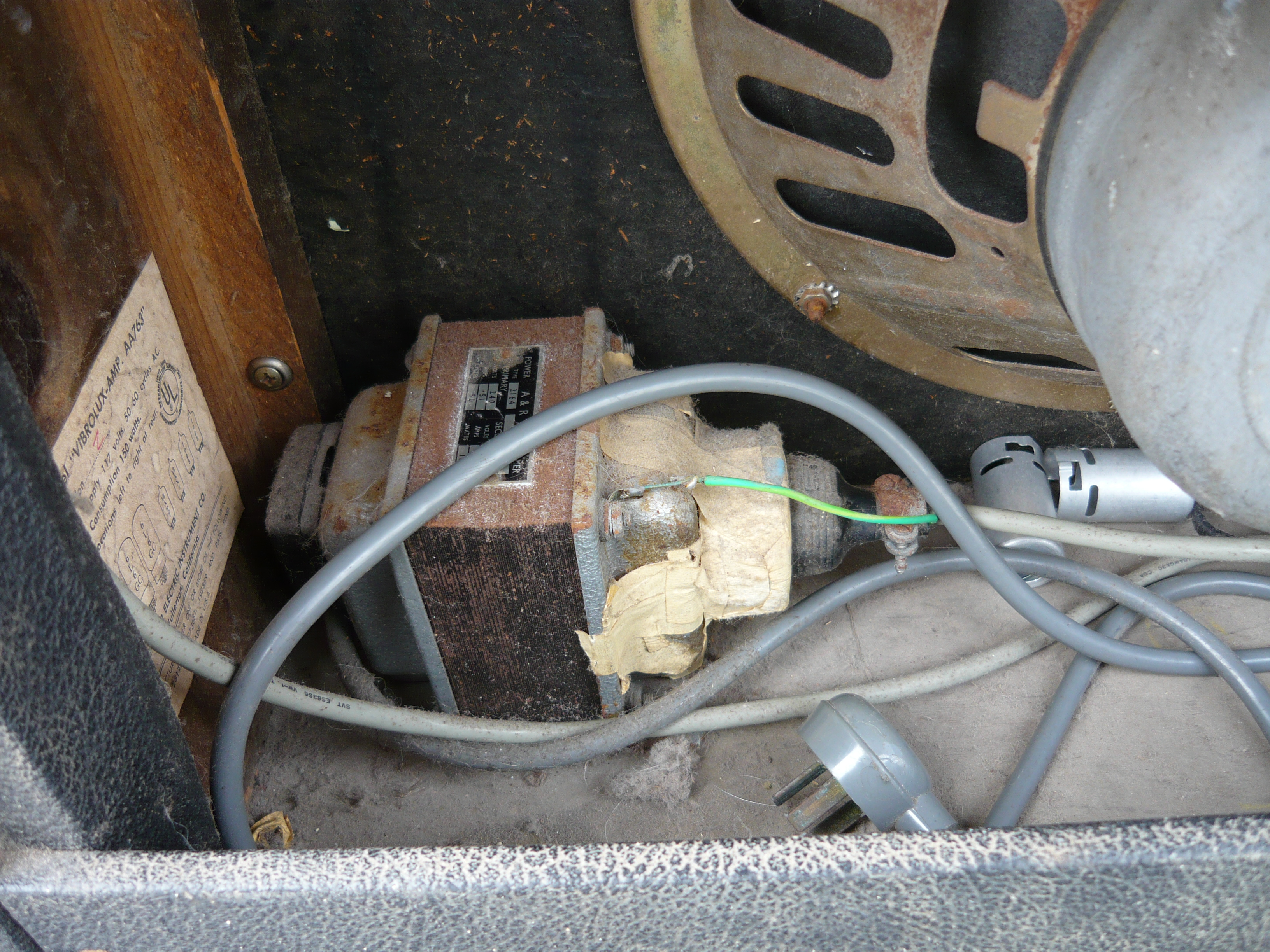
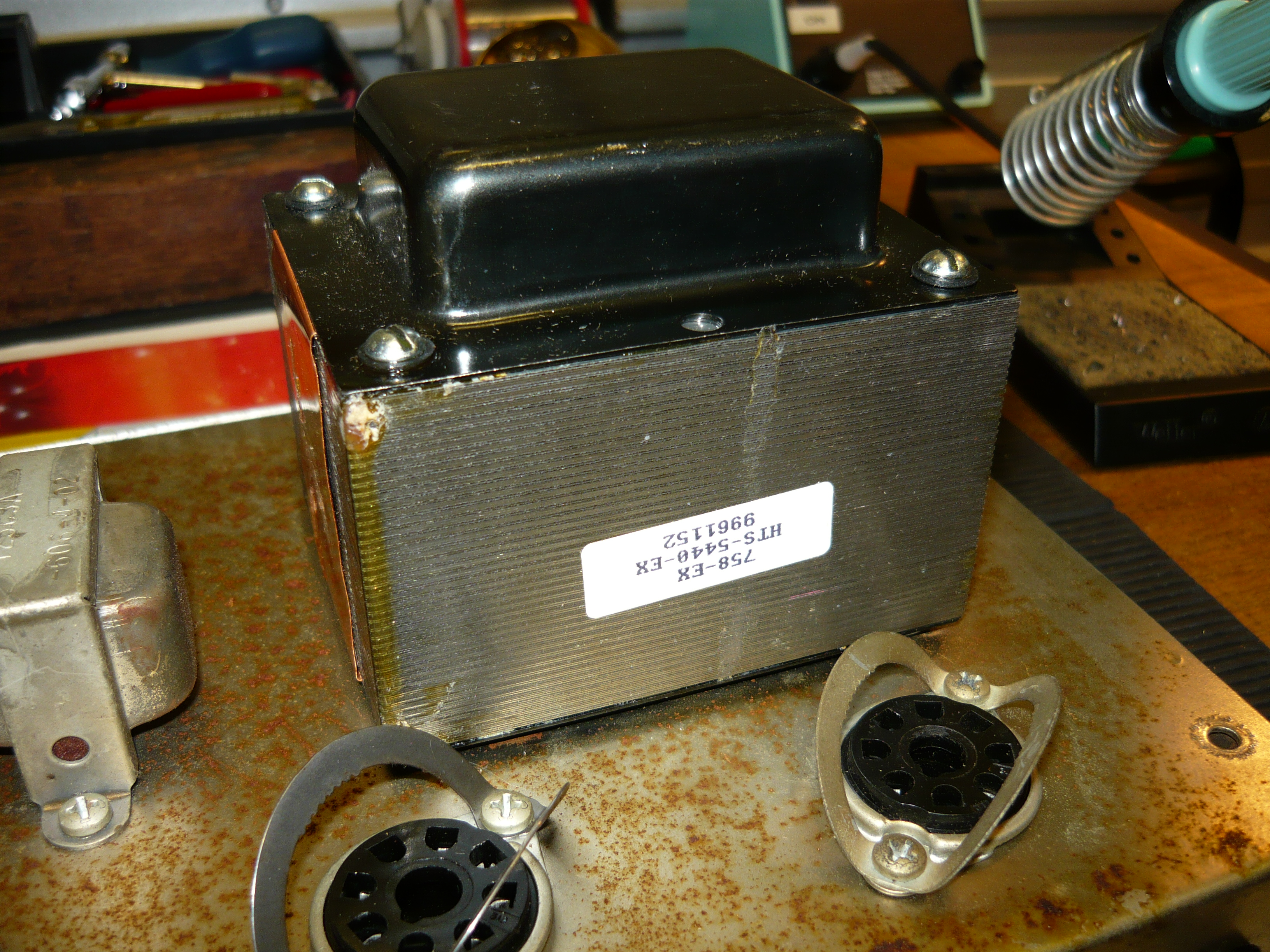
Our recommendation to the customer (Mark), via Bondi Intermusic, was that we remove both the stepdown and the original USA power transformers, and source a reproduction Vibrolux power transformer with an “export” primary, ie the primary winding has several wiring options for global power. This recommendation was accepted, and we installed a transformer made by Heyboer (USA), supplied by Mojo Musical Supply Co. A new 240V 3-core flex & 3-pin plug was also installed and the mains power wiring within the amp chassis rewired to an acceptable standard.
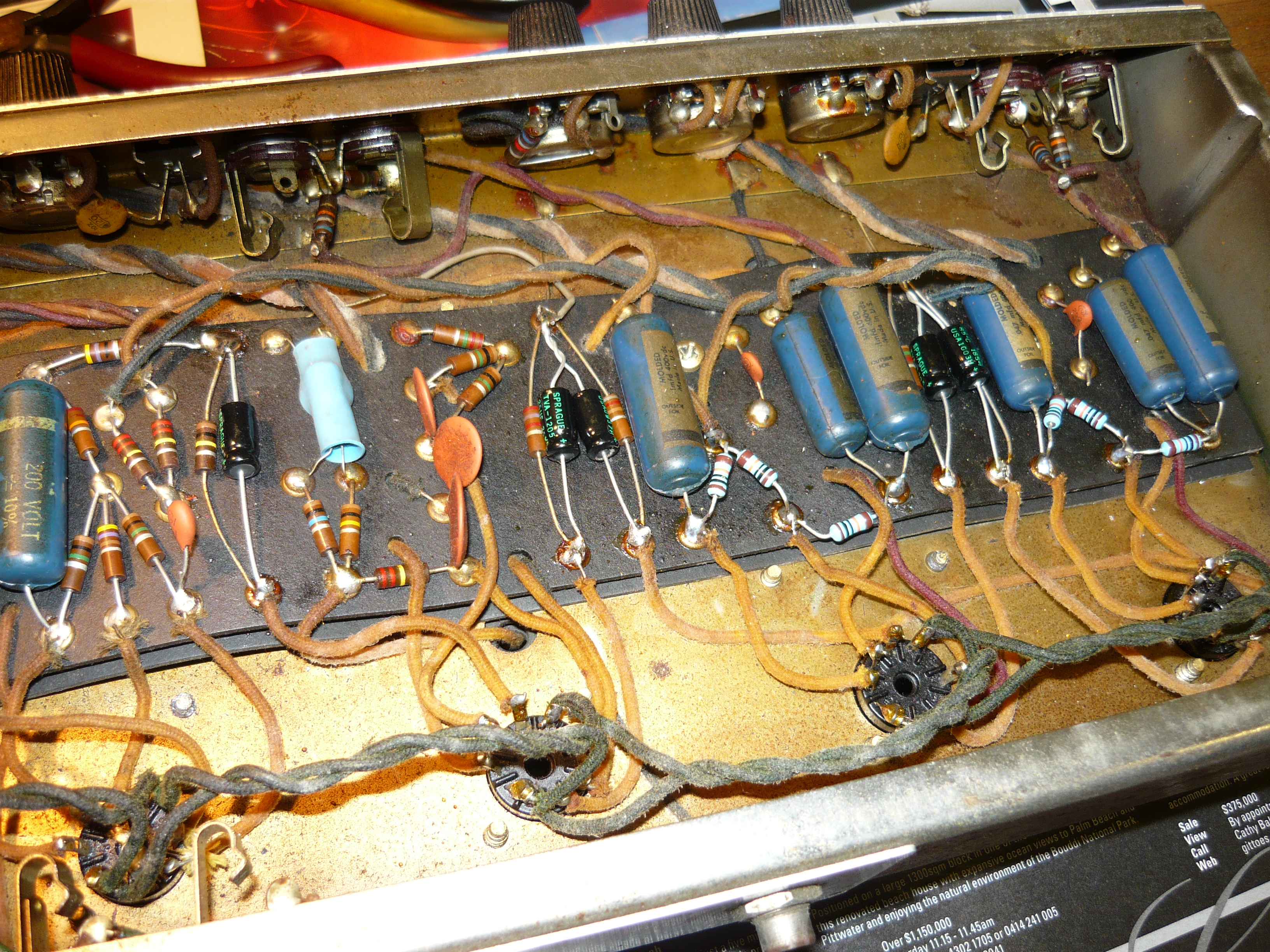
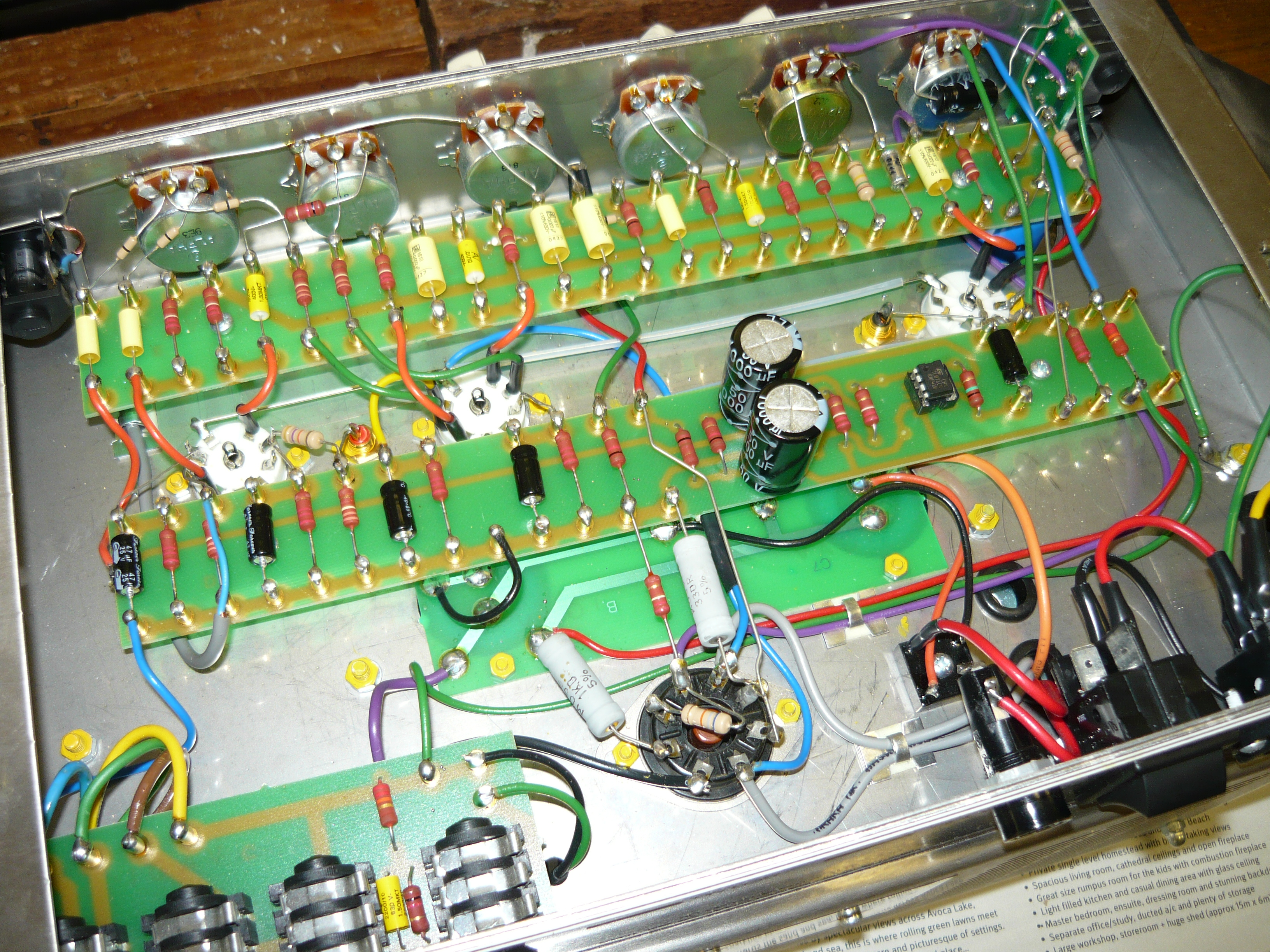
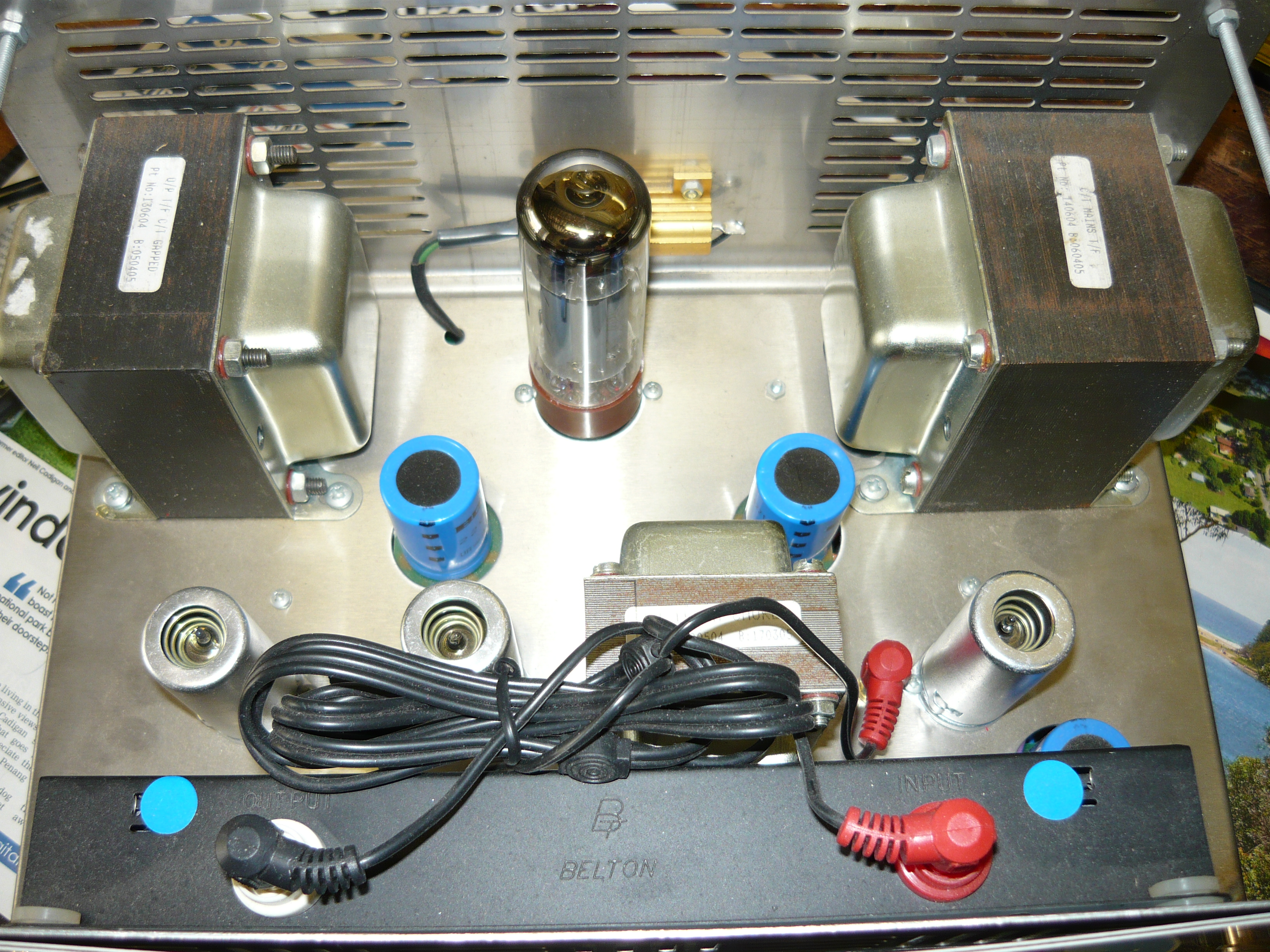
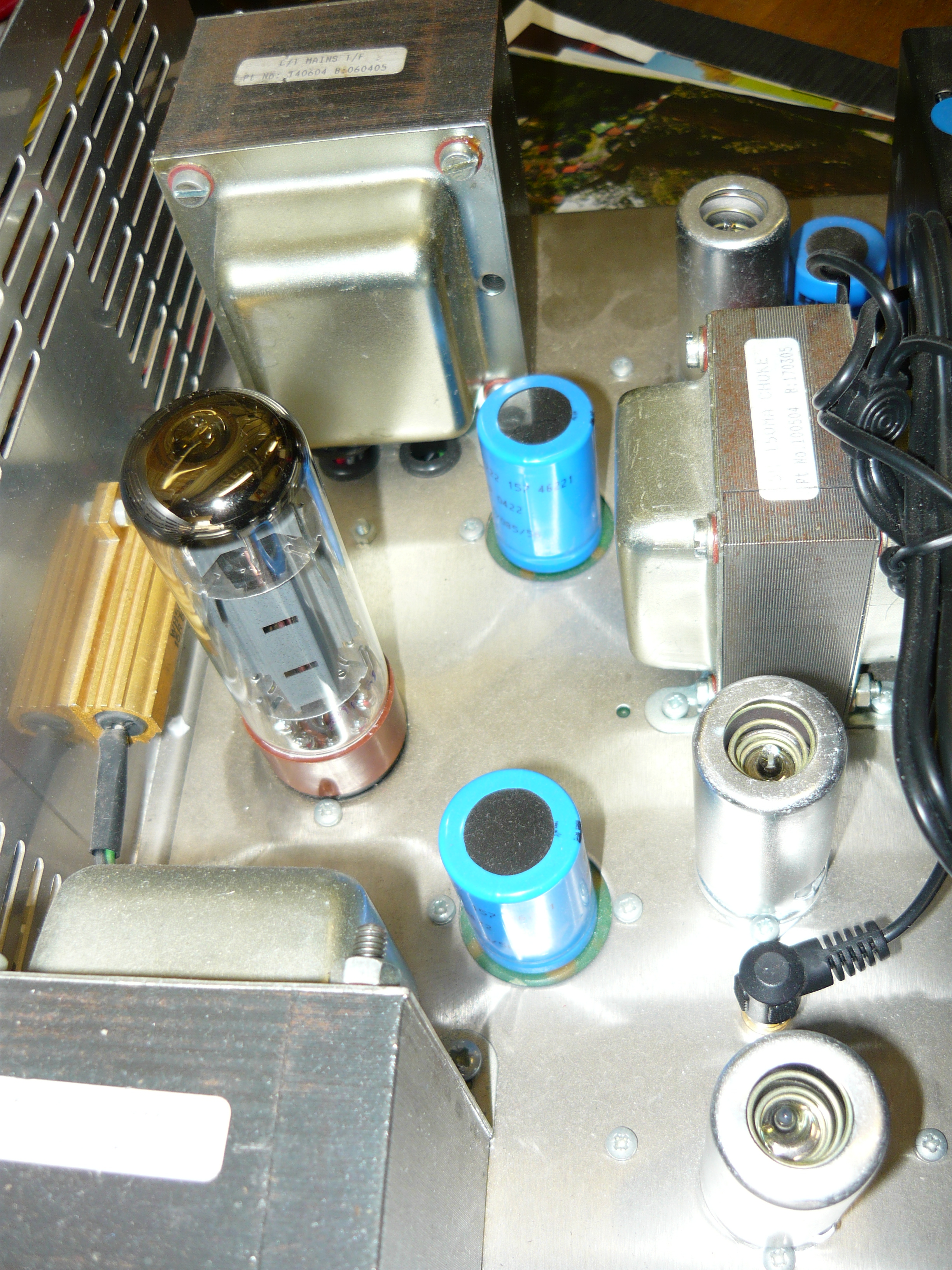
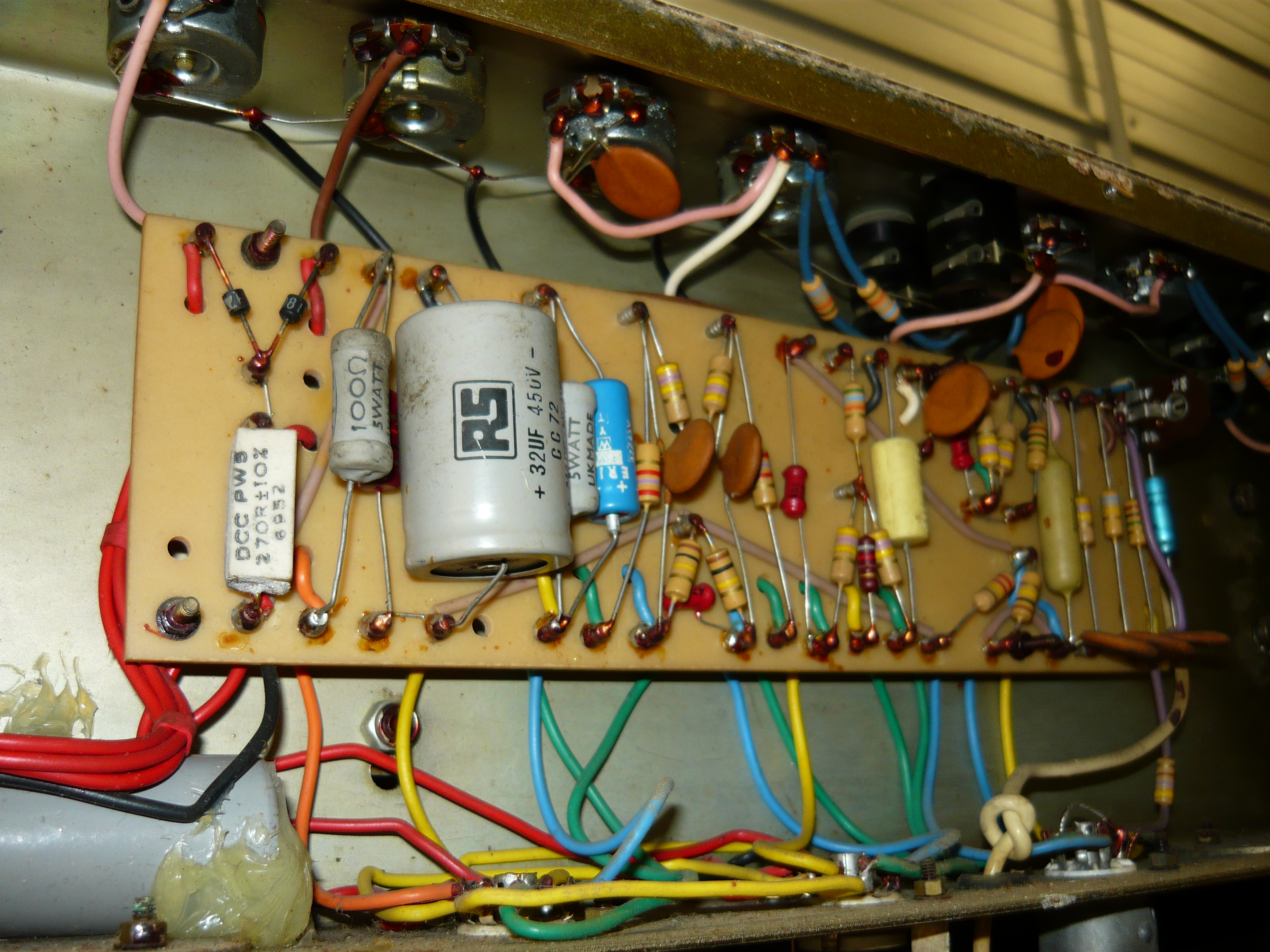
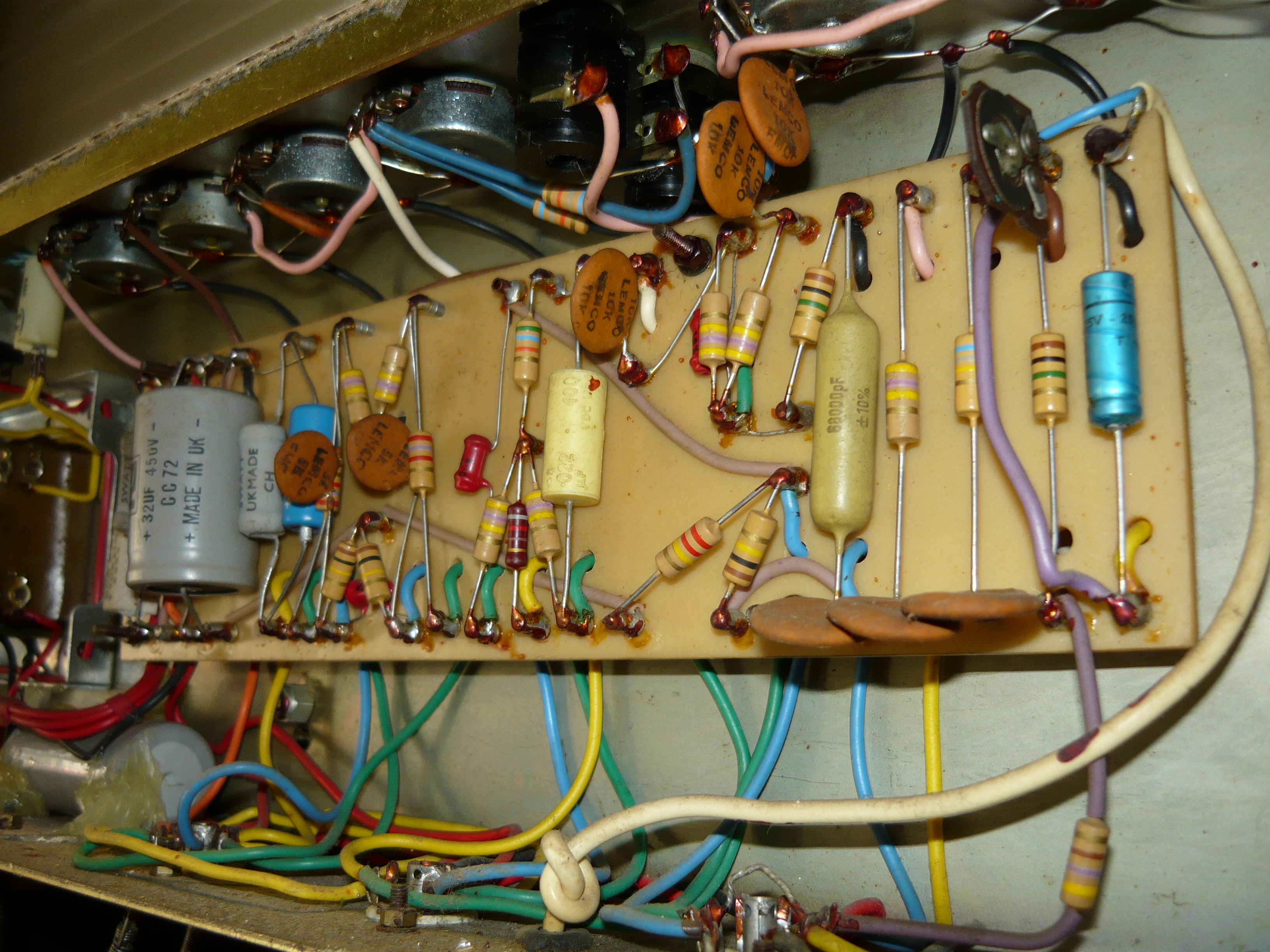
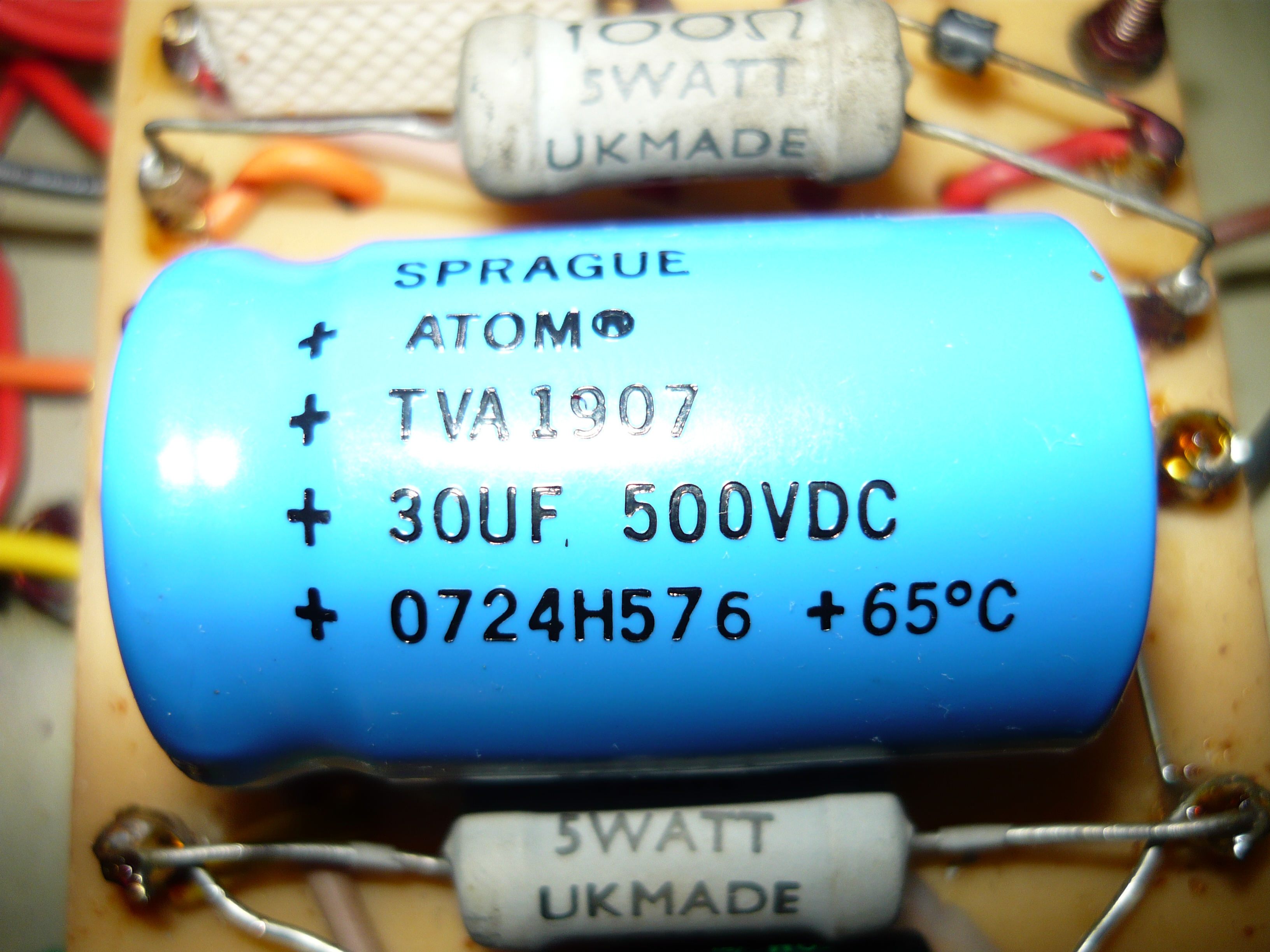
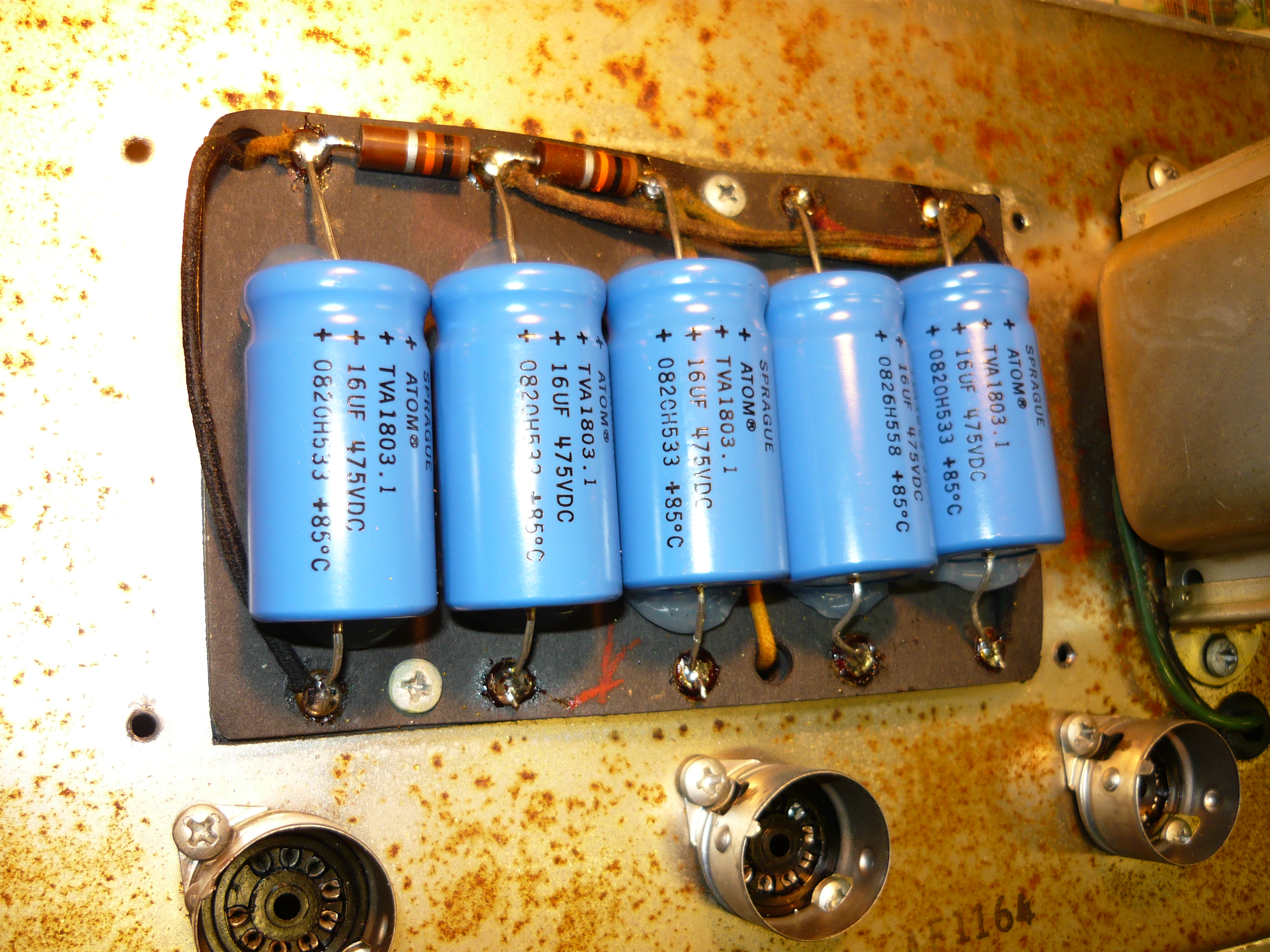
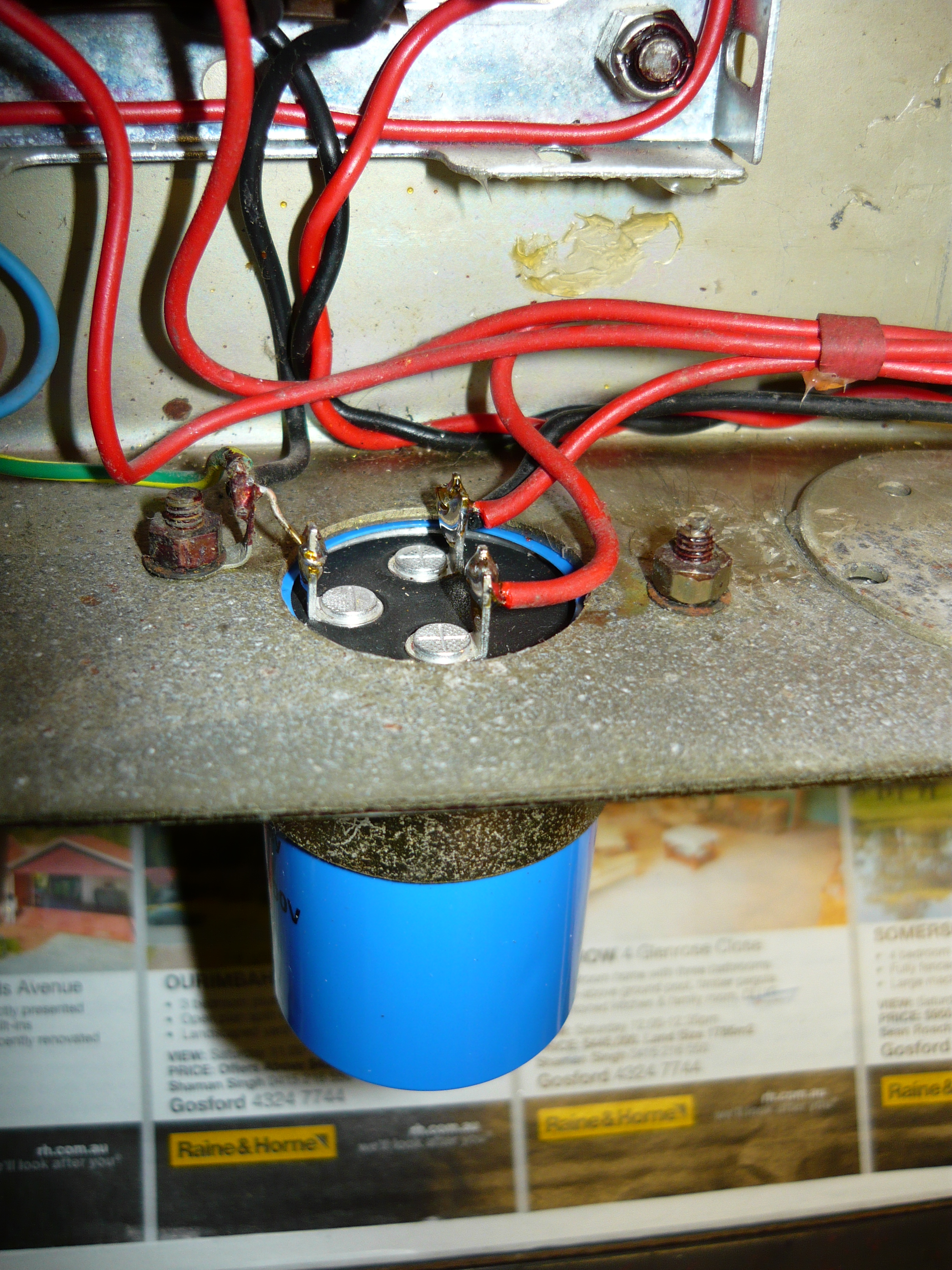
Once all the above was completed and tested, we could get on with tonal improvements. We replaced the five cathode bypass capacitors with Sprague 25uf/25V units, as per the photo. This will help bring the 12AX7 gain stages back to life. Next, we replaced the five ageing power supply capacitors with Sprague 16uf/475V units, as per the original spec, the first pair are paralleled giving 32uf for the main reservoir capacitor, which is well within spec for a GZ34 rectifier. These five caps are bedded down in some silicone (neutral cure), so the axial leads will not be stressed as the amp is bumped around, or loaded in & out of motor vehicles, etc (see photos).
All the amp’s pots (potentiometers) were cleaned/lubricated with Caig Faderlube, and all the jacks cleaned with DeOxit. It’s amazing that in an amp that’s nearly 50 years old – after this basic level of servicing, all the original pots & jacks work just fine ! If only they made stuff this well nowadays.

Someone not known to us has previously replaced all the 100K ohms anode resistors – no doubt they had become noisy. Most importantly, the bias voltage supply was repaired, with a new capacitor and the original resistor values restored. Now, we can install some new valves, as appropriate, and have a listen to this amp.
A couple of the valves tested fine, so we ended up installing a new 12AX7, a 12AT7, a JJ GZ34/5AR4 rectifier, and for the first time we installed a matched pair of the Tung Sol reissue 6L6GC output valves, which have received favourable reviews in the guitar media. We rebiased the 6L6’s and carried out a power output test. The end result was perfect – 40 watts into 8 ohms at the onset of clipping.
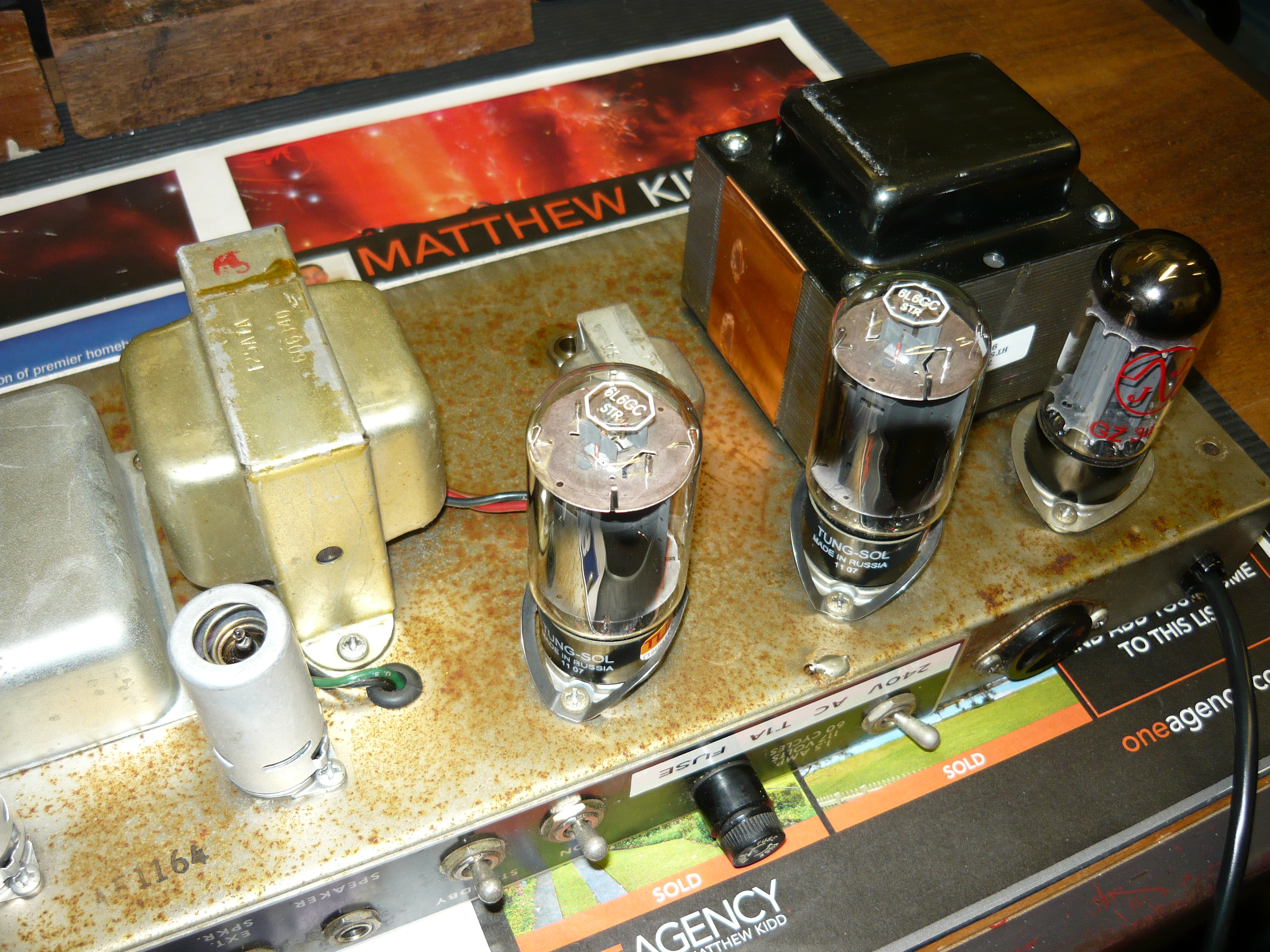
Well, there we have it ! This wasn’t an inexpensive repair by any definition. Over 4 hours labour plus high material costs, but it will be worth it once Mark is cashed up enough to load a good quality  guitar speaker into this amp – he will be able to enjoy the full tonality of this fine early 60’s amp.  Hope you enjoyed the blog, please check in with us again.
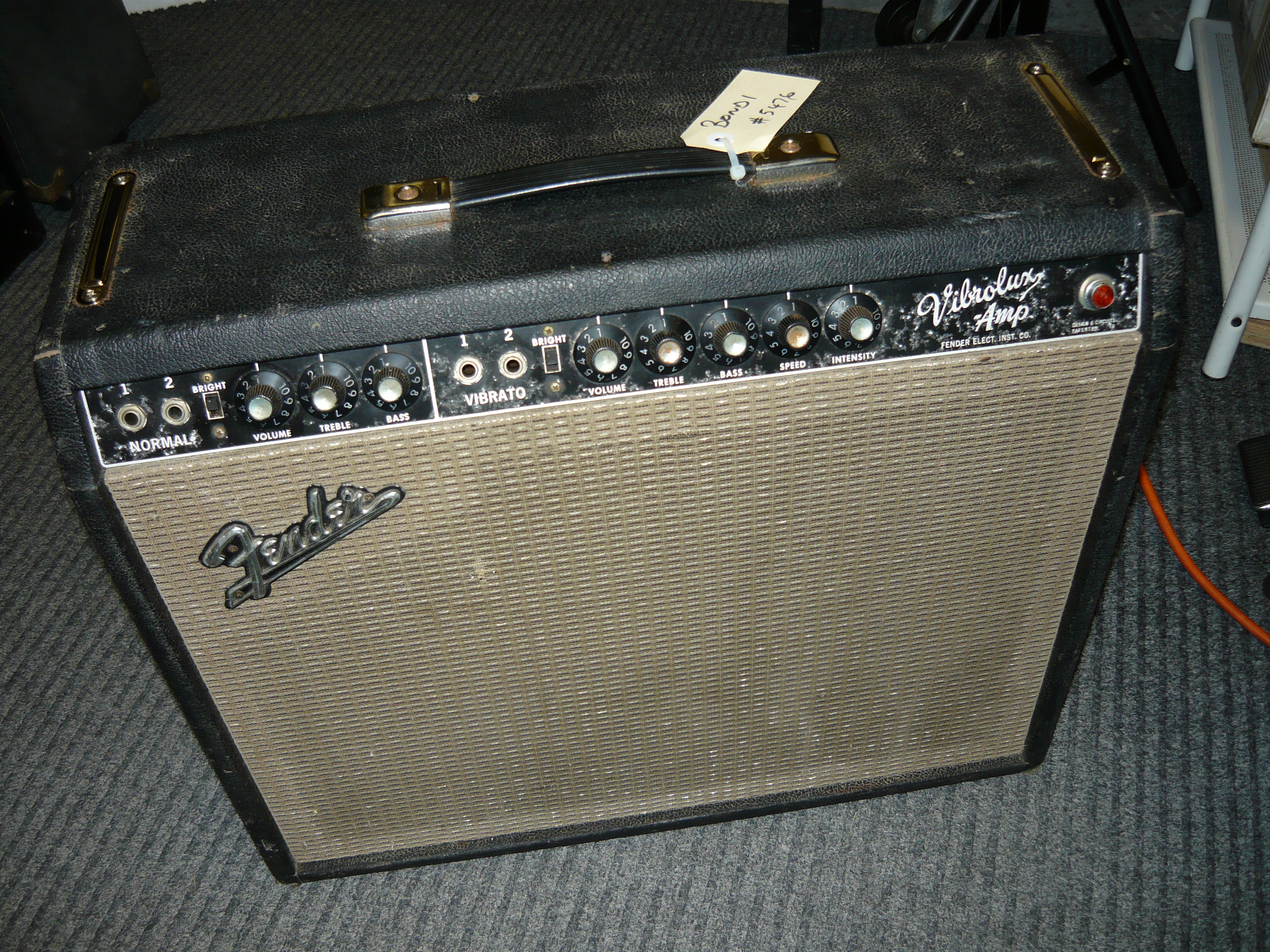
ps> we connected the amp up to our current workshop reference speaker – the Warehouse (WGS) ET-65, ie their clone of the famous 65 watt Celestion from 30 years ago. This speaker is like a high powered “Greenback”, with more bottom end (for want of a better description). Well, the Vibrolux really came alive with this speaker – a LOT more volume, not to mention more bottom end, more tone, more everything. Recommended !

ps> Mark did install a WGS ET-65 in this amp as per our recommendation, and in addition back in 2015 ordered from us a matching 1×15 cab loaded with the Eminence 15″ guitar speaker which sounds amazing with this amp – Mark is a surfer from Maroubra NSW, so all he needs now is a reverb pedal and he is fully equipped for some surf instrumentals.
Introducing the Matamp C7

April 20, 2012

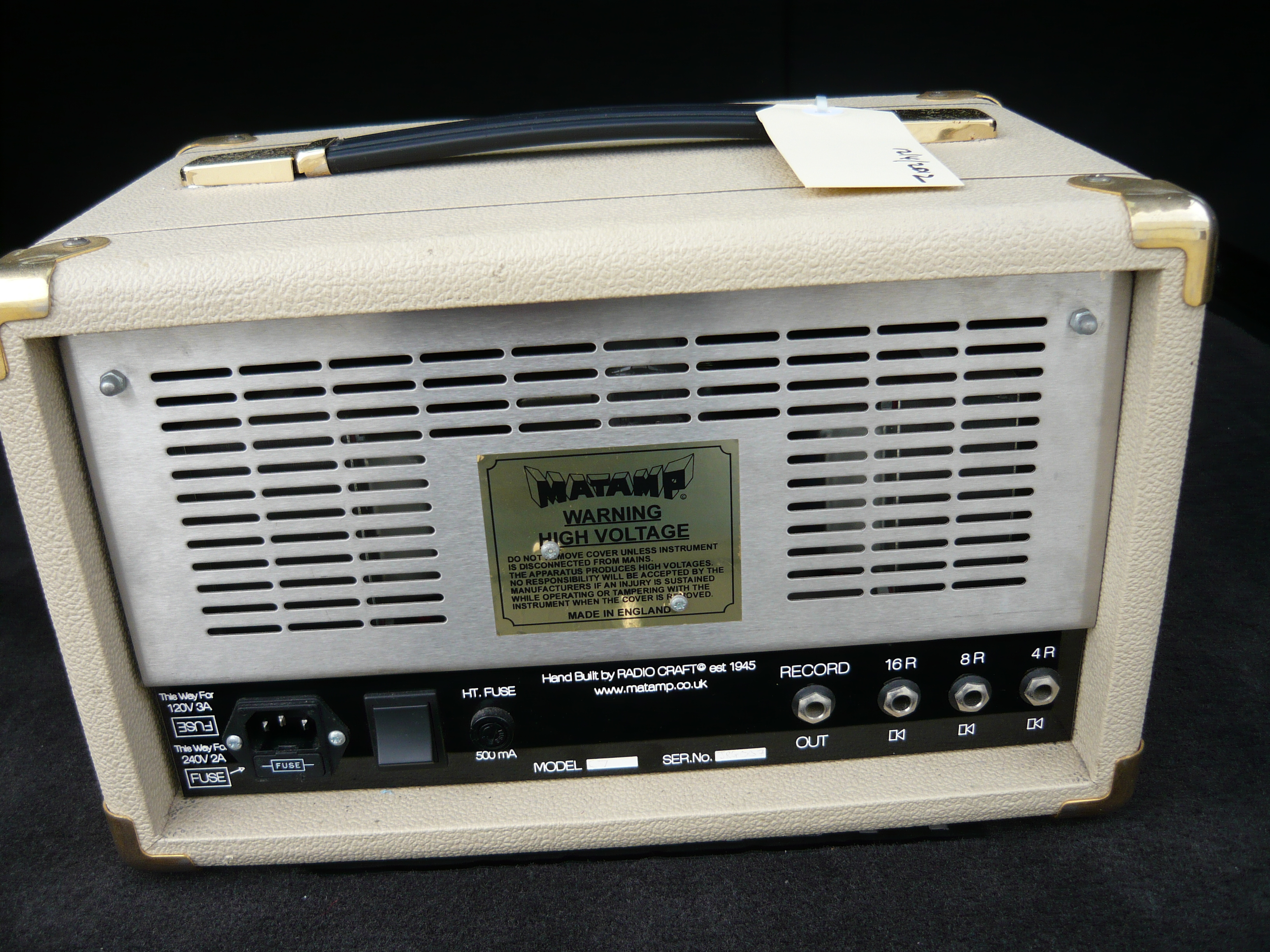
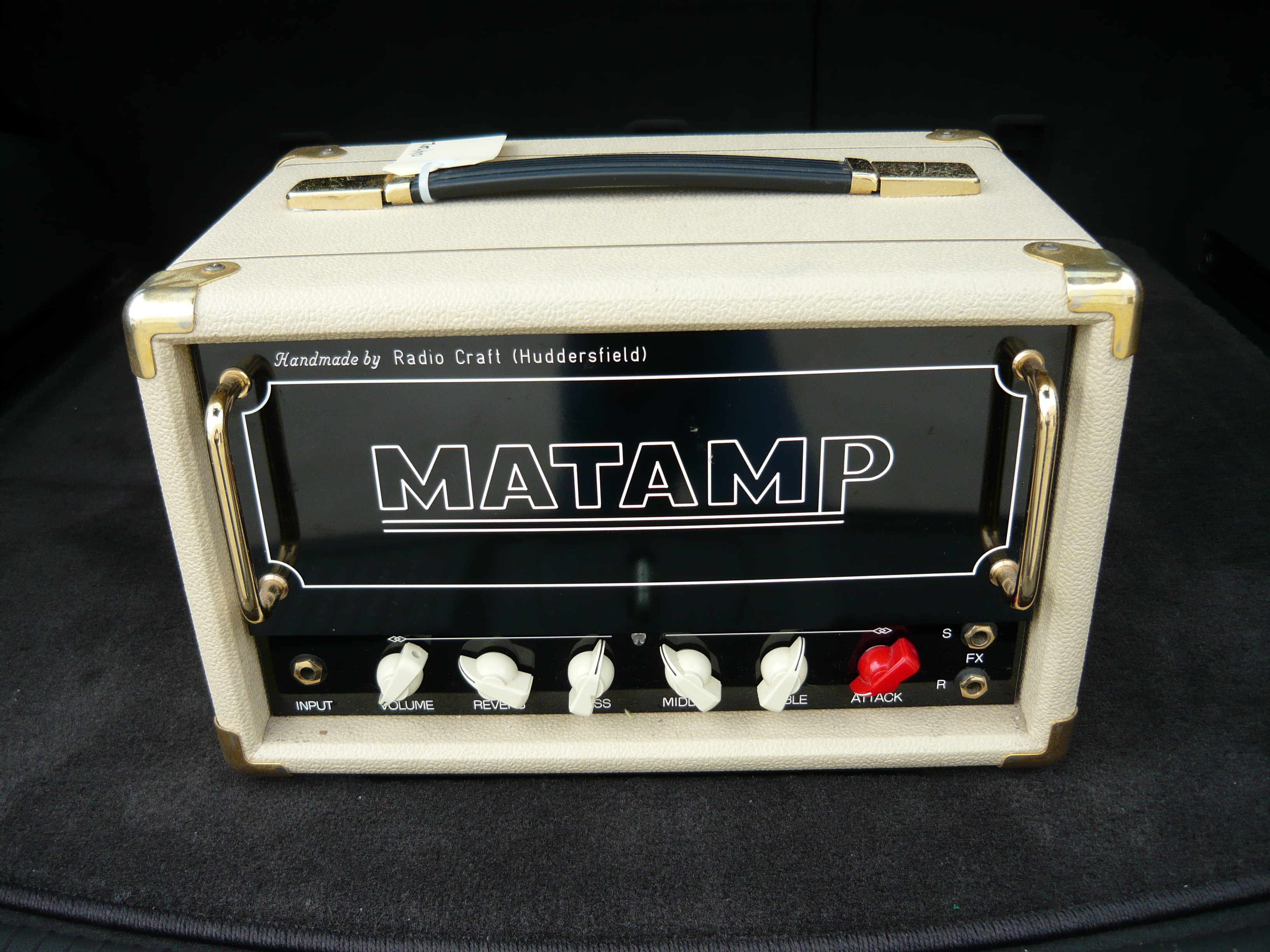
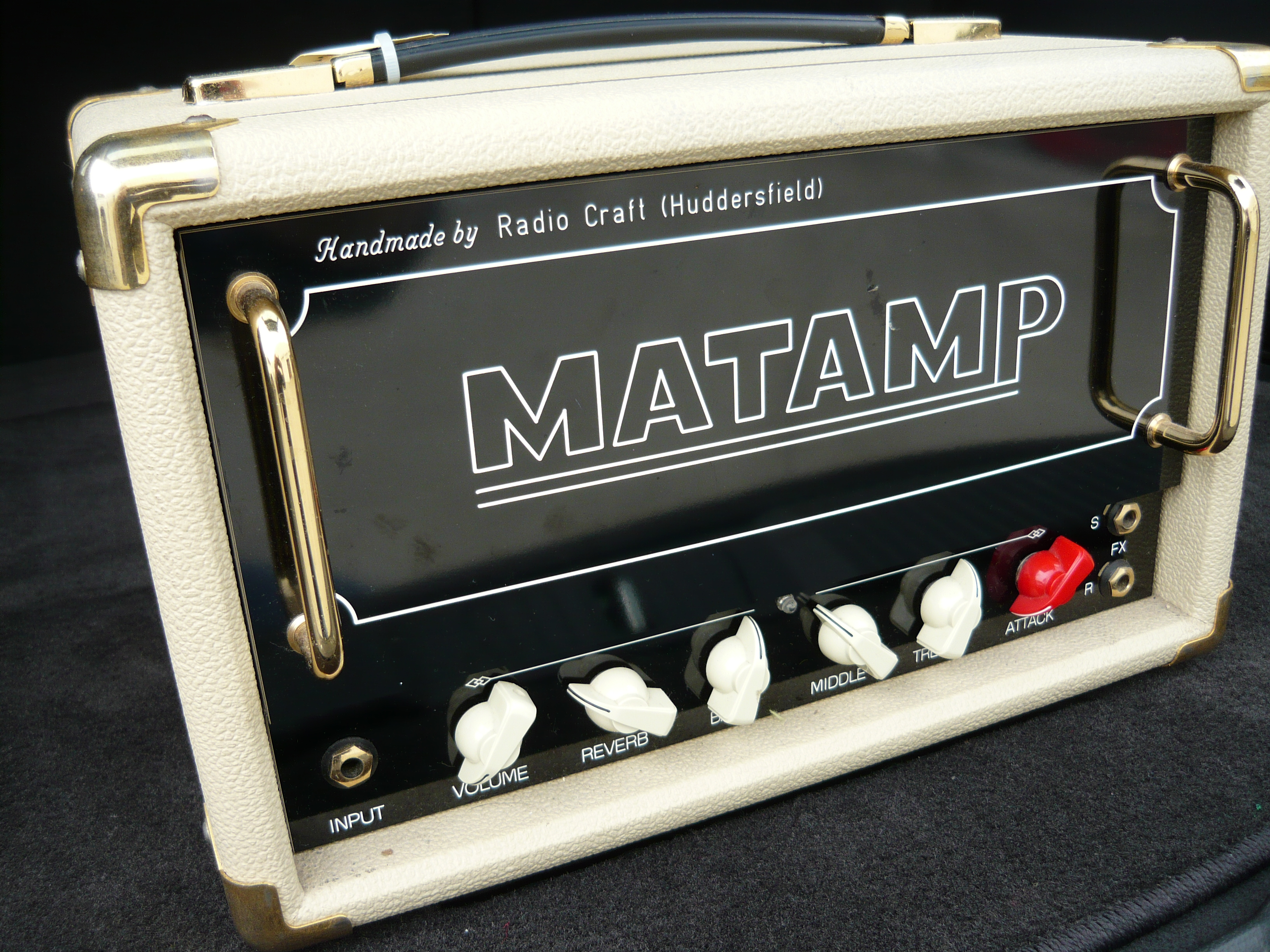
Hello readers, this week we thought we would introduce an amp to you that is pretty rare in these parts – the Matamp C7 head. Actually, any Matamps are rare in these parts. This amp is one of a pair of C7’s belonging to James, a regular NSW Central Coast customer of ours.

We have serviced both C7’s in the past (the other head is covered with black tolex), this C7 had stopped working altogether on this visit. It turned out that the single EL34 output valve (tube) had shorted out internally, blowing the HT fuse. There was no other damage at all, so replacing the EL34 and the fuse restored the amp to its previous good working order.

The C7 is a 7 watt amp based on a EL34/6CA7 power output valve, in single-ended configuration, operating in true Class-A mode. There is an all-valve preamp, consisting of three 12AX7 dual-triode preamp valves, although the reverb drive circuit employs a TL071 IC. The reverb recovery circuit uses one of the 12AX7’s. The inclusion of reverb in this class of amp is unusual, but unfortunately the quality of the reverb effect is not sensational.

What is sensational though, is the high standard of construction and assembly compared to just about any other similar style of amp on the market. The original Matamp company in the north of England goes back to at least the 1960’s, and the C7 is built to the same bullet-proof standards as the original 120 watt heads, which were held in high esteem at the time.

The use of an EL34 output valve, as compared to the more usual 6V6 or EL84 valves, plus beautifully over-engineered power & audio output transformers, gives this amp a much bigger sound than comparable single-ended amps. The original Matamps employed Baxandall EQ (2-band), and a 6-way rotary tone switch for fine control over the bottom-end. Today’s Matamp is voiced quite differently, actually much closer to the Hiwatt/Sound City/Roost amps tonality, with 3-band interactive EQ.

Other design features unique to this amp include a (passive) FX Loop, an active Attack control, which gradually bypasses the negative feedback loop for a bigger, looser tonality, or sweep the opposite direction for tighter & cleaner – this control more than makes up for the lack of a master volume. The Record Out jack on the rear panel automatically switches in a 15 ohm/50 watt resistor across the output for recording from the amp direct, without the need to be plugged into a speaker. The LED power on indicator is actually powered from the EL34’s cathode bias supply, so gives you a visual indication that the EL34 has warmed up and is operational.

Well, there we have it. A distinctively British-voiced single-ended valve amp that possibly won’t appeal to everyone, but we would say that any of the recent Matamp models are worthy of your consideration. Although most likely intended for the home-recording guitarist, this amp is robust enough for live gigging. We definitely congratulate Matamp for not selling out and for continuing to manufacture in the UK to their traditional high standards.

A Tale of two Musicman combo amps

April 1, 2012

Hello, welcome to the blog. In the past few months we have completed major overhauls to a pair of 1970’s Musicman combo’s. You might remember we published a blog last year regarding a major overhaul to a Musicman amp, which still belonged to its original owner. That particular blog has received hundreds of hits and continues to be read on a regular basis, so we are now attracting Musicman repair & restoration work from around the place, which is very gratifying. We have always had a high regard for the quality of construction, and the serviceability of these amps. Nearly 40 years after they were released on to the market, they are still capable of giving reliable performance, they just need some TLC from time to time, like any valve (tube) amp.

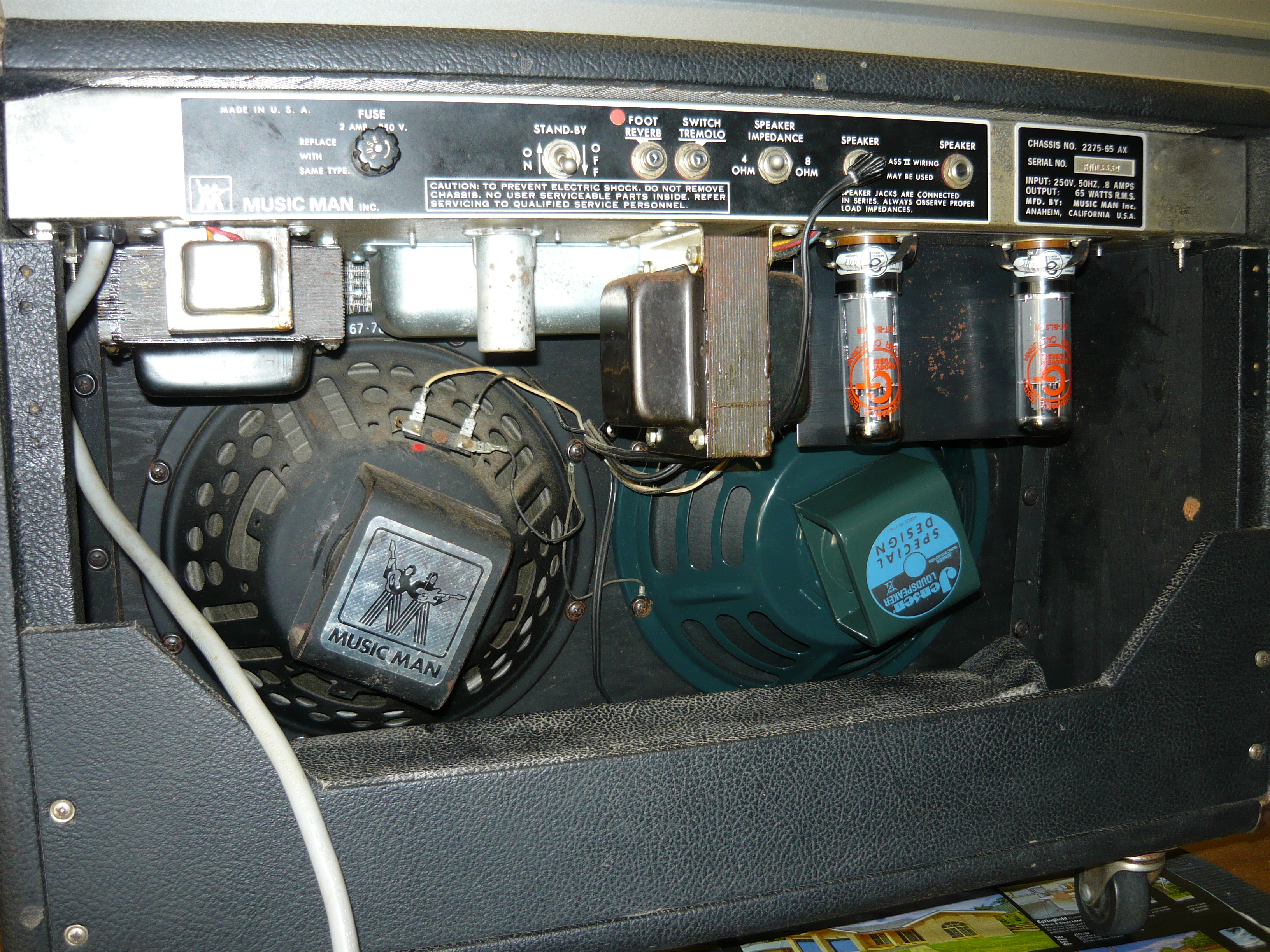
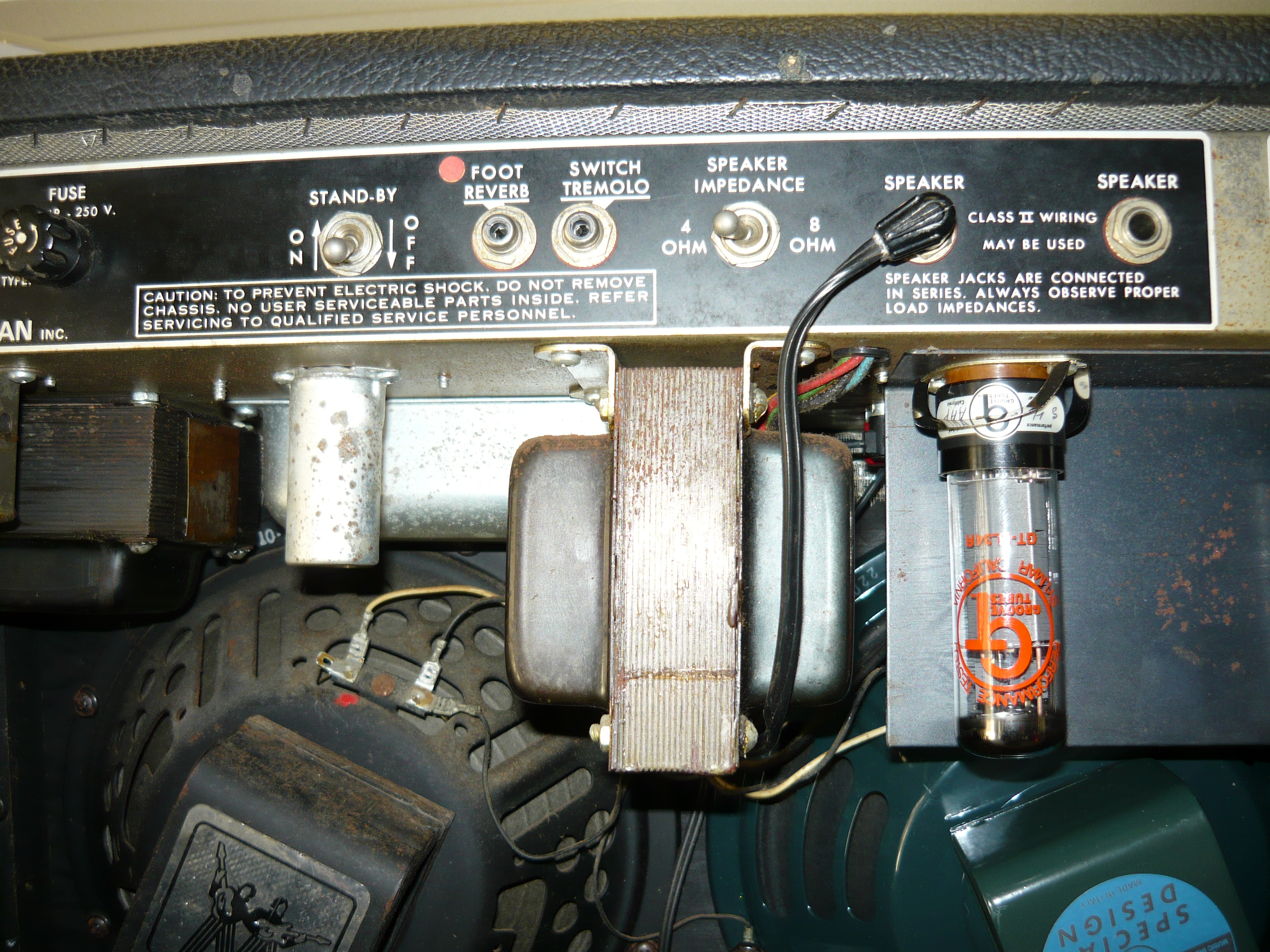
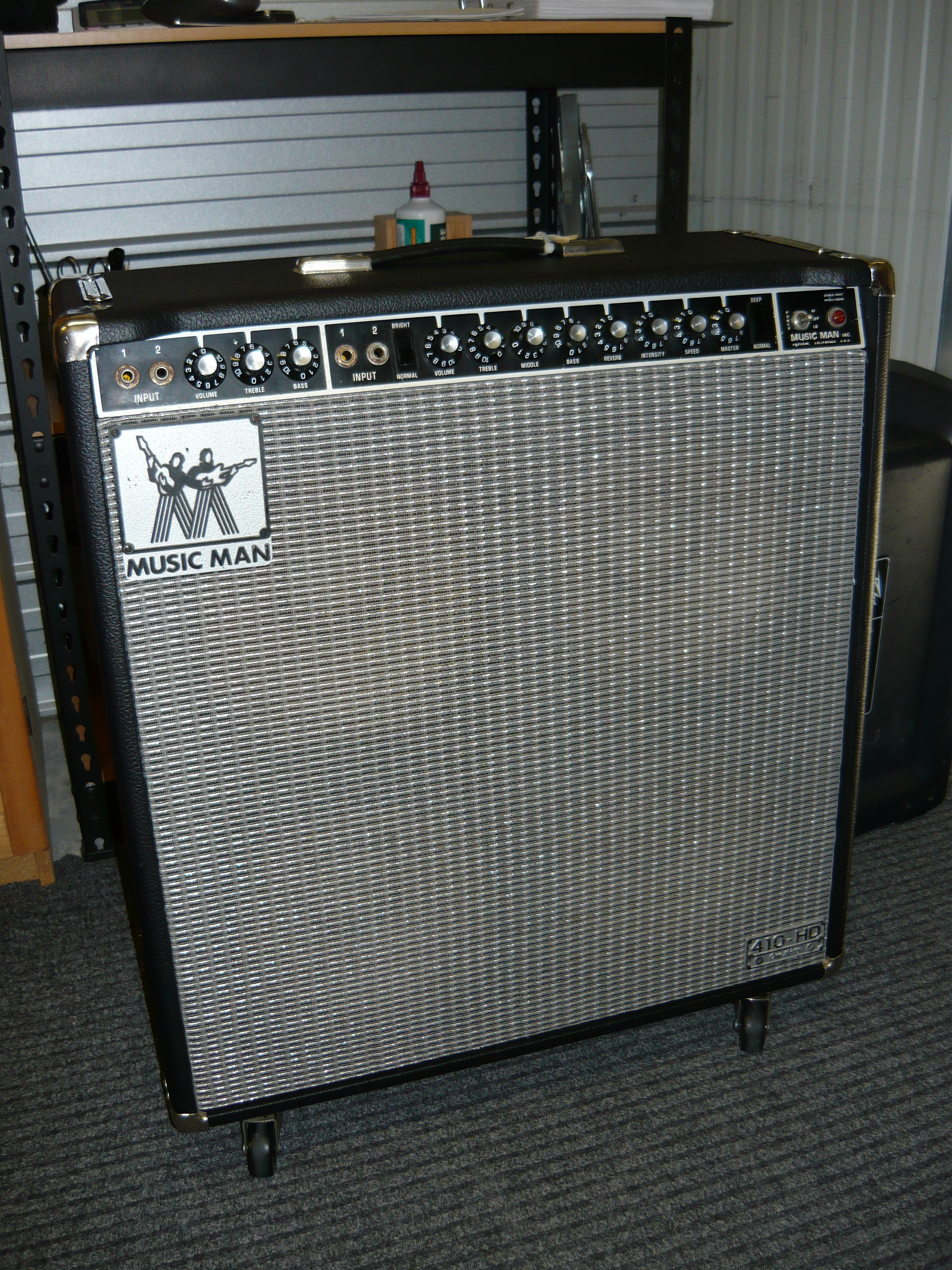
Our first example is the 2×10 65 watt model, possibly from around 1976. This was sent up from Sydney by Bondi Intermusic with the stated fault:  lights up – no power. You can see in the photo that the model number badge is attached in the wrong place on the front grille. We discovered that this was done to hide a hole in the grille material.

It didn’t take too long to realise why there was nil output from this amp, even though the amp was powering up, and the valves (tubes) were clearly operational.  The low voltage supply had failed due to a short-circuit component, which means the preamp was no longer functional.

The completely solid-state preamp relies on + & – 16V DC rails to operate. These DC voltages are smoothed & regulated by a simple circuit which includes filter capacitors and zener diodes acting as shunt regulators. Examination of the various circuit boards suggested that all the power supply filter capacitors (ie, electrolytic), for both high voltage & low voltage supplies, plus the pair of zener diodes should be replaced.

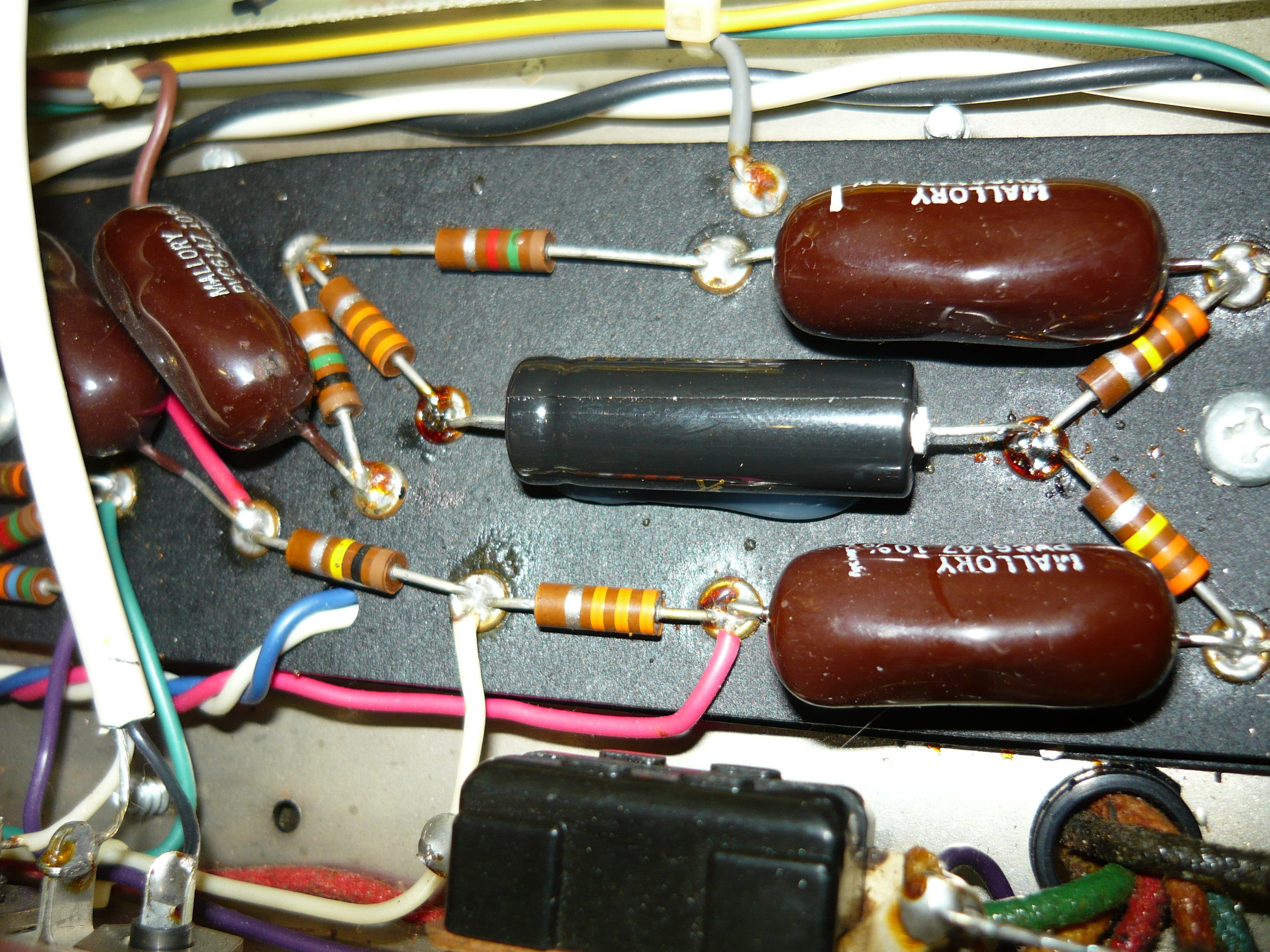
As the photos indicate, the various electrolytic capacitors have now been replaced using the very fine F&T brand caps from Germany, bedded down in some silicone (neutral-cure) for best stability. There are actually three boards within the chassis requiring this work, plus the main high voltage caps mounted within a “can” on the outside of the chassis.

There were numerous other issues to be resolved, for example the amp failed the earth test, but the replacement of the 240V 3-pin plug fixed this. All jacks were cleaned with DeOxit and all pots were cleaned with FaderLube. The “deep” switch was cutting in & out, luckily we had a black plastic rocker switch available that was an exact fit. Nil reverb effect required removal & repair of the reverb springline.

You would have noticed from the first few photos that we have replaced one of the 10-inch speakers  with a new (reissue) Jensen P10Q, 40 watt alnico magnet unit. The original speaker had an open circuit voice coil (ie, it was “blown”), but the customer didn’t seem to be aware of this. We quoted on a couple of options, but the Jensen was selected as the most cost-effective option. We often find the original Musicman speakers have not lasted as well as the electronics.

Right at the end of all this work, one of the apparently OK GT EL34’s failed, so we ended up installing a new matched pair of EL34 output valves & rebiasing the amp. These amps run in class-B mode with 700V DC supplied to the EL34 anodes, so we bias the amp to run a bit cooler than with most amps. Don’t get too hung up about whether this amp or that amp is in class-A, class-AB, or class-B or whatever, these amps sound great and there is no obvious crossover distortion which would add an unpleasant, non-musical edge to the tone.

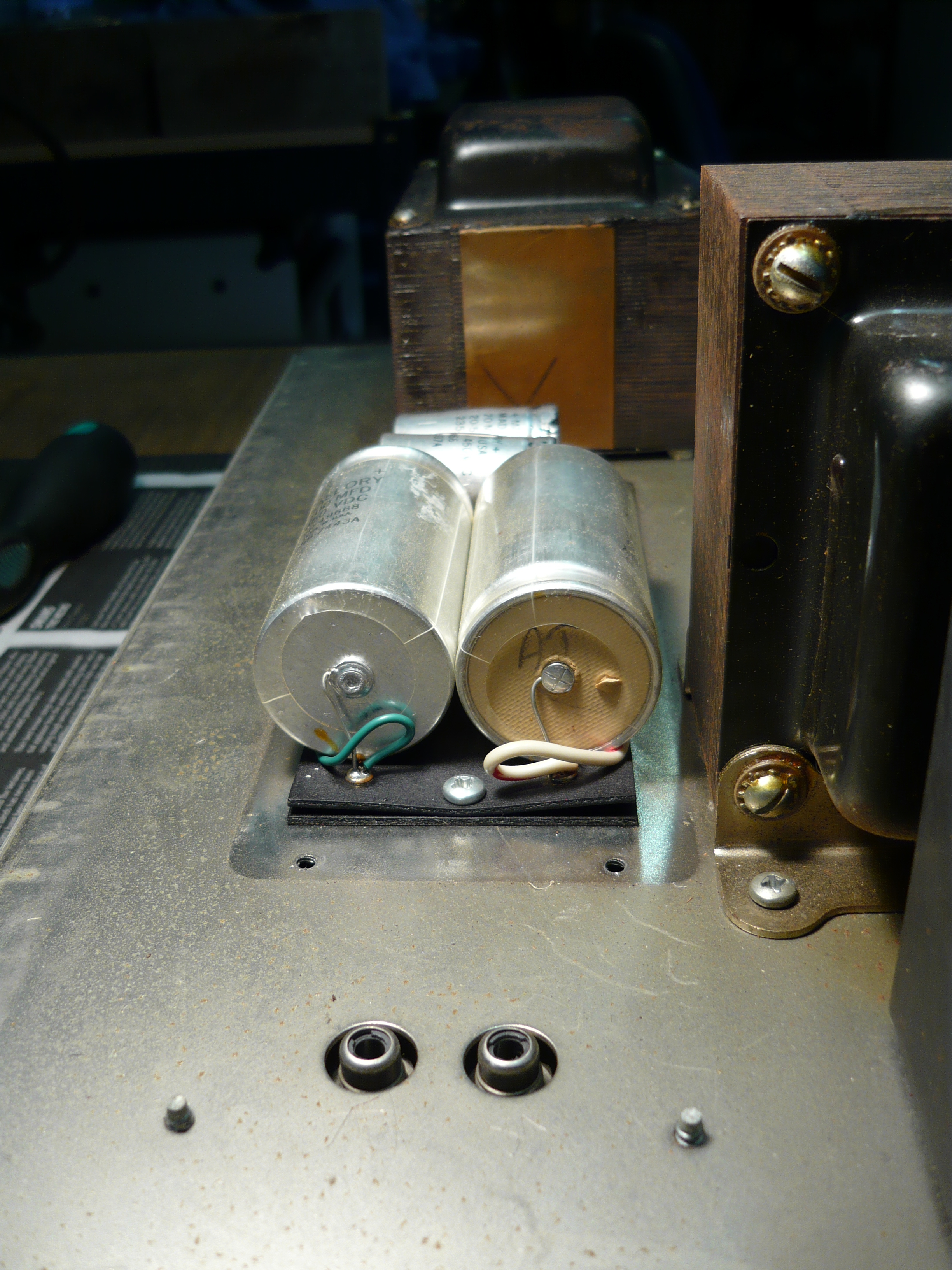
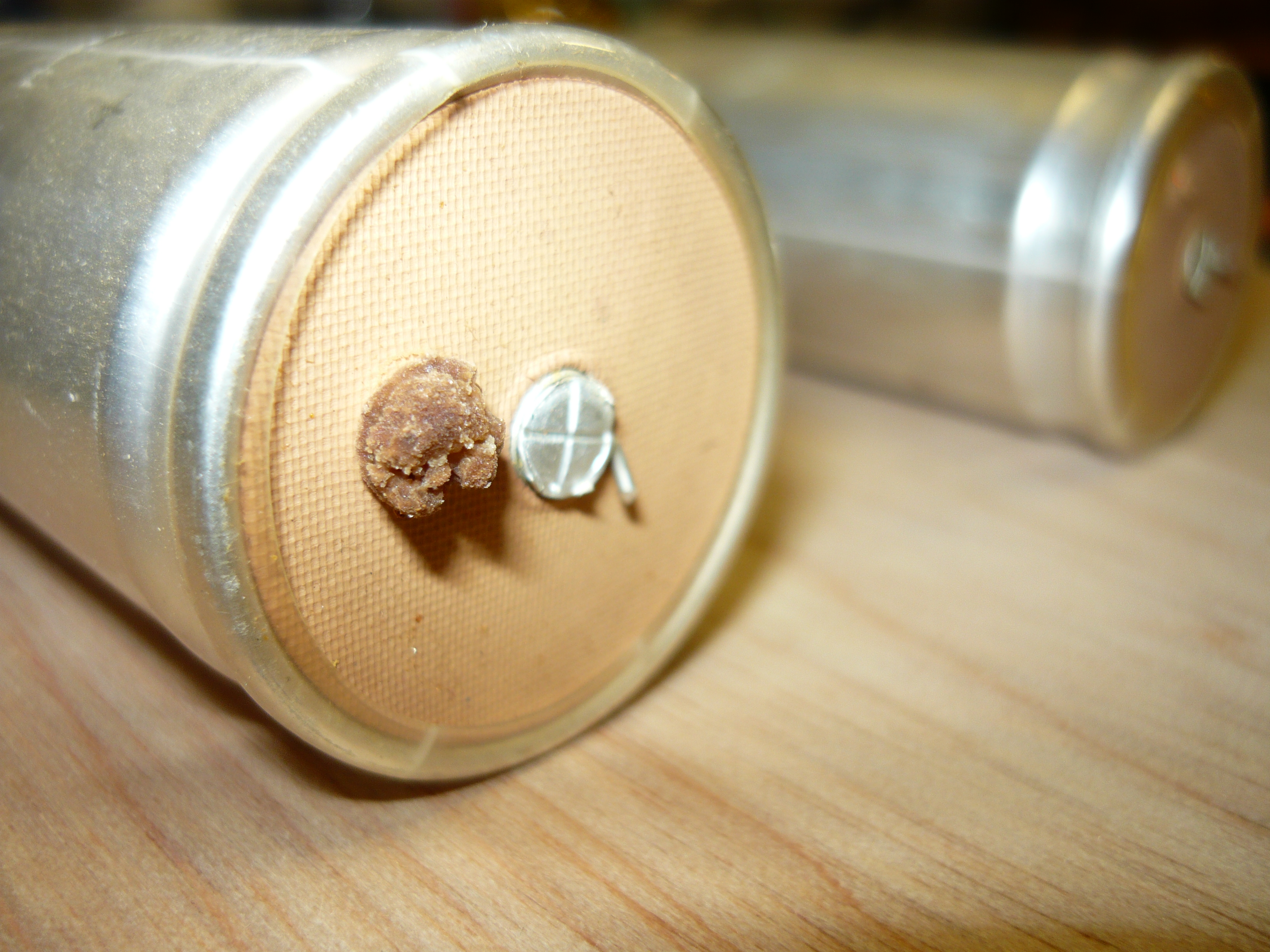
In the final photo for this amp you see the (original) main high voltage power supply capacitors in typical condition, well beyond their expected working life. We replace these with a pair of 500V DC can mounting style capacitors, rather than axial, because of their higher working voltage (2 x 500V caps in series = 1000V) and also their higher ripple current rating, which is a significant factor in a voltage-doubler power supply as per the Musicman amps. The caps are bedded down in some silicone so they are held firmly in place.

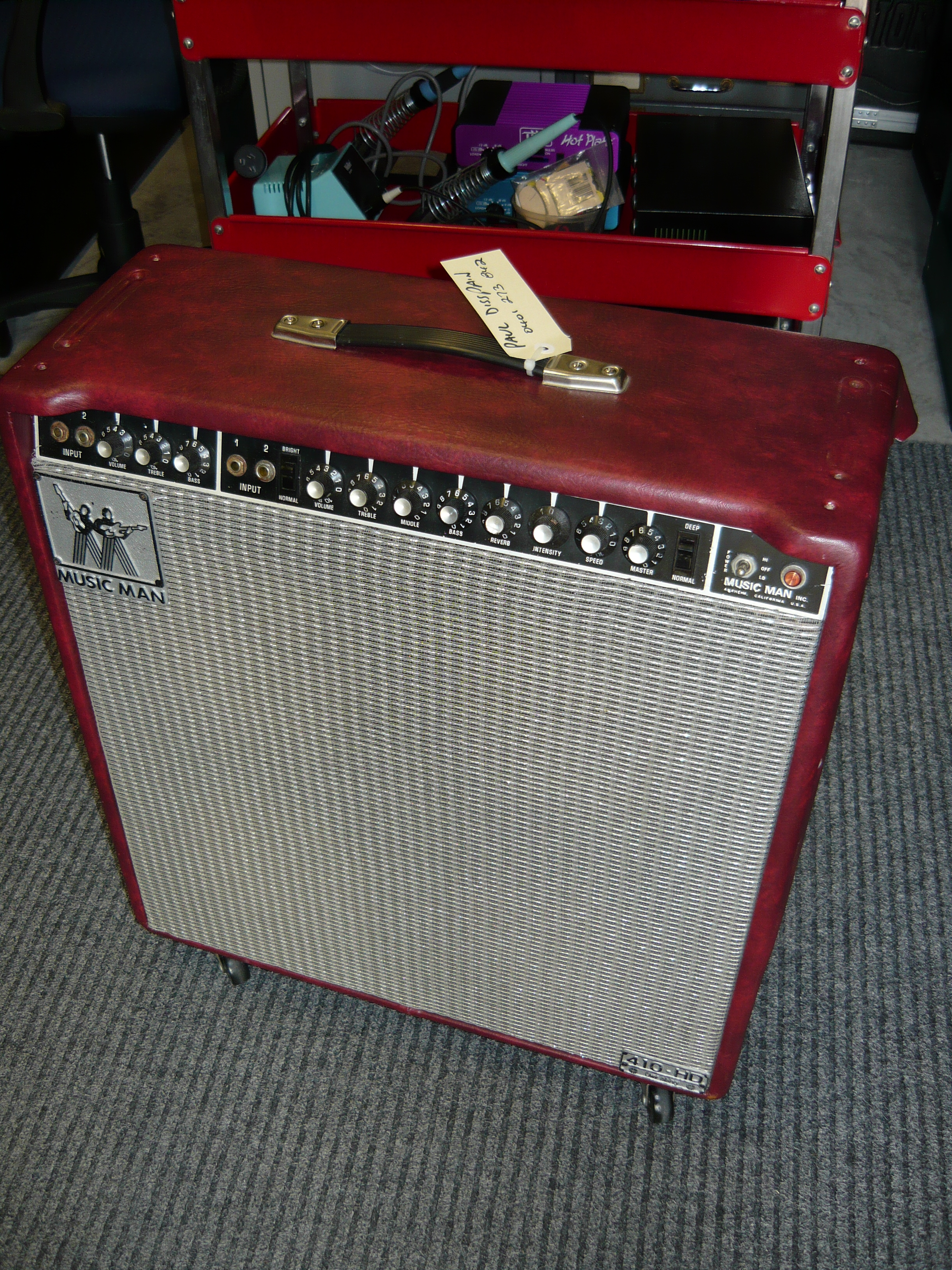
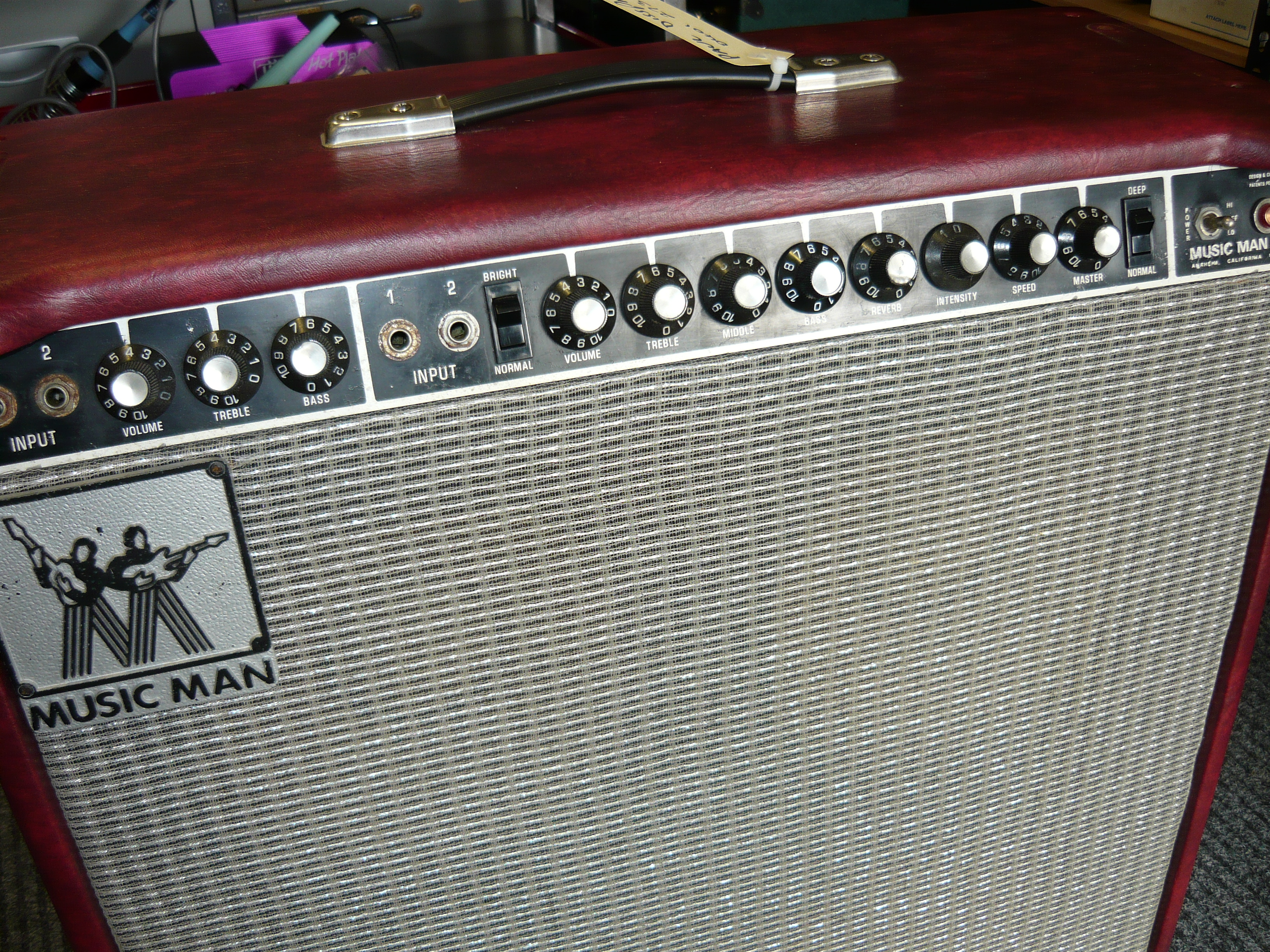
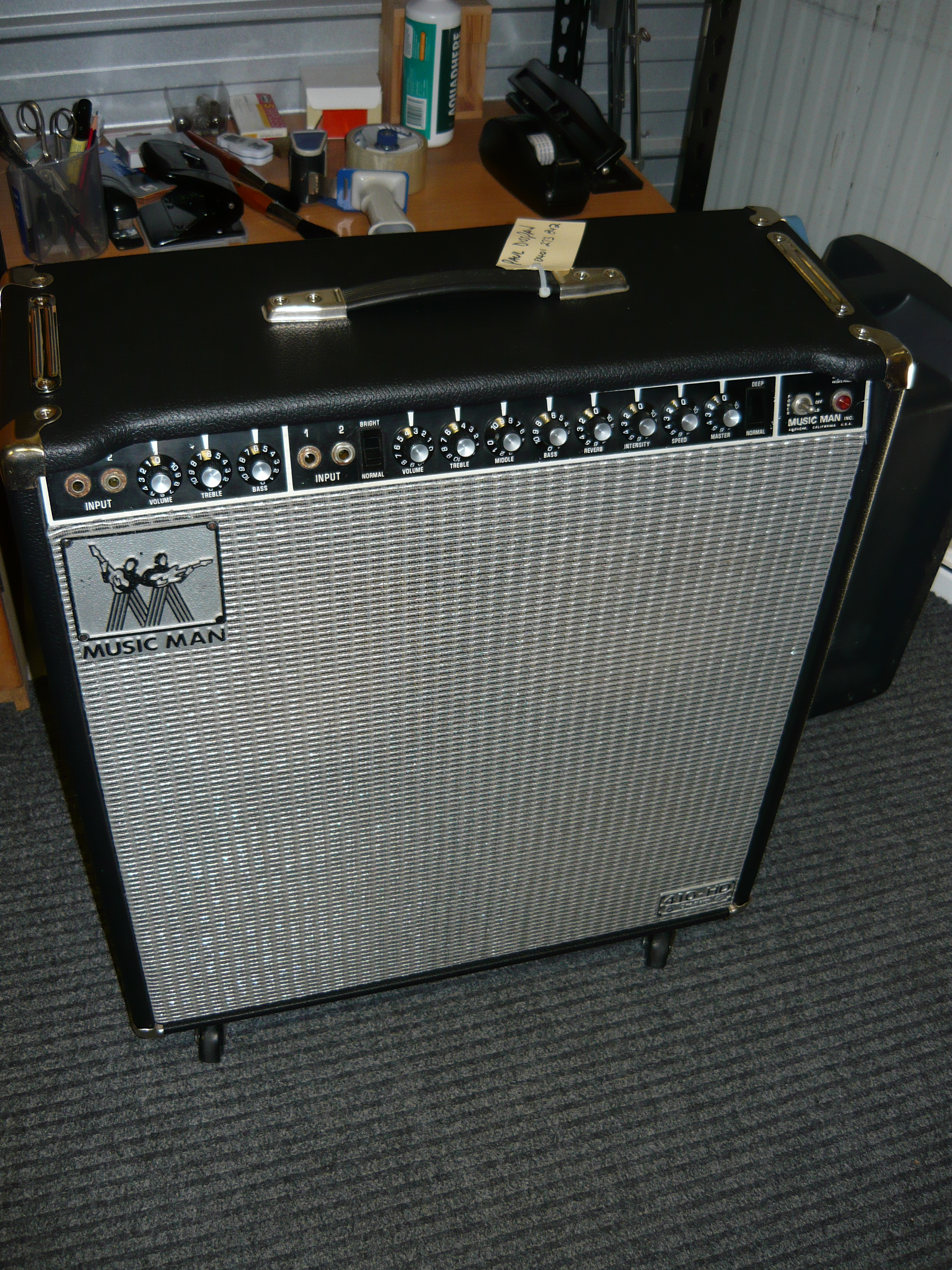
The 2nd of our two Musicmans is like the bigger brother of the previous amp, delivering 130 watts into 4 x 10-inch speakers. The chassis & control panel layouts are exactly the same, just a much taller cabinet, and we would think the date of manufacture is very similar to the 65 watt combo. This example came from Paul, a regular central-coast customer of ours, not only for an electronic overhaul but also to have the cab stripped back & recovered with an appropriate vintage-style black tolex.

As you can see, someone has recovered this amp (badly) with a ghastly 1970’s vinyl lounge/furniture upholstery, so the amp looks a bit of a joke. The original grille has also been replaced at some unknown point in time. The upholstery has been applied with contact cement – this stuff is very difficult to remove completely. Underneath the upholstery we found there was an earlier attempt at a “natural” finish cab, ie the cab has been stained and a top coat of semi-gloss applied.

What a nightmare ! So – every item of hardware, every little cosmetic item had to be removed, and the vinyl stripped off. The cab needed to be filled & sanded before applying the black tolex, and re-installing all the bits & pieces. The baflle was removed, the speakers and the reverb tank put to one side, so the baffle could be sanded a bit, repainted flat black, and a new grille cloth installed. The whole cab was re-assembled and you can see the end result which is very pleasing. The two rear panels were long gone, so Paul helped with some plywood offcuts and his trusty router.

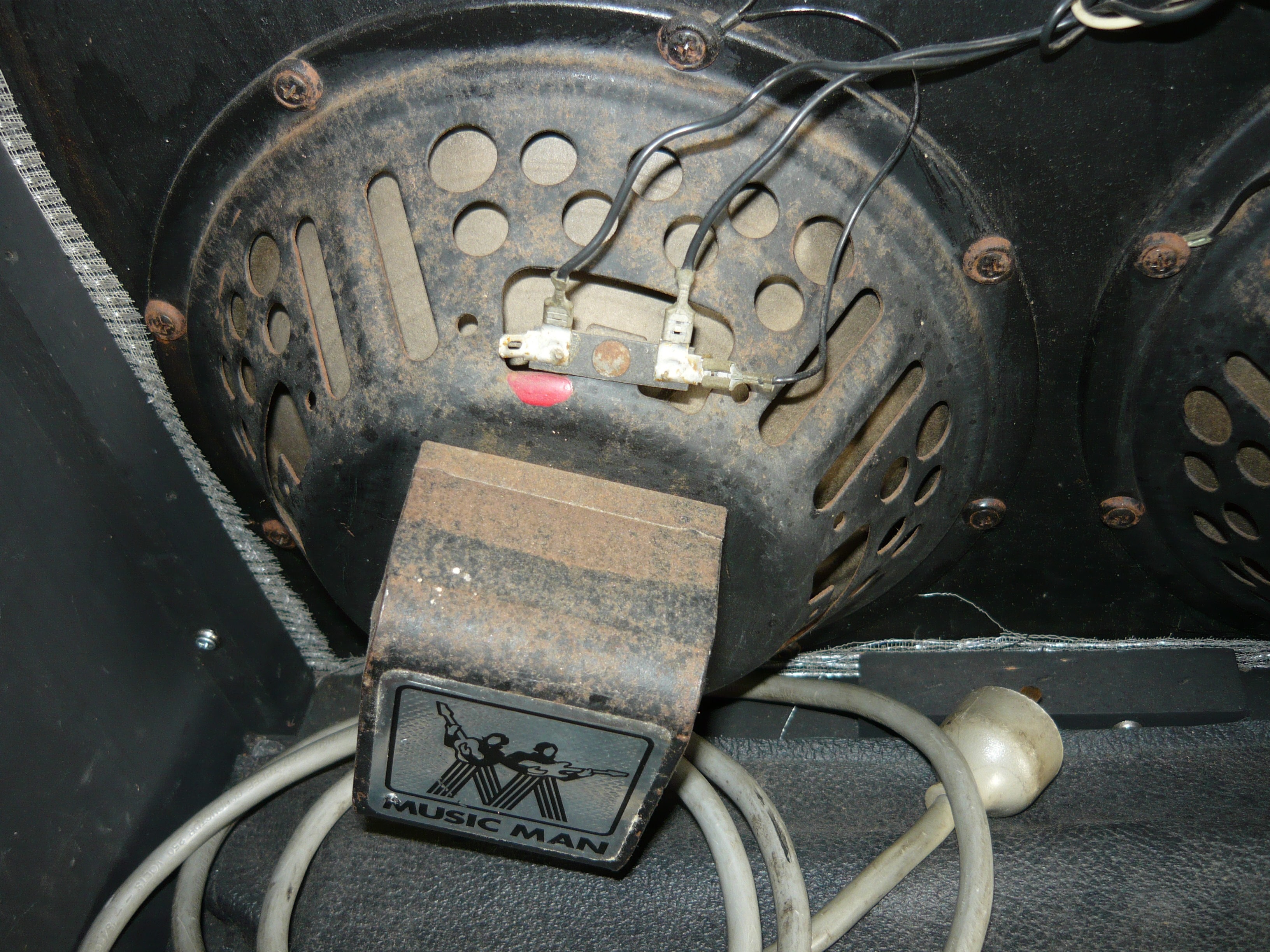
This combo still has the original four alnico magnet speakers, which are in good working order. The chassis required all the usual service work: tighten loose transformer, replace 240V 3-pin plug, clean jacks & pots, replaced nine electrolytic capacitors in the low voltage & high voltage power supplies, replaced damaged master volume pot & knob, replaced quad of EL34 output valves & rebias amp.

The entire overhaul took well over 10 hours labour to complete, over a period of time, in amongst the many other amp orders etc going on. Take a look at the last two photos, the end result looks terrific ! We had to use Fender style vintage repro tolex & grille cloth, as the original Musicman stuff is long gone, but it looks quite convincing and such an improvement on the way the amp looked before. Paul had some of the original and rusted metalwork refurbished & re-plated which made a big difference cosmetically.

This amp develops its best sound at quite high volume, so is probably not appropriate for that restaurant gig ! It also makes a good bass amp, as long as you plug it into an external bass cab. Many thanks to Paul D. for his continued custom.

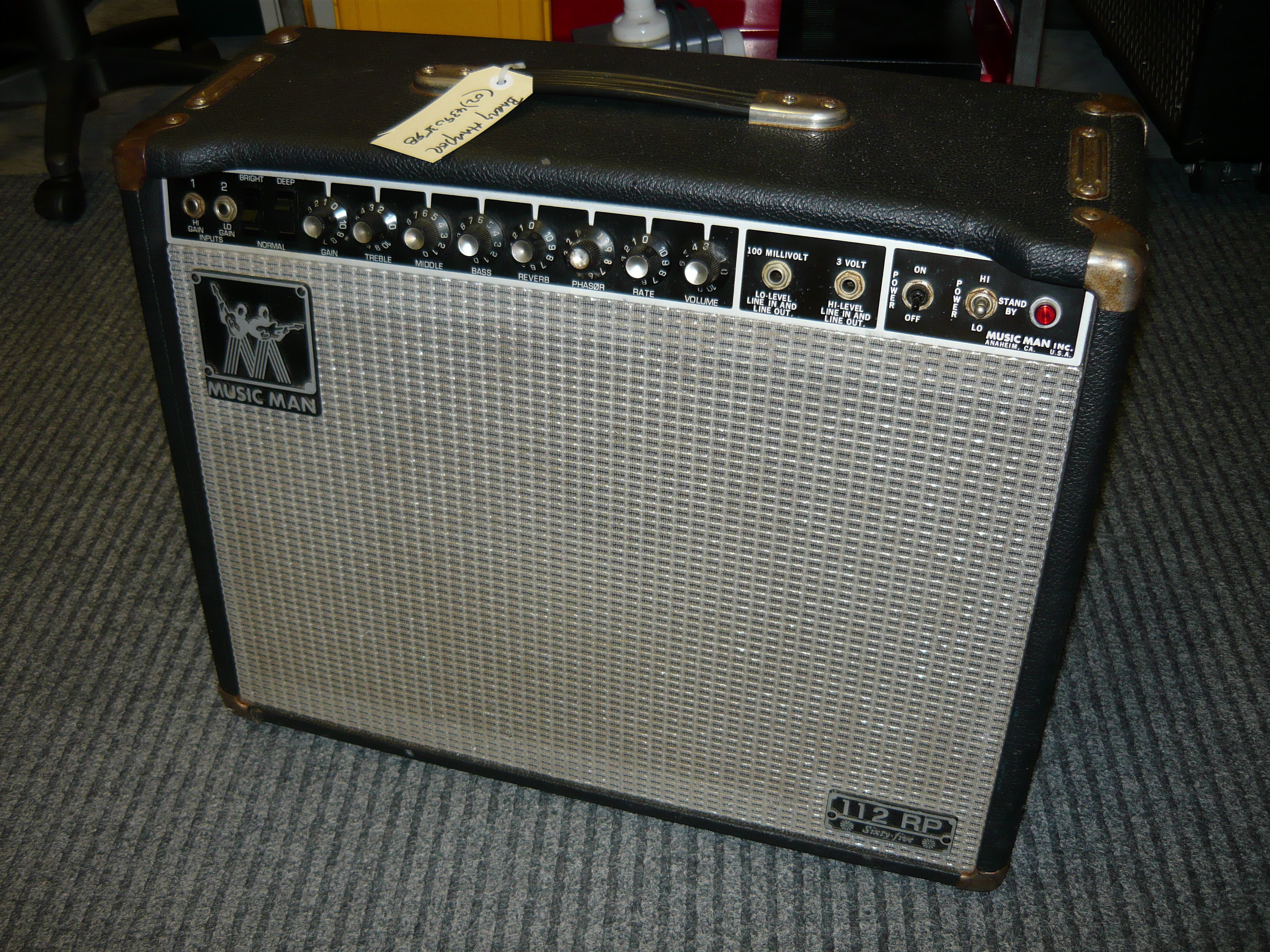
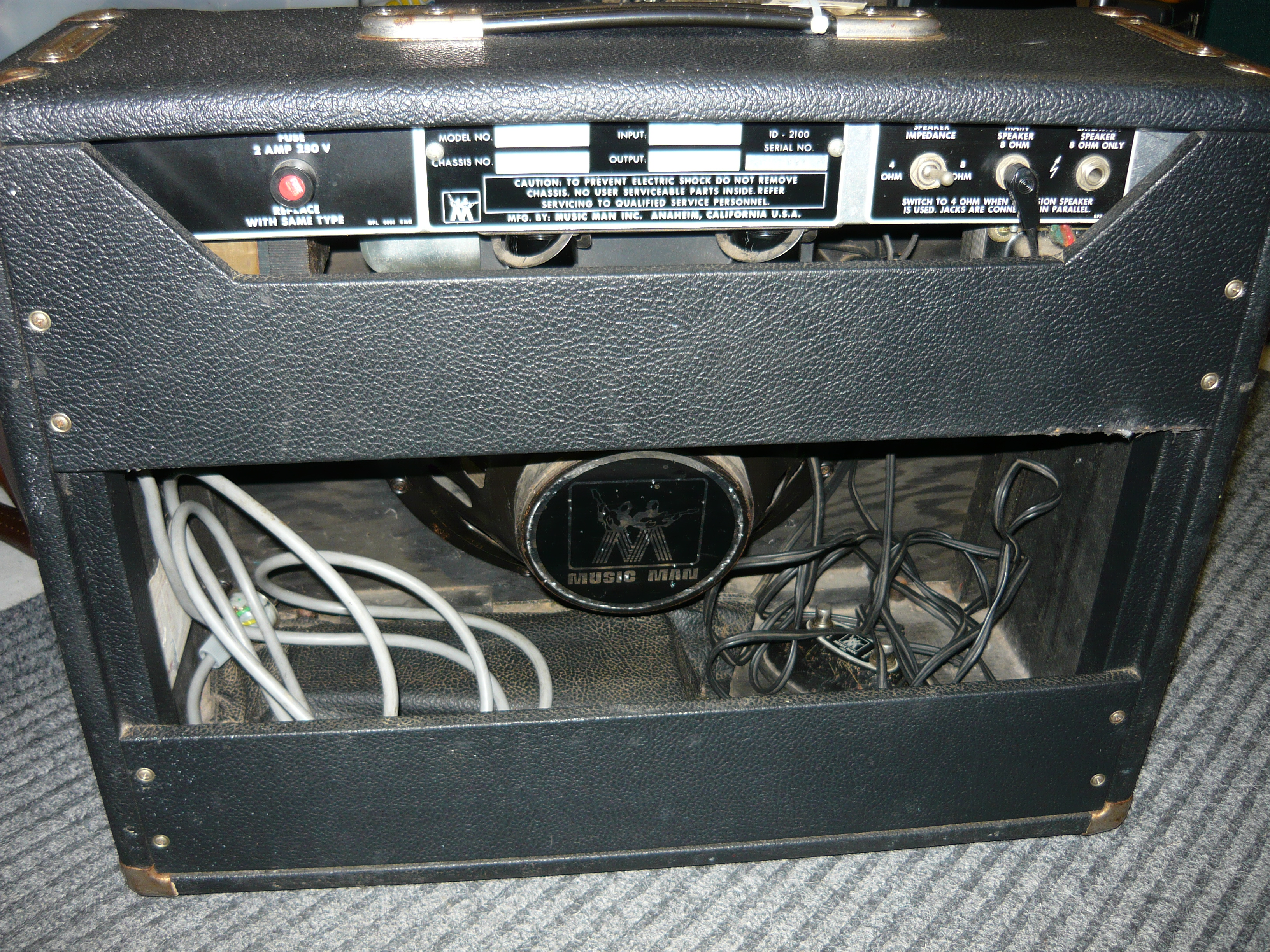
Just when we thought it was safe to close off the final paragraph, a third Musicman combo arrived at the workshop for repairs. Only recently acquired by a local musician, this model is a different beast from the previous two amps, introduced a few years further down the track. This model is a single channel design and includes reverb, two FX loops, and most unusually, a built in phaser (spelt phasor !?!?).

Well, the phaser is a rarely used effect nowadays, but still it works quite well. The two FX Loops cater to two different signal levels, but are almost never used by the owners of these amps. The most significant difference to the earlier models lies in the fact that both the preamp stages and the phase-inverter/driver stages in the later amps are completely solid-state, implemented using both IC op-amps & discrete TO220 package power transistors. The power amp employs 6L6GC output valves, as opposed to the earlier EL34/6CA7 valves, operating in pure class-B mode, delivering about 75 watts.

The way the valves are driven is also quite different, using small power transistors to drive the cathodes of the 6L6’s. The control grids are connected to the bias supply only. You will notice from the photo here that the speakers have changed from alnico to ceramic magnet. So it’s a slightly different sounding amp to the earlier version. This amp once agin needed a general service, replacement of a damaged pot, replacement of the output valves, and replacement of the pair of high voltage capacitors, which you will see in the next two photos are in a very bad way, and well past their use-by date.

Many thanks to the three musicians, plus Bondi Intermusic, who contributed their amps to this blog, by way of submitting them for service to our  specialist valve (tube) amp workshop, here in Gosford (Wyoming) NSW. Bye for now – IR.


A very rare Marshall JMP

March 1, 2012

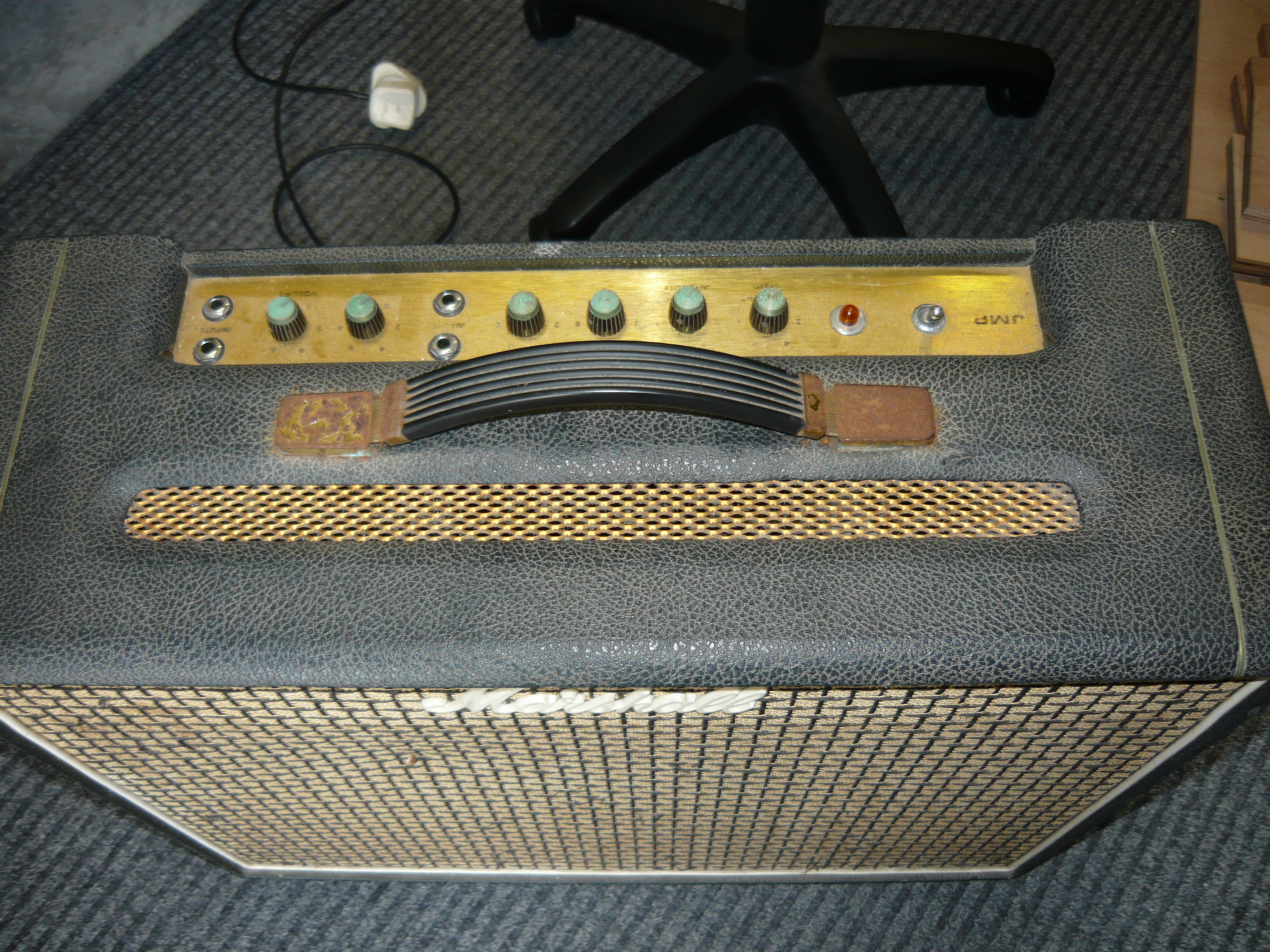
The subject of this week’s blog is the Marshall JMP era model 1930 10 watt tremolo combo, designated the 1930 ‘Popular’ in Marshall histories and catalogues, but designated as the model 1930 ‘Lead’ on the amp itself. This amp is extremely rare in the land of OZ (this is the only example we have ever seen), and in fact we reckon it would be a rarity just about anywhere.

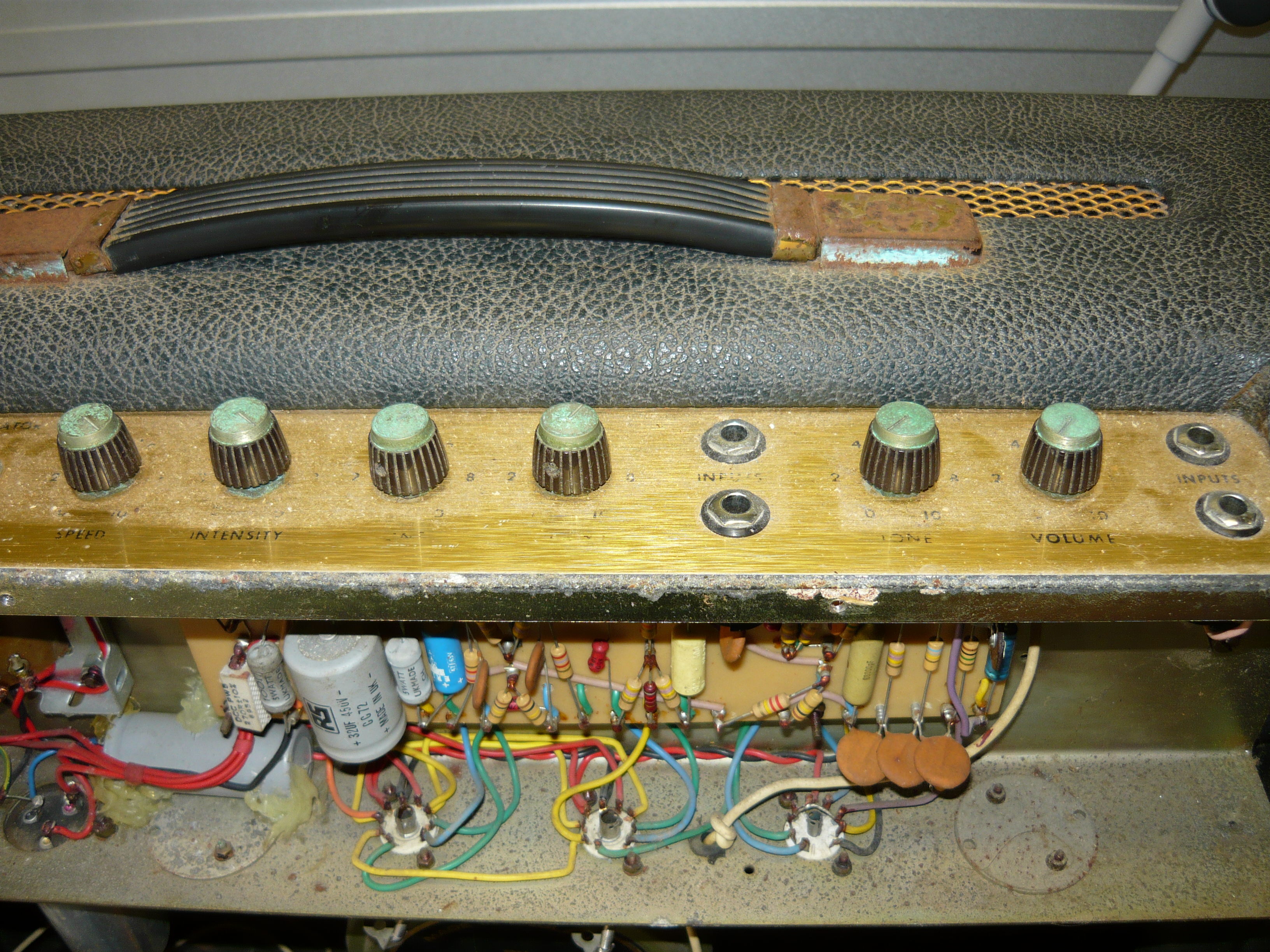
Basically, the 1930 is a 10 watt combo amplifier with a single 12 inch Celestion speaker. Two channels, each with two inputs and separate tone and volume controls for each channel. A valve (tube) generated tremolo operates on all four inputs with intensity and speed controls. A tremolo on/off footswitch completes the package. The valve (tube) complement is a pair of 6GW8/ECL86 triode/pentode valves for the push-pull ouput stage and phase-inverter stage,  and a single 12AX7/ECC83 for the preamp. One half of the 12AX7 is used as an oscillator for the tremolo, so that leaves only a single gain stage in the preamp.

For those of you who are unfamiliar with the 6GW8 valve (tube), a.k.a. the ECL86 in the UK and Europe, this valve combines a pentode power valve, with 9 watts anode/plate dissipation rating, so think of it as similar to the well known 6BQ5/EL84 but with lower power ratings, plus a triode similar to one half of a 12AX7/ECC83, both in the same glass envelope, with the standard miniature 9-pin base. A pair of the these valves can theoretically achieve an audio output of up to 14 watts, in class-AB/cathode-bias operating conditions.

The 6GW8 was manufactured in Australia by AWV (Amalgamated Wireless Valve), and I’m sure in several other countries. Manufacture ceased a long, long time ago, so we have been relying on new-old-stock for years. The 6GW8 was widely used in Australia in domestic electronics as well as guitar amps under 20 watts. Typically, amps that developed about 14 watts rms, would have been sold as 20 watts (ie, “music power” rating). Aussie guitar amps using the 6GW8 would have included Vadis, Moody, Goldentone, Challenge, Diason, Kee, no doubt the list goes on and on. The pentode section was also used as a reverb driver, especially in Goldentone amps, with the triode section used for gain recovery after the reverb springline.

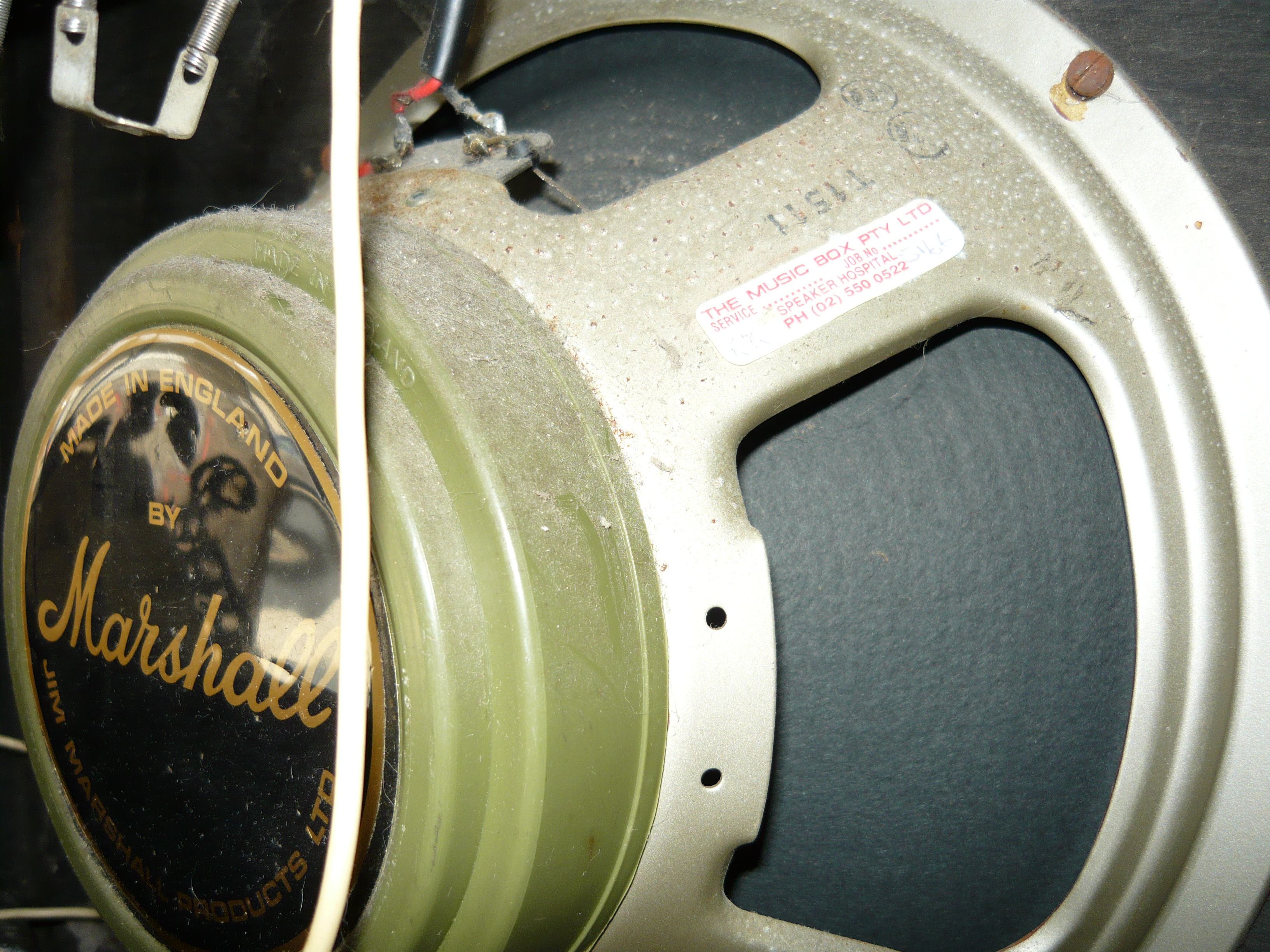
This amplifier came to us from Bondi Intermusic, barely producing any musical sounds at all and in need of a major overhaul/refurbishment. Fortunately, both transformers were OK and the apparently original Celestion ‘Greenback’ speaker was working fine too, although it had been reconed in Sydney at some unknown point in its history. The existing valves were definitely past their use-by date and the 9-pin valve sockets themselves were only providing intermittent connectivity, even after a blast with DeOxit.

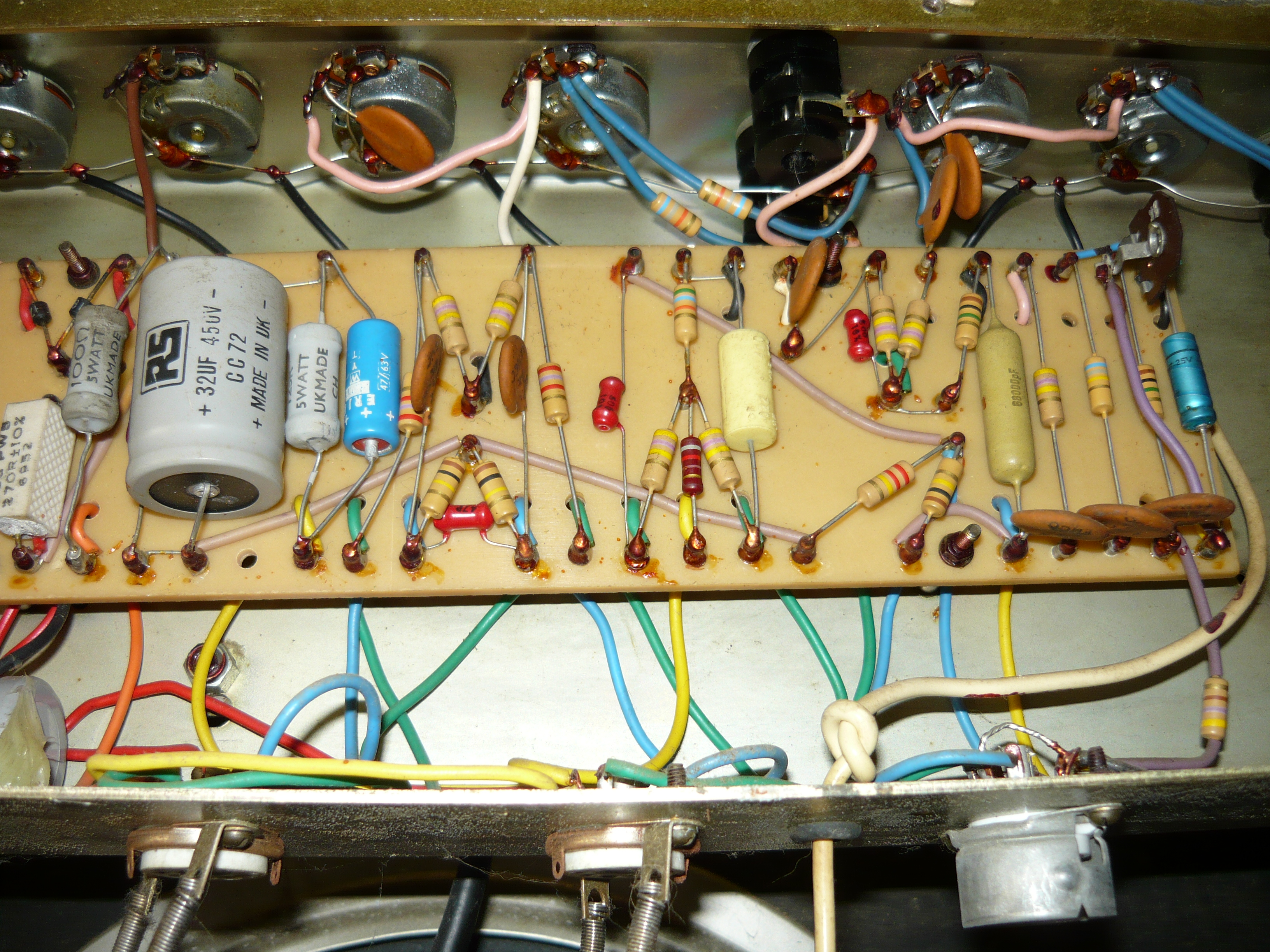
Here are some “before” and “after” photos of the amp repairs. The first three shots show the board and hand-wiring. All three 9-pin valve sockets would need to be replaced.

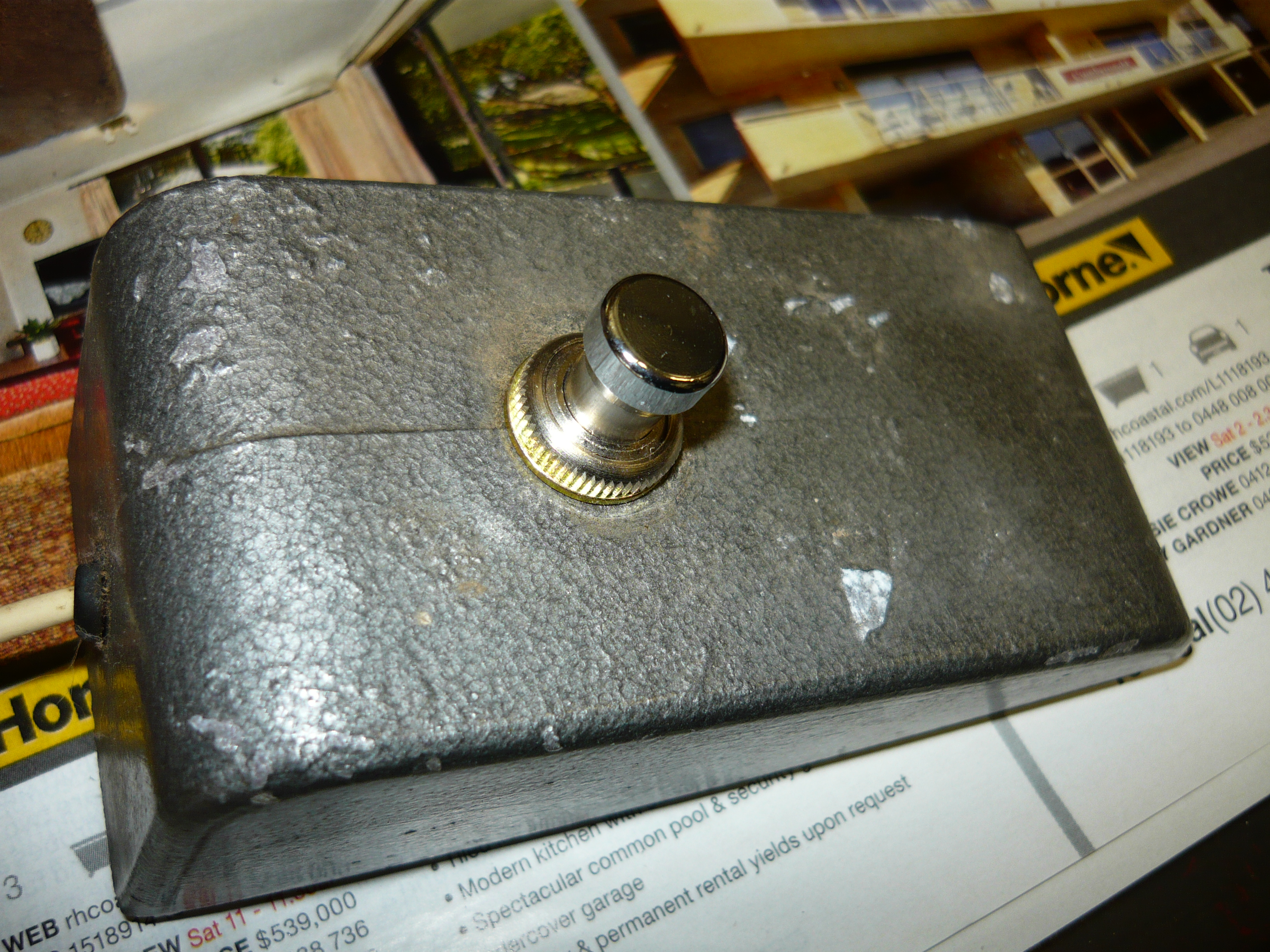
Even after replacing the 9-pin valve socket, the tremolo only worked intermittently. This necessitated replacing the board-mounted trimpot, and the footswitch (which is hard-wired into the circuit).

The impementation of the tremolo effect is very similar to that in the famous Marshall 18 watt combo, but this amp design has much less preamp gain.

Because the volume and tone controls plus channel mixing components are placed before the single 12AX7 gain stage, this stage is running wide open without any post-gain volume control to moderate noise levels. Therefore, we found it necessary to install a selected low-noise “high-grade” 7025 valve in this socket.

Because we are relying on a diminishing supply of new-old-stock valves, it is next to impossible to source the 6GW8’s in matched pairs (ie, the pentode sections). You will be lucky just to get a pair of the same brand. We were able to source a pair of made-in-UK but labelled Sylvania, in their original packaging. This amp, like most similar amp designs, relies on a single cathode bias resistor, common to both (pentode) valves, to achieve the correct bias level. Due to the fact that the 6GW8 parameters might be all over the place, it would be prudent to bypass this arrangement altogether, and install two separate cathode resistors (of double the original value each), bypassed by separate capacitors. With this approach, each 6GW8 will self bias to approximately the same level, and this is exactly the solution we implemented. The original components are still on the board, but somehow we doubt that anyone will start manufacturing the 6GW8 again !

You can see from the next two photos that we have now replaced the power supply filter capacitors, firstly a can-mounting 32+32uF unit, and secondly a board mounted axial lead 30uF/500V. A couple of badly worn pots needed replacing. The new cathode bias components installed were a pair of 270R W22 series ceramic body plus a pair of Sprague Atom 50uF/50V axial lead bypass caps.


While setting up the new cathode bias arrangements we discovered an internal earth loop within the amp which was creating an unnecessarily high level of hum ! Rerouting the earth return path from the 6GW8 cathodes directly to the earth connection of the first filter cap corrected this problem, by removing this heavier current from flowing via the preamp circuitry. This amp would have been noisy right from the factory.

All amplifiers need to be tested for electrical safety compliance, especially an amp that is about 40 years old ! All that was needed in this case was a new 240V 3-pin plug. Thanks to Mark W., for sending us this unique example of vintage Marshall/JMP production. We also have a 1963 Vibrolux from Mark for a major overhaul, and attention to electrical safety issues, which will be the subject of a future blog.

I have to admit, when first confronted with this JMP, fully expecting problems sourcing quality 6GW8 replacements, I tried to persuade Mark to allow us to convert the amp to EL84 output valves. However, Mark wanted to keep the amp as original as possible, and he was proved correct in this choice, as the overhaul was completed successfully and only slightly over budget. See you next time !

A Nice Stack !

February 26, 2012

Hello again, readers ! Two very good customers and also very good friends of ours, Mr Bob Spencer and Mr Simon Bray, sent us this photo quite recently. They have stacked up their personal collections of the Richards amp for a photo opportunity. No doubt they got together to do some speaker comparisons, or some such activity. The photo shows three generations of the Richards amp.

The top amp is Bob’s ‘Lil Buddy’ 6V6-powered amp, old-logo and from an earlier millenium, also discussed in great detail in an earlier blog. The next amp down used to be Bob’s but he sold it to Simon. This amp is a 28-watt KT66-powered beauty, old-logo but from this millenium, with baxandall EQ and gain stages designed to achieve the level of robustness demanded by Bob ! The output transformer in this one was wound for us by N.Z. audio guru, Simcha Delft, based on the original RadioSpares (UK) transformers of the mid-1960’s. We think Simcha may have quit the transformer winding business, which is a real pity. If you have any more information re this topic, please contact us.

The next amp down, in stunning vintage Brit green repro tolex, is Simon’s 7.5 watt “Studio Expressionist” amp head, new-logo, 3rd-generation, 2007 build. Don’t be fooled by the 7.5 watt rating – this amp is not a toy or a ‘practice’ amp, but a serious piece of rock’n’roll kit which earns its keep being regularly hired out for recording sessions, as part of Simon’s hire business. The Expressionist” amps have been described in great detail in previous blogs.

And last, but most definitely not least, is Bob’s 4 x KT66-powered 85 watt monster, old-logo and from the very beginning of this millenium. The same design criteria was applied to this amp as the 28 watt KT66 amp mentioned above. The transformers were wound for us by Sydney audio guru, Martin Kell. This is the amp Bob uses with his band “Raw Brit”, based in Melbourne. Check them out on the web, there are now heaps of videos uploaded.

Thanks guys !

Service Centre for the BIG MUFF

February 9, 2012

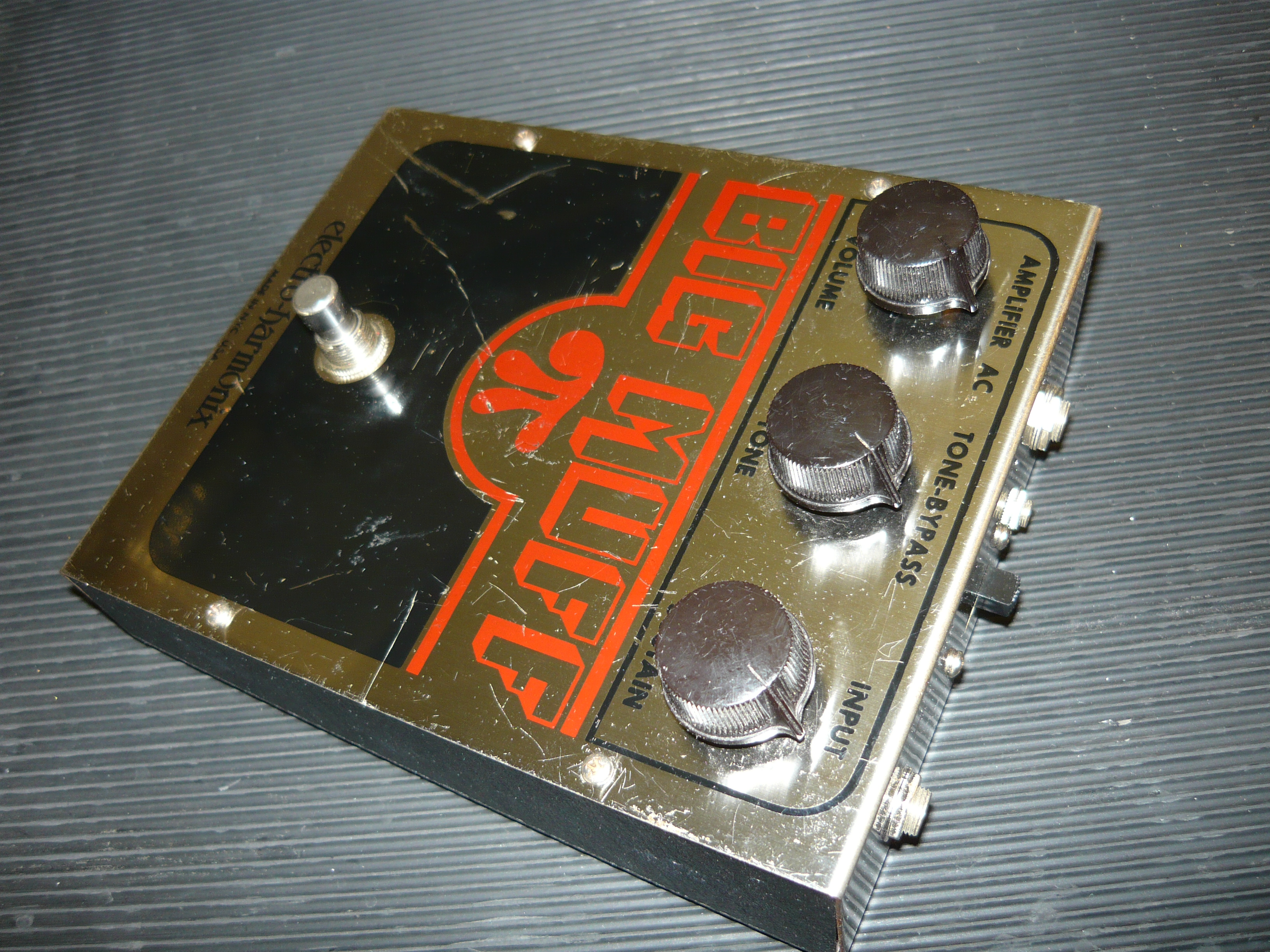
The Big Muff is a timeless classic in the fuzz-pedal world. It’s been heard on numerous recordings and been offered by countless boutique pedal manufacturers in one form or another over the years. There are a bewildering number of different versions of this pedal, which for convenience can be broadly grouped into four categories: vintage USA Big Muff, vintage USA (op-amp) Big Muff, Russian Big Muff, modern USA (NYC) Big Muff.

Many Big Muff users and collectors will tell you that pretty much every Big Muff sounds different, even comparing examples from the same version and/or year of manufacture. We tend to agree with this, based on our experiences servicing these pedals. Apart from normal component variations over time, different component values were often substituted, whether this was intentional or simply a case of running out of certain components, we do not know. We have also noticed different pots fitted to otherwise identical models, which would result in a different sweep altogether !
When considering the reasons for such wide variations in tone & performance with the Big Muff & other E-H pedals, one factor cannot be overlooked. At different times over the four decades of production of E-H pedals, the quality of assembly and in fact quality control in general was pretty poor ! The pedals often looked like they were wired up by someone in a hurry, with soldering that wasn’t going to hold up on the road. This applies to both USA & Russian manufacture.

To give credit where it’s due, however, E-H have come up with some of the most extraordinary pedals over the years. Our personal favourite has to be the Electric Mistress (flanger), for those classic early 80’s guitar sounds, a la The Police, The Pretenders, etc. Once again, there are several versions of the Electric Mistress, and restoring this pedal to full operation can sometimes create challenges for the service tech, depending on the problem.

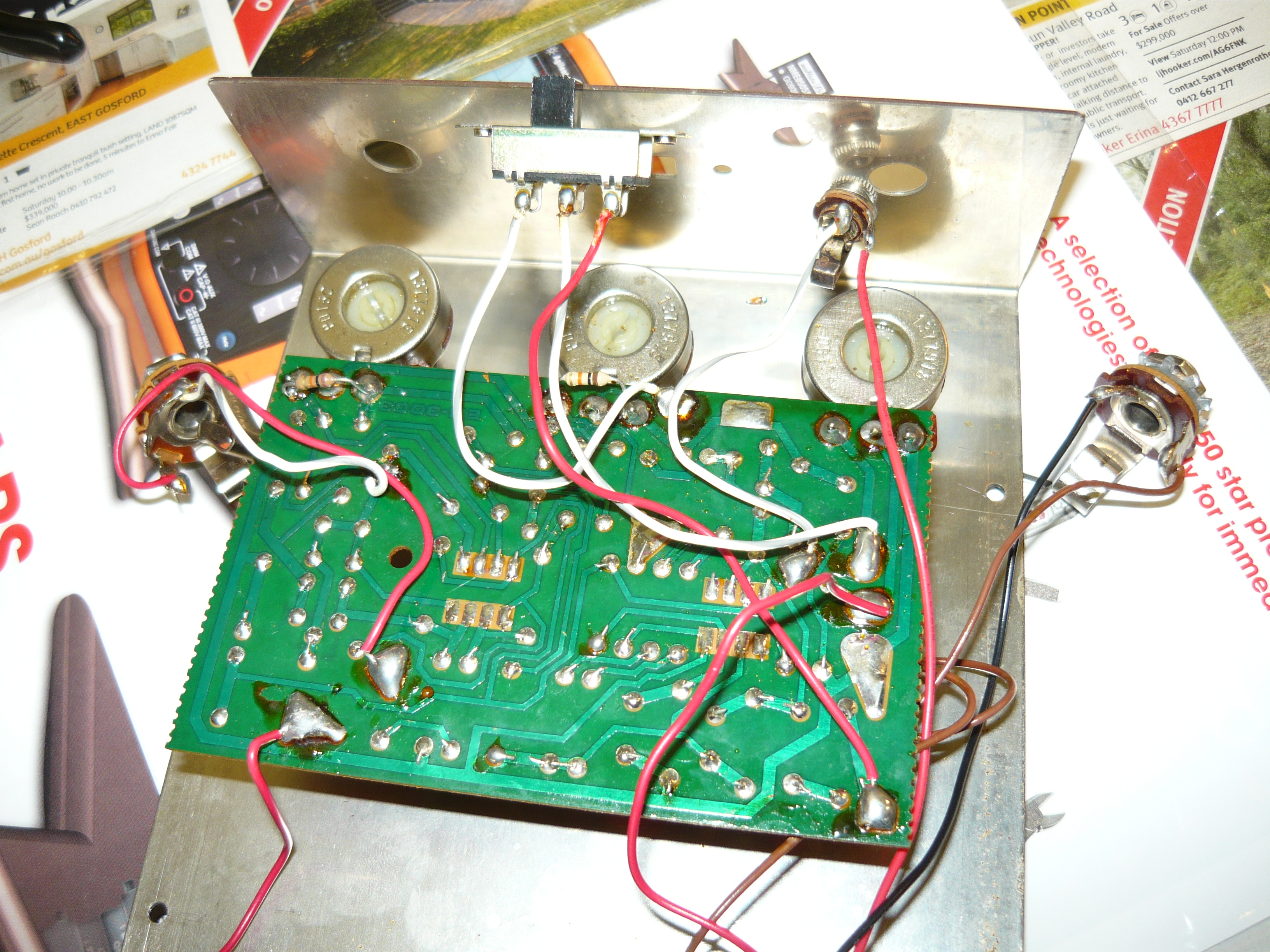
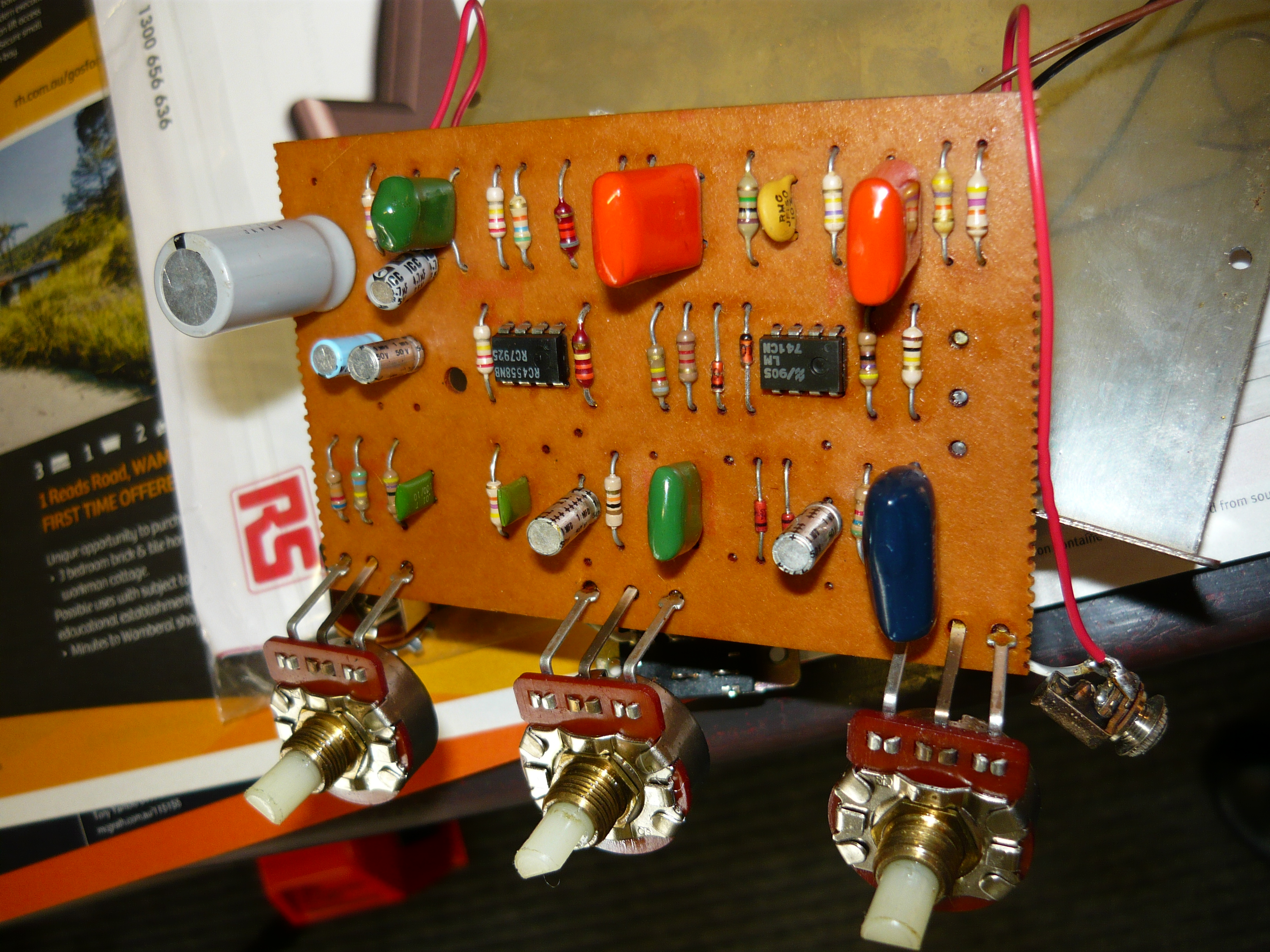
Recently, a pair of barely functional Big Muff (IC/op-amp) pedals from the late 70’s arrived in our workshop for attention. The two pedals had quite different printed circuit boards, different pots, but almost exactly the same circuit (which we reverse-engineered as the schematics available on the internet often have errors). Even if working properly, these two apparently exactly the same pedals would have sounded very different to each other. You can see from the photo above that the older pedal of the two has been the subject of numerous attempts at rewiring & modification. We ended up correcting & rewiring much of this in order to get the performance on par with the newer of the two pedals.
Amazingly, the pots in both of these pedals work OK, just requiring a squirt of Faderlube to clean & lubricate. The main issues tend to be jacks & switches. The original jacks are cheapo – the best solution is to replace them with Switchcraft jacks. The EQ bypass slide switches are particularly prone to causing loss of signal and should automatically be replaced. Luckily there is an exact size replacement out there. In one of the pedals there was a blown IC and very cheapo IC sockets which just weren’t doing the job, so they were all replaced. Tidy up the wiring & rework any dodgy soldering and we have a pair of working Muff’s, still not quite the same as each other, but much closer than before.
Please contact us by email re any service enquiries for E-H pedals in general, and the Big Muff in particular. In most cases we will be able to assist. We can also supply custom linear power supplies for pedals that require different voltages from the usual 9V DC, ie 18V & 24V DC are sometimes specified by E-H (see previous blog re Rich Split & 18V PSU for example).

Tye Pennington orders a custom Rich Split with 18V power supply

February 2, 2012

Sydney-based guitarist & recording/mixing engineer Tye Pennington contacted us in November of 2011 regarding the availability of a customised version of the Rich Split active buffer/splitter pedal. Tye and his band KTR, ie Killing the Ritual, were in the studio working on their debut album, with Tye performing both engineering and guitar playing duties. At this stage, Tye had already attempted splitting the guitar signal to record with multiple amps, experiencing terrible noise problems with “ground loops”.

For a more detailed appraisal of the issues arising from recording &/or performing with multiple amps &/or signal paths please read our previous blogs on the subject: Rich Switch A/B/Y, Bob’s Rich Split & More About Signal Splitting. These can be found in the Pedals archive.

Here is what Tye had to say:  Hi Ivan, just wanted to quickly say how much I love your pedals, I am the proud owner of the Rich Fuzz & the Class-A Distortion, and they have a permanent home on my pedalboard. Anyway, I was interested in the Rich Split for a studio project where we will be splitting to at least four guitar amplifiers simultaneously. I think the Rich Split will be perfect for the task, but I am also interested in using the pedal at live gigs. My question is would it be possible to have the pedal modified with fooswitches to engage/disengage the sends (outputs) ? Cheers !

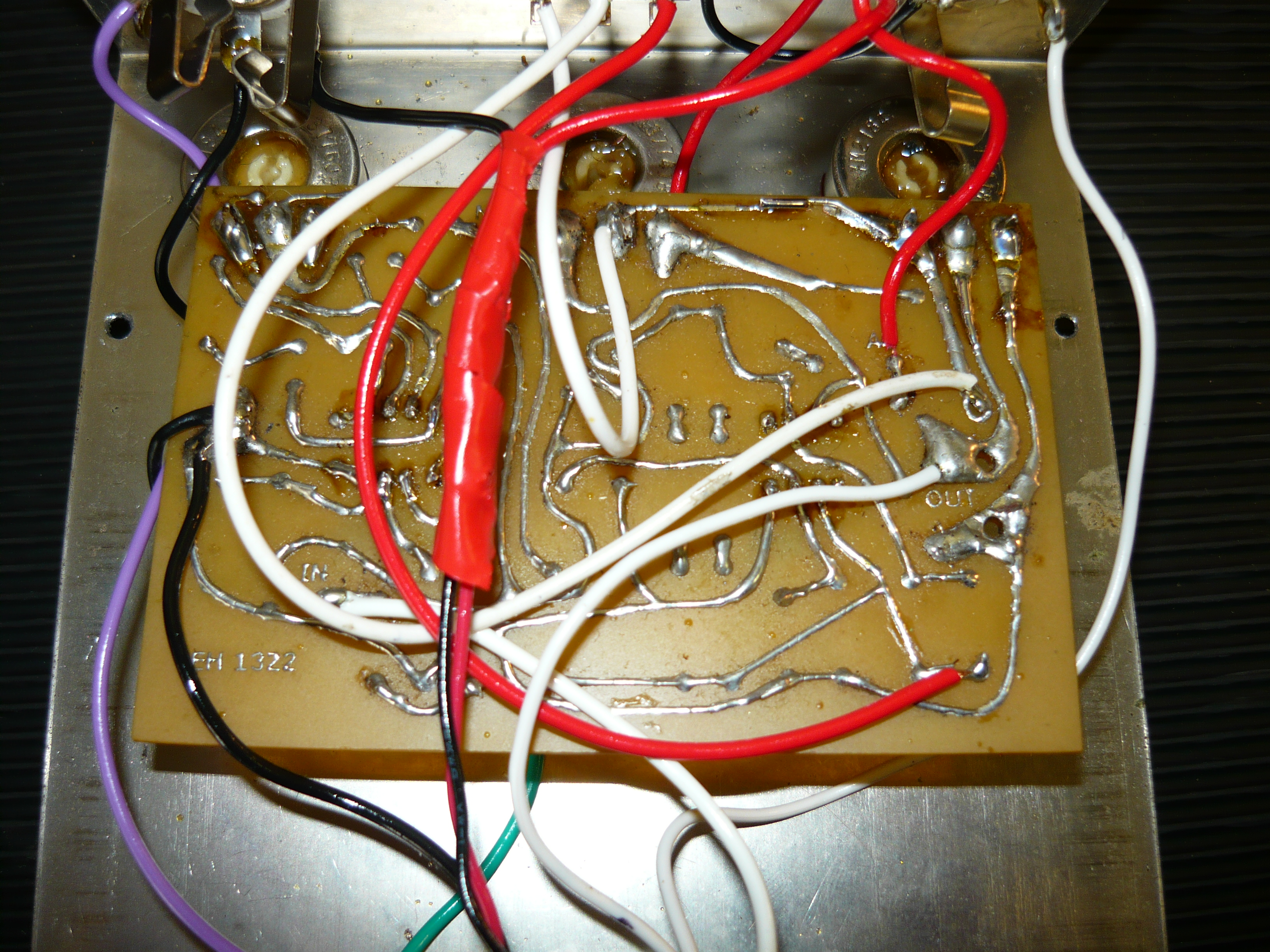
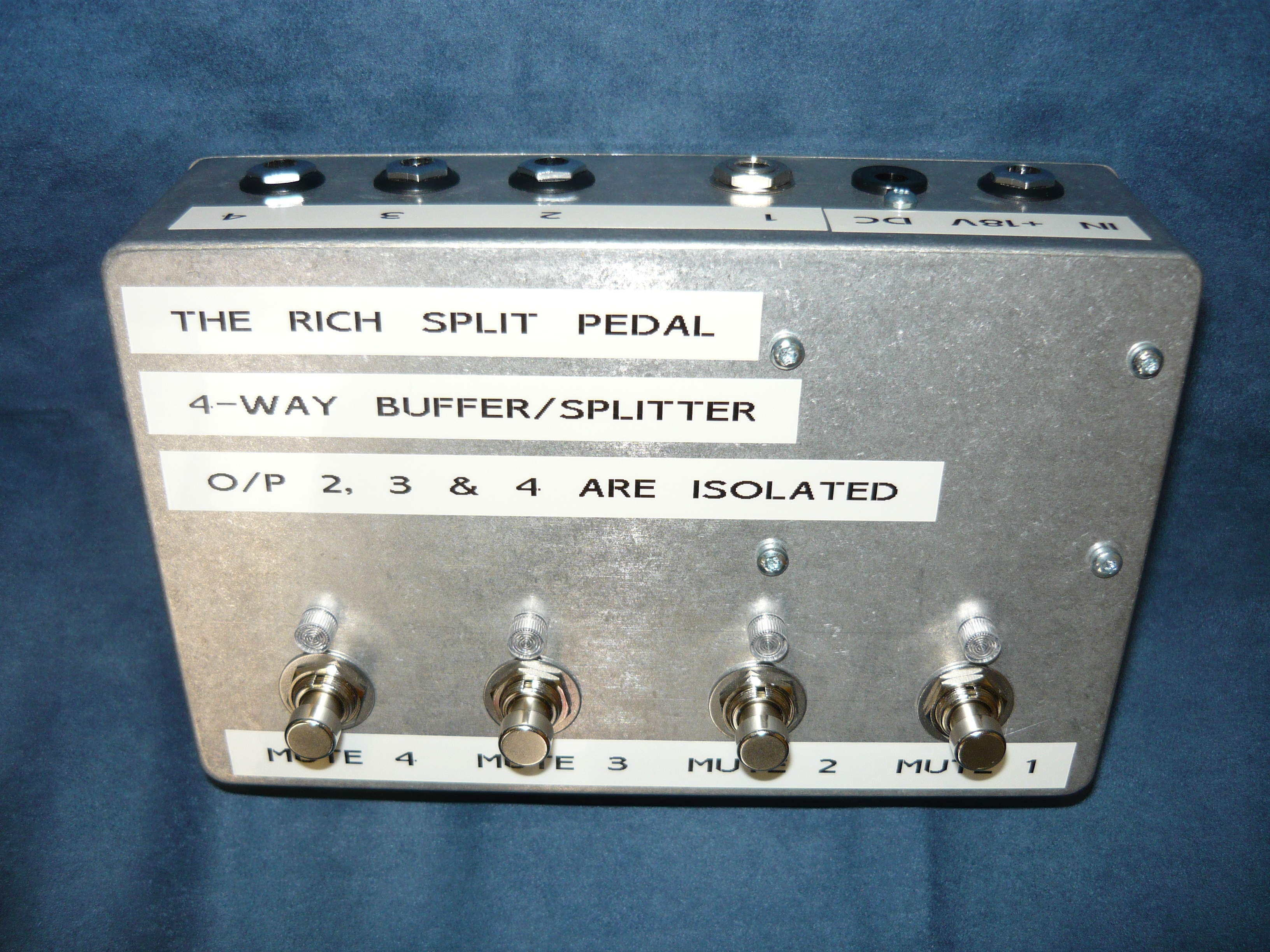
So, we set about designing a 4-way Rich Split, with three transformer isolated splits, one direct split, plus four individual mute switches and LED status indicators. An external regulated +18V DC power supply is required, although the pedal will run off +9V DC at reduced headroom. Power consumption is quite low, even with all LEDs illuminated. The electronics, footswitches & Harbuch broadcast quality line transfromers all fit neatly inside a Hammond die-cast aluminium enclosure, which also provides superior shielding from external noise sources. The Rich Split pedal is currently available with up to five splits, although the majority of customer orders have been for the 2-way & 3-way splitters.

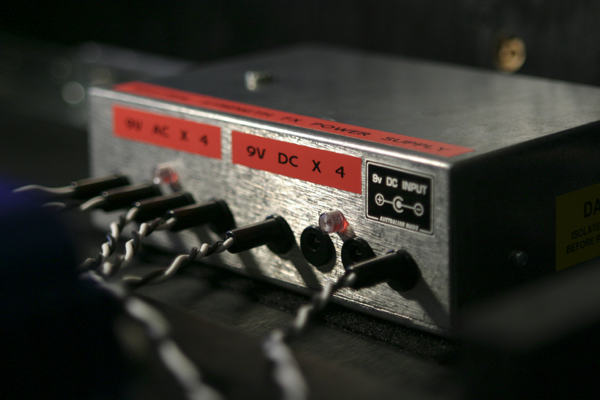
A high-quality regulated power supply is a critical component for an active splitter & other similar gear. Although this pedal will happily run off +9V DC, +18V DC is the recommended supply voltage to achieve reasonable headroom. Some commercial pedalboard power supplies will provide regulated +18V DC. We have experimented with some of the switch-mode power suplies (SMPSU) on the market, and have found them to be unsatisfactory for powering the Rich Split & Rich Switch  pedals, ie under some circumstances they have introduced noise into the signal chain. The best solution is still the linear (ie, analogue) power supply.

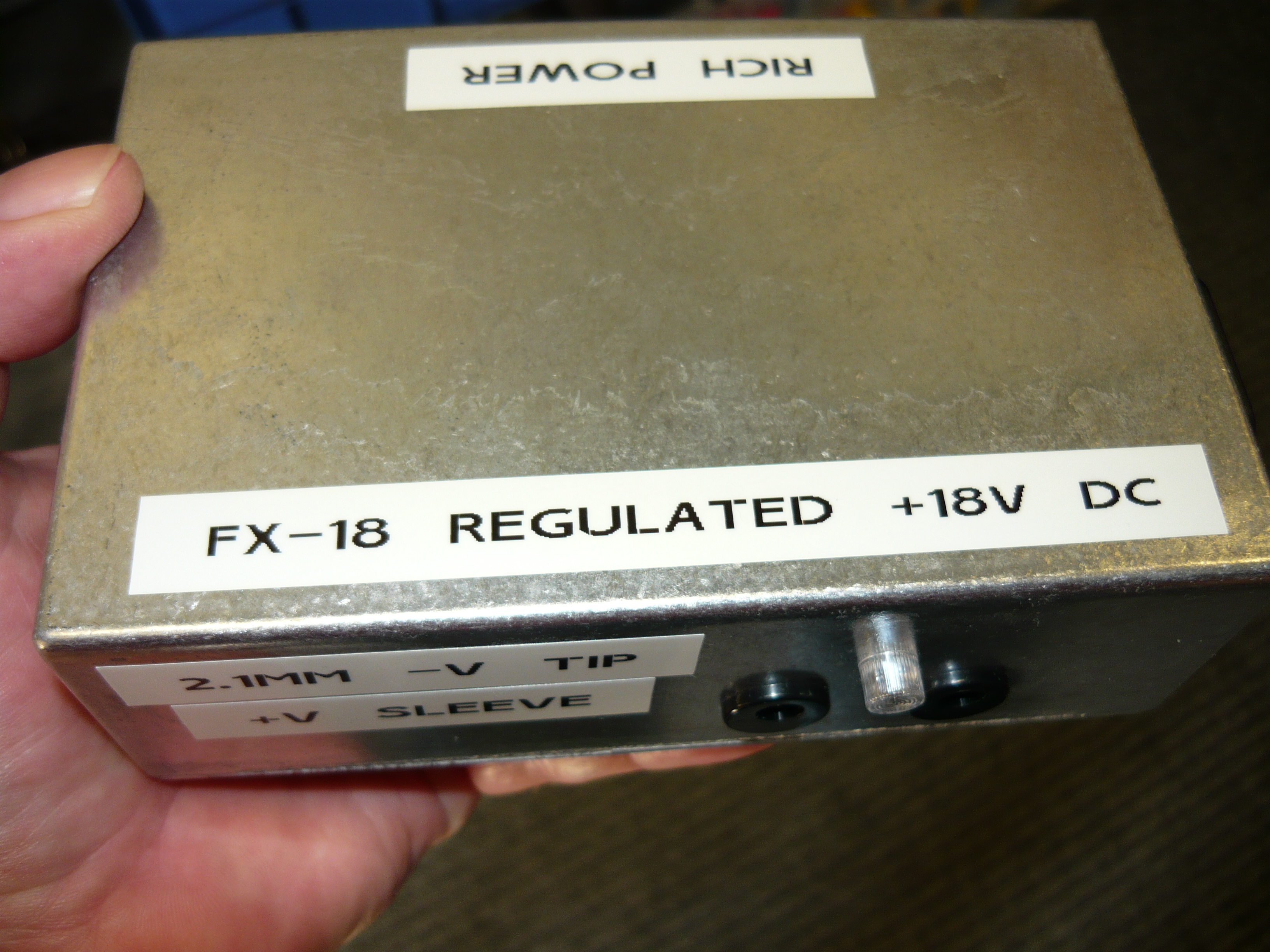
For customers like Tye, who require an external +18V DC regulated power supply, we can supply the model FX-18 Rich Power pedal at reasonable cost. We are not a commercial manufacturer of power supplies, but have always offered individually custom-built pedalboard power supplies for guitarists in a variety of configurations. These units are relatively indestructable, housed in a robust Hammond die-cast aluminium enclosure, and protected from normal guitarist type abuses & incidents.

Thanks agin to Tye, for his enthusiasm for our products and we hope to hear soon the results of his recording project. Future blogs now being prepared will include the extremely rare Marshall JMP 10 watt Lead/Tremolo combo, and other major overhauls of vintage amps.

The Galaxie Guitar Amplifier by Vadis

January 14, 2012

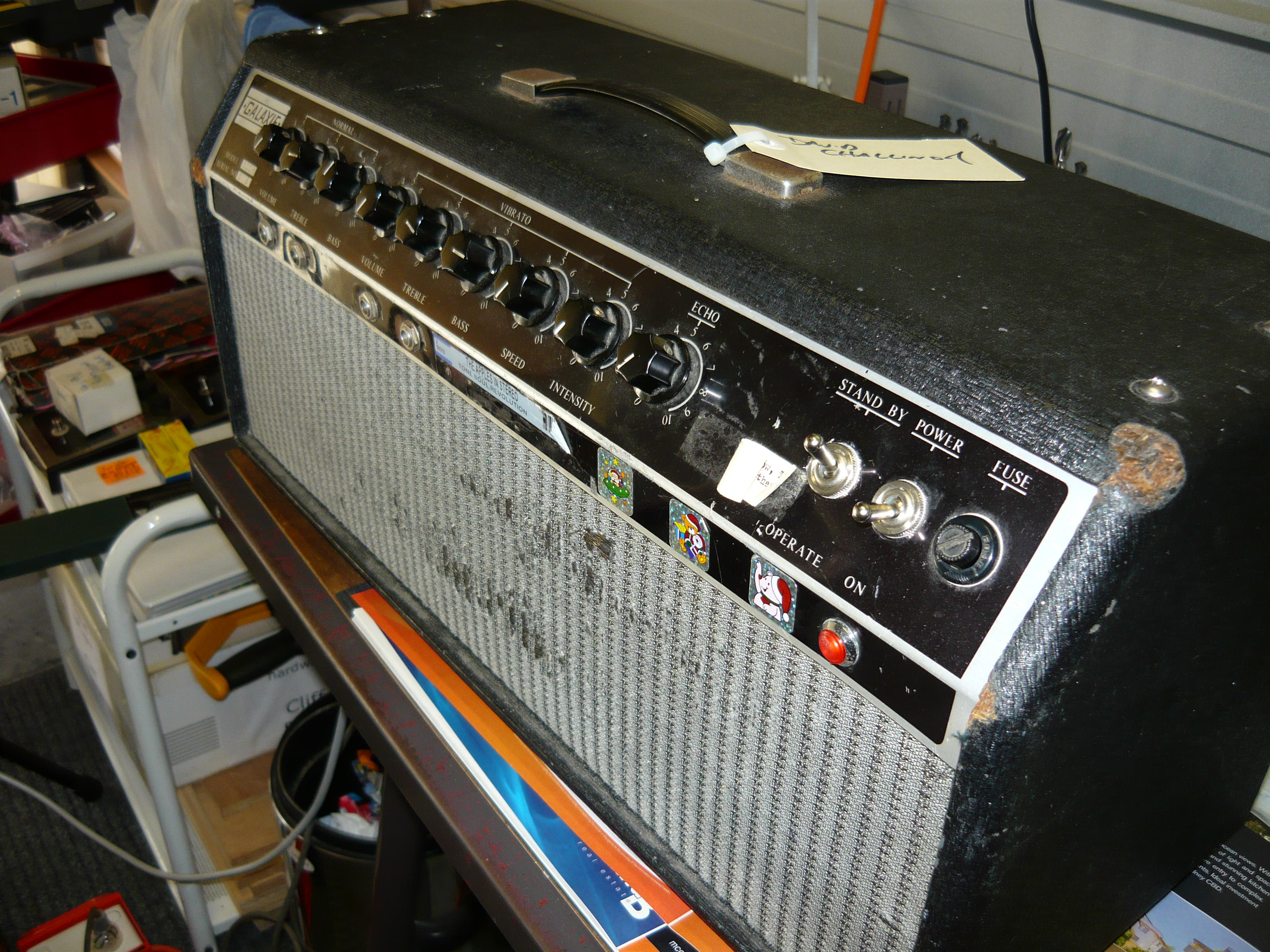
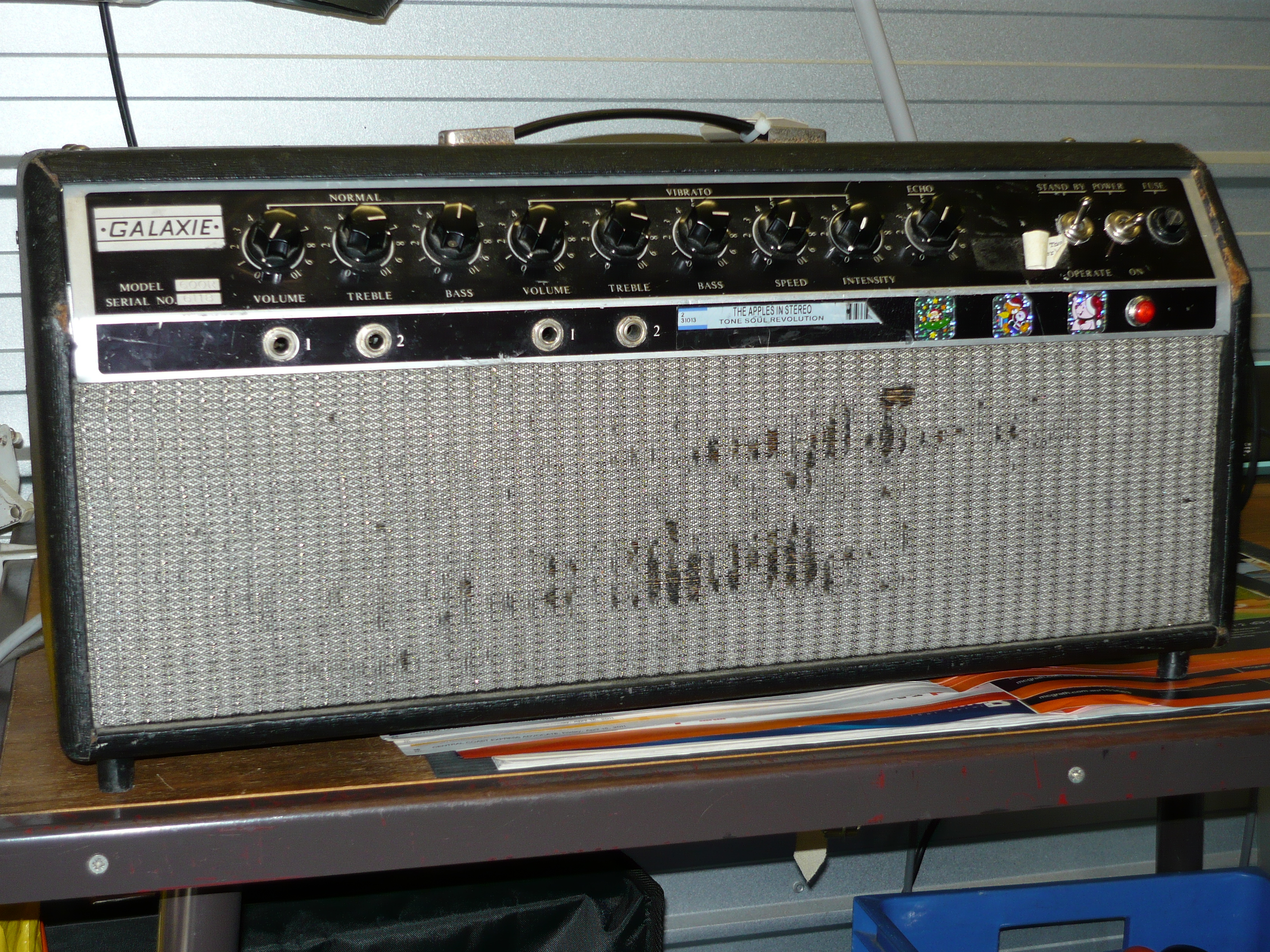
Happy New Year and welcome to 2012 !!  Recently, we carried out a major repair of a Galaxie 60 watt head for David Challinor of the Sydney-based indie band, Sounds Like Sunset. The Galaxie amp is actually a rebadged Vadis amplifier, obviously rebranded for one of the major music stores, possibly Palings, possibly Nicholsons, J Stanley Johnston or Harry Landis, all situated in the Sydney CBD back in the day, but we don’t actually know the details. This was fairly common practice in the 1960’s manufacturing scene, and the Vadis amp may well have been rebadged with other brand names as well. If anyone reading this blog can shed some more light on the subject, please contact us via email, it will be most appreciated.

Vadis amplifiers were manufactured in a small factory unit in Brookvale, a northern beaches suburb of Sydney, Australia. The business name of the manufacturer was Soundcraft Industries, Pty Ltd. The name of the proprietor was Jerry Dewey, although I can’t be sure of the correct spelling. Production started in the early 1960’s and continued through to the early 1970’s, but those dates are just approximate. Vadis amps were distributed exclusively through Dynamic Music, who were located in the same general area of Sydney. No doubt this arrangement would have limited the profitability of Soundcraft Industries, but it also gave them a broad penetration of the musical instrument marketplace, as it existed at that time.

Believe it or not, we actually have a family connection to the Vadis amp. My father, Jack Richards, a guitarist and arranger on the Sydney pro music scene back in the day, lived in the North Narrabeen/Elanora area of Sydney, as did Jerry Dewey. Knowing that Jerry was in the electronics industry, my father suggested to him repeatedly that it would be a shrewd move to start manufacturing guitar amplifiers, as at that point in time there were only two serious competitors, Moody in Lidcombe (Sydney), and Goldentone in Melbourne. By the time Jerry actually started production, however, there were several new competitors starting up in Sydney, Melbourne and Brisbane. Nevertheless, the enterprise was successful.

My father also claims to have suggested the name Vadis, from the name of a Sydney nightclub, Quo Vadis (also the title of a movie). We have no idea what became of Jerry Dewey after Soundcraft Industries closed its doors.

The classic Vadis 40 watt and 60 watt heads and combos typically employed a pair of 6CA7/EL34 output valves, originally with a 5AR4/GZ34 rectifier, but later replaced with solid-state rectification. A resistor (eg 1000 ohms, wire-wound) was normally used rather than a filter choke. These models had two preamp channels, one brighter than the other, and very effective all-valve reverb and tremolo. The reverb design is very similar to that of the 60’s Ampeg amps, but using a 12AU7/ECC82 driver valve. The tremolo employs direct modulation of the 2nd 12AX7/ECC83 gain stage cathode bias, in the 2nd (reverb) channel, resulting in that classic valve amp tremolo, unobtainable any other way. The 2-band passive EQ in each channel, was sometimes as per the Vox “Top Boost” channel, but driven from the anode of the preceding stage, rather than by a cathode-follower buffer stage, sometimes a very simple “tweed amp” style, but most often used a modified Baxandall EQ, optimised for guitar, and obviously a design unique to the Vadis amp. The more expensive amps used Ferguson transformers, manufactured in Chatswood (Sydney), with cheaper alternatives used in other amps.

There were numerous other lower-powered models employing different output valves, and were generally single channel. Most of the lower powered amps employed the 6GW8/ECL86 dual function triode – pentode valves, which could deliver up to approx 12 watts output in push-pull. These valves were very common in Australian-made guitar amps and record players, etc, in the 1960’s, but are long out of production.

The speakers used in the Vadis amp were primarily MSP (Manufacturers Special Products), a division of AWA in Sydney, or Rola (later Plessey Rola), also manufactured in Sydney. The Rola 12PEG (15 watts) and 12UEG (20 watts) alnico magnet guitar speakers sounded very fine indeed and are quite collectable today. Later, Plessey Rola introduced the updated ceramic magnet versions, the 12U50 and 12P30. The 12UX50 twin-cone model was widely used in PA systems at the time (late 60’s through early 70’s).

Well, by the late 60’s live performance of rock’n’roll music was changing in a big way, with ever more powerful amps appearing on the scene, and we can imagine that Soundcraft Industries, with their mid-60’s style amps, would have been under a lot of pressure from their distributors, and from retail, to reduce costs to stay competitive. By the beginning of the 70’s the Vadis amp was still a valve (tube) power amp, but with a solid-state preamp. Tone and performance suffered compared to the older models, but the writing was really on the wall when the entire range went completely solid-state. Thus, the Vadis story came to an end.

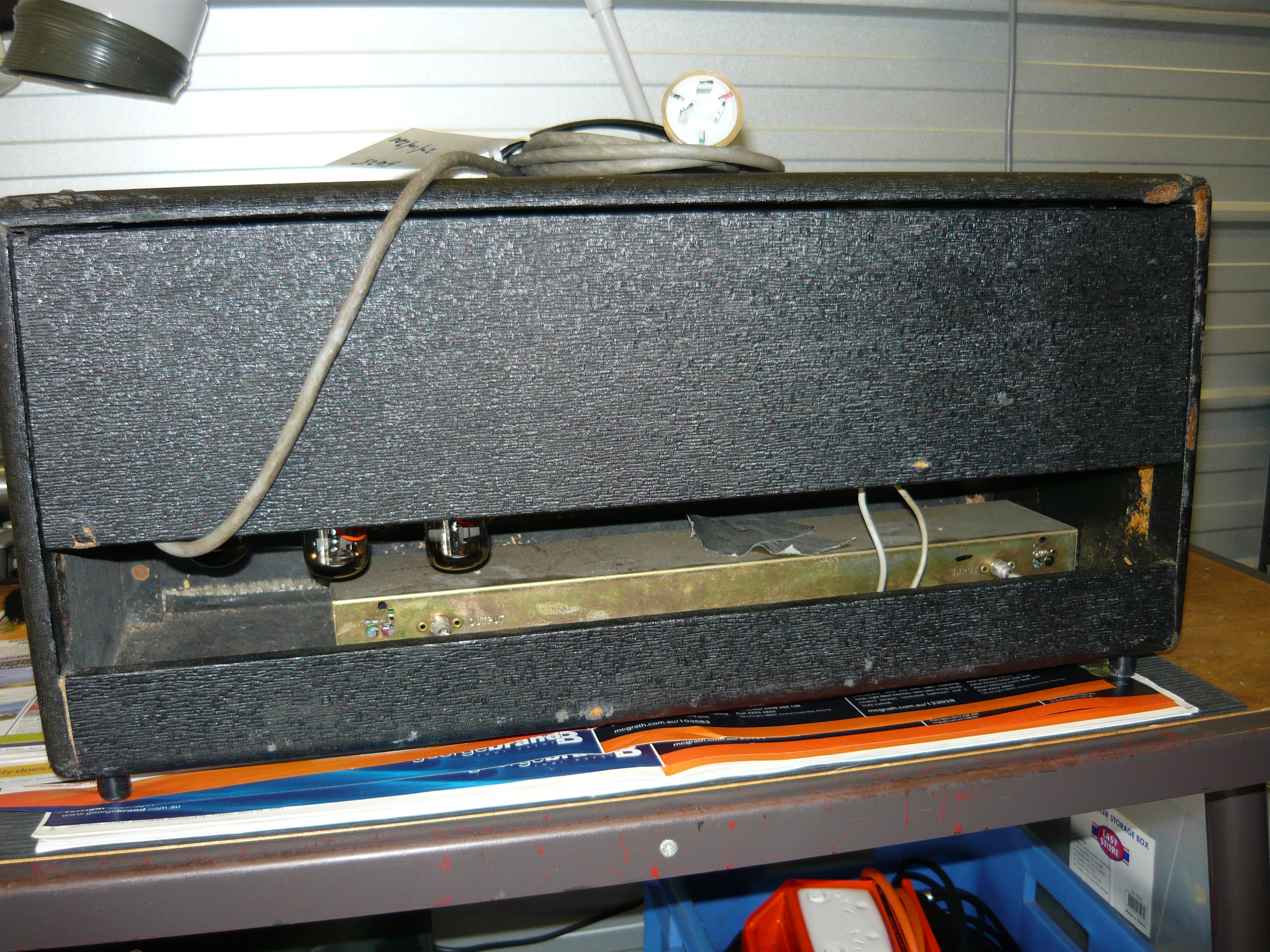
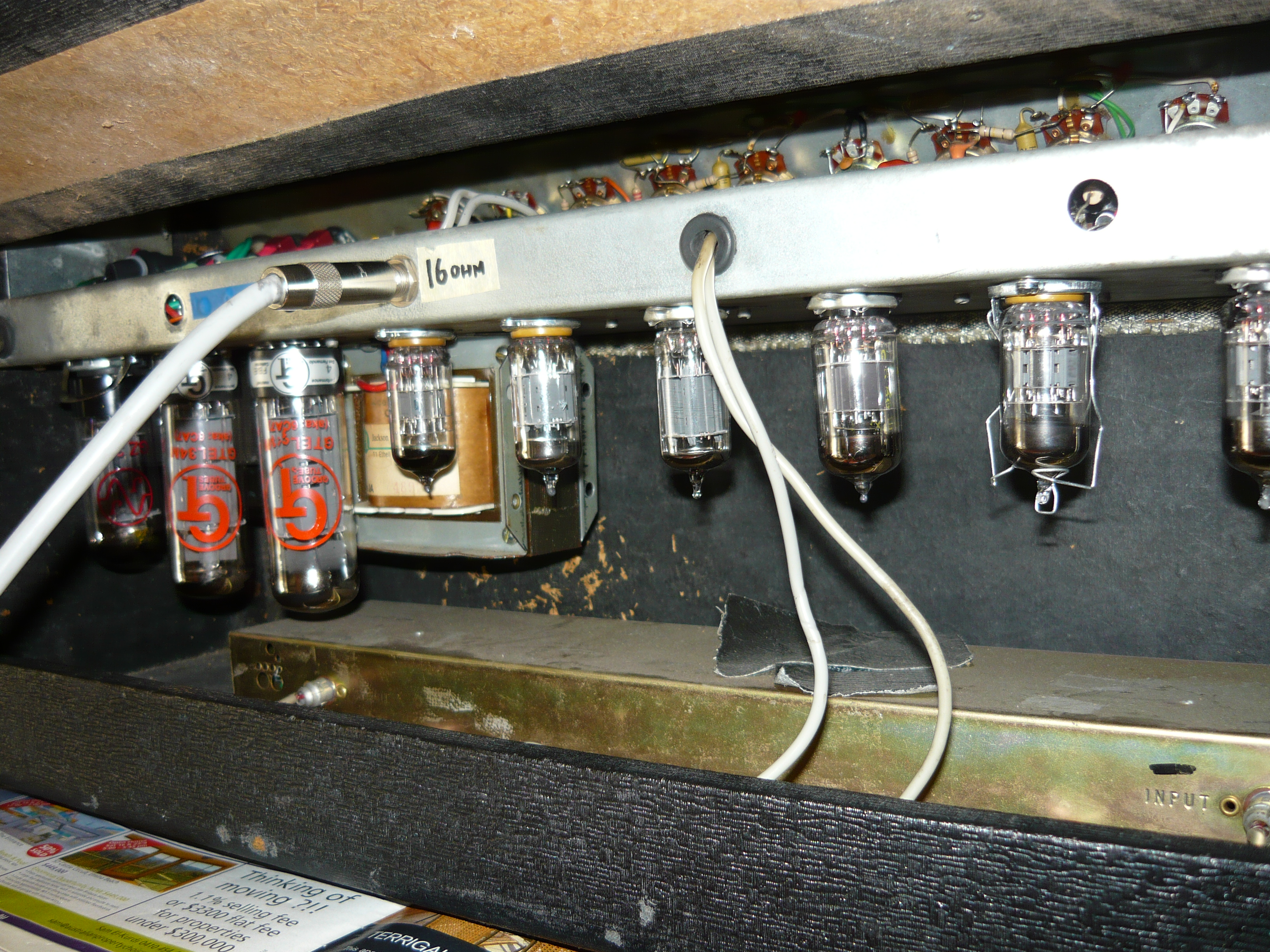
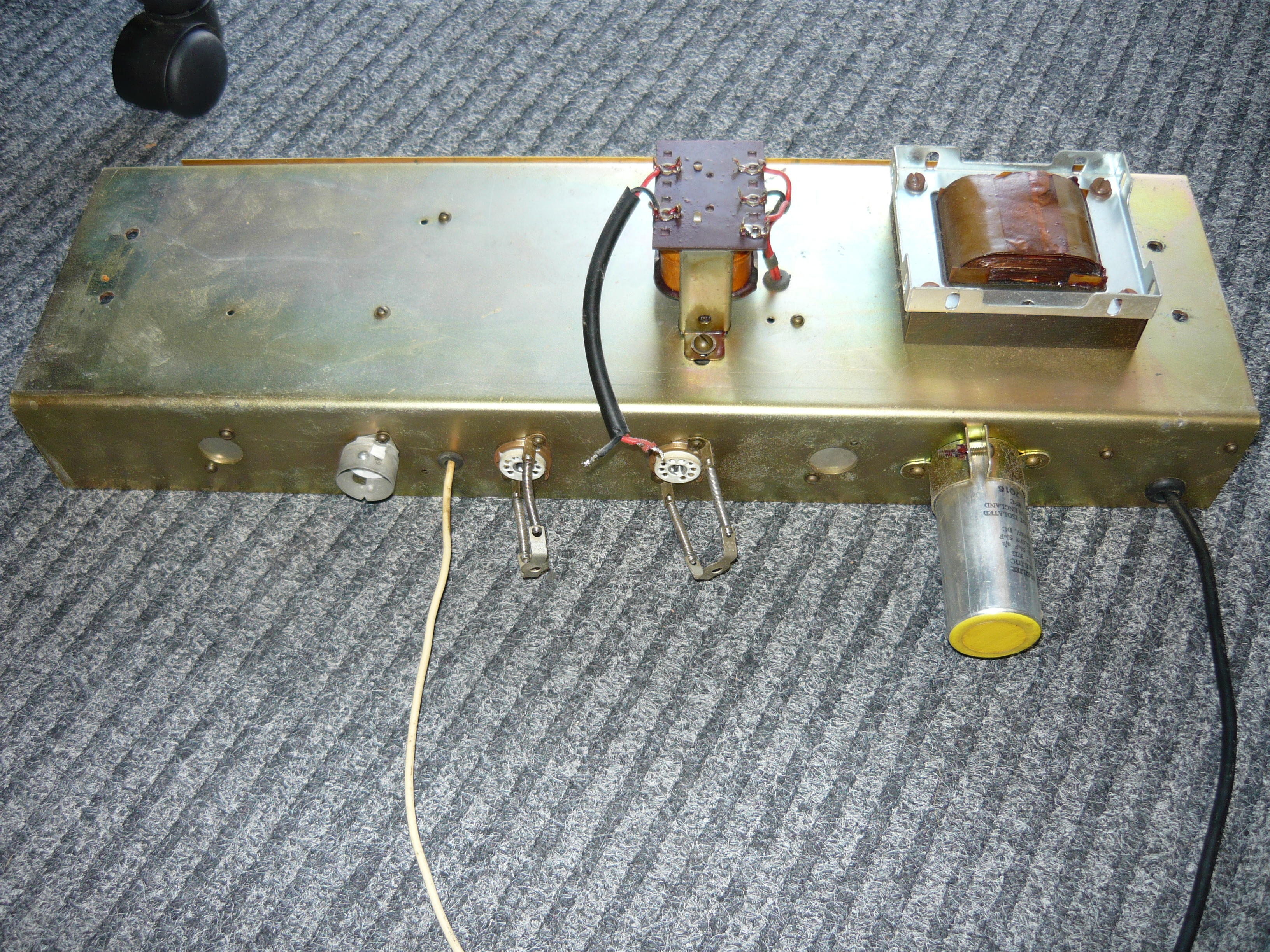
Getting back to Dave’s amp – both the transformers in this amp had previously been replaced by the writer, installing custom wound replacements from Special Transformers, of Sydney (no longer in business). This amp has had a hard working life and has been used in live performance until quite recently. The power transformer was replaced a 2nd time by a tech not known to us, this was possibly a Mojo unit, but was unfortunately underpowered for this application and developed a short circuit, blowing the fuse of course, and leading Dave to bring the amp down to our workshop. We selected a Mojo Tweed Bassman replacement unit, as having closest to the desired current & voltage ratings, ie able to support EL34 output valves plus a GZ34 rectifier, and importantly it would fit in the available space with some additional metalwork to enlarge the rectangular chassis opening.

Apart from replacing the transformer, there were numerous other issues to sort out, as you would expect in a 45 year old amp. I’m sure the designer would be amazed that these amps are still in use, and even more amazed at the alternative styles of music being performed !! In this amp the GZ34 and its octal socket required replacement, and the 240V wiring tidied up with emphasis on a good earth connection, as per compliance with Workcover NSW standards. All these amps will require replacement of 40+ year old electrolytic capacitors, we recommend a good quality cap such as Sprague Atom (USA) or F&T (W. Germany). Some caps will need to be bedded down in silicone to keep them secure. The bias supply voltage is adjusted by means of paralleling up resistors as required, so is not at all convenient. Jacks & pots will need cleaning or replacing as required. One problem will be the condition of the 9-pin preamp valve sockets. In many cases they will be so damaged and/or corroded that replacement is the only option, which is labour intensive as the Vadis amp is wired true point-to-point, with all components mounted directly between tagstrips and valve socket pins.

The tremolo function in Dave’s amp hadn’t been working for some time, but replacement of the 9-pin socket and a couple of resistors & capacitors restored it to full working order. It sounds fabulous !! In spite of the seemingly random earthing employed in the chassis wiring, the amp is amazingly quiet, and sounds pretty damn sweet. The reverb is a bit surf’s up for our tastes, but is definitely useable – just turned down a tad. We think that Mr Jerry Dewey probably knew a thing or two about electronic design, 60’s style.

Thanks again to Dave for his continued custom, and for supplying us with such rare & unusual items to discuss here in the blog.

http://soundslikesunset.com.au

Once again – if anybody can shed any light on any of the missing pieces of the Vadis jigsaw puzzle, please make contact via email and we will publish an update as appropriate.

Regards, Ivan.

Modifying popular valve guitar amps for the blues harp player

December 27, 2011

Hello. Happy Christmas 2011 !! From time to time we are approached by blues harp/harmonica players to optimise their guitar amp for harp. This blog only applies to valve (tube) amps – there seems little point in using a solid-state amp for this purpose, you might as well just plug into the PA system. Many such players own a Fender valve amp, or a made-for-harp clone of a Fender, eg Sonny Jnr amps. However, there are now many alternatives in the 15 watt range (including our own amps), and the made-in-China options are really quite inexpensive, if not always particularly well built.

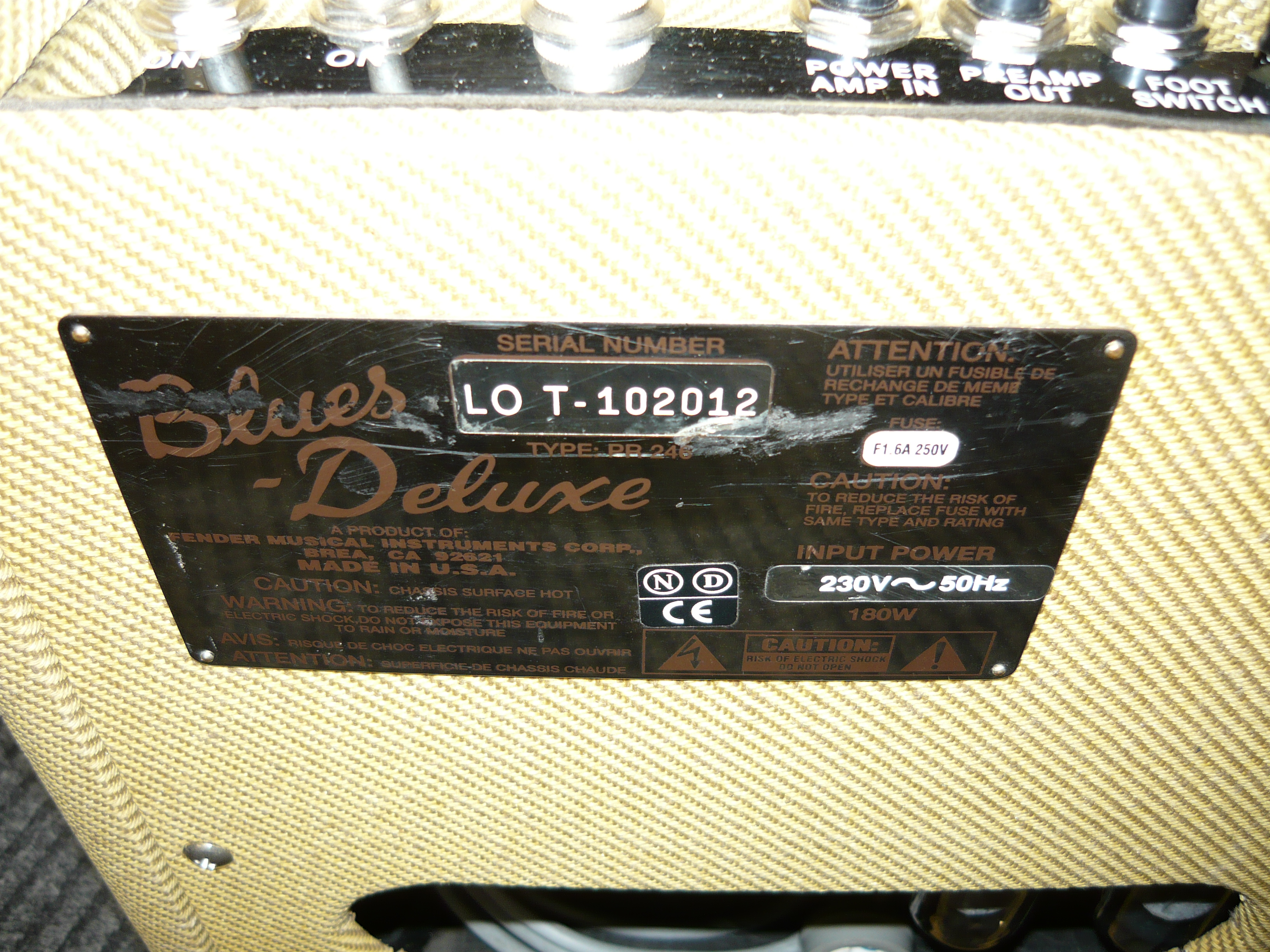
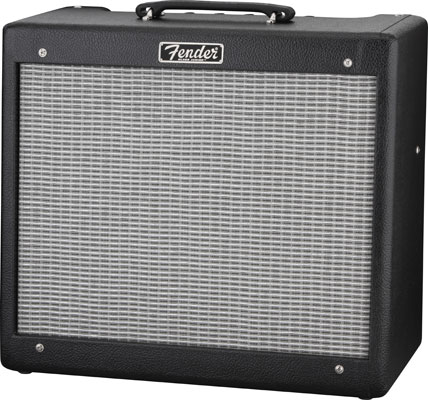
Typically, harp players will plug into a Fender Pro Junior, Blues Junior or in this example a Blues Deluxe 1×12 40 watt combo amp, made in the 1990’s and finished in tweed covering. Well, it’s all about personal taste, but my ears tell me that the original Blues Deluxe and Blues DeVille amps had a sweeter tone than the current Hot Rod series of Deluxes and DeVilles. One customer of ours was playing an archtop guitar through this model, plugged into the #2 input jack for the cleanest possible sound, ie for a strict jazz stylist.

So, why would we need to modify these amps in any way ?? Basically, most guitar amps have way too much gain and way too much emphasis on the “treble” end of the spectrum, for amplifying a blues harp. The harp player will experience endless problems getting adequate level before feedback sets in, and also achieving the desired authentic blues tone. A proven approach is to substitute preamp valves (tubes) to reduce gain to manageable levels, which can also have the additional benefit of giving a smoother, more HI-FI response. Substituting the 12AU7/ECC82 valve in lieu of the 12AX7/ECC83 in positions V2 & V3 will make a huge difference. In position V1, we need to work with the individual player to select the most appropriate valve, quite possibly the 12AX7/ECC83, the 12AT7/ECC81 or the 5751 might work well here. The amp will now sound pretty bland if you plug a guitar into it !!

To correct the EQ bias towards the treble end of the frequency range, the harp player is advised to set the bass control much higher than usual for a guitar, and to cut back on the treble & middle controls. The prescence control could be left at 12 o’clock, while the other controls are being adjusted, and then set according to taste. Other amp upgrade options could include replacing the speaker with a more harmonica-friendly unit – I have never been that impressed with the stock speakers in most Fender amps anyway. I believe Weber (USA) offer some speakers with an H (ie harmonica) dust cap, but have not tried such an option personally.

A recommended modification for users of microphones that give their best response into a very high input impedance, is to increase the amp’s input impedance to say around 5 megohms. This MOD will require removal of the printed circuit board (p.c.b.) in any of the amps discussed today, and the replacement of a single resistor, so it’s not like brain surgery, but it is a skilled job strictly for those people with a temperature-controlled soldering tool plus soldering expertise, otherwise you will damage the board.

Thanks for visiting our site – this will probably be our final blog for 2011, but we will be back in 2012 with plenty more amp & pedal material currently in various stages of preparation. Have a great New Year !!

Service Centre for (Holden) Wasp Amplifiers

December 17, 2011

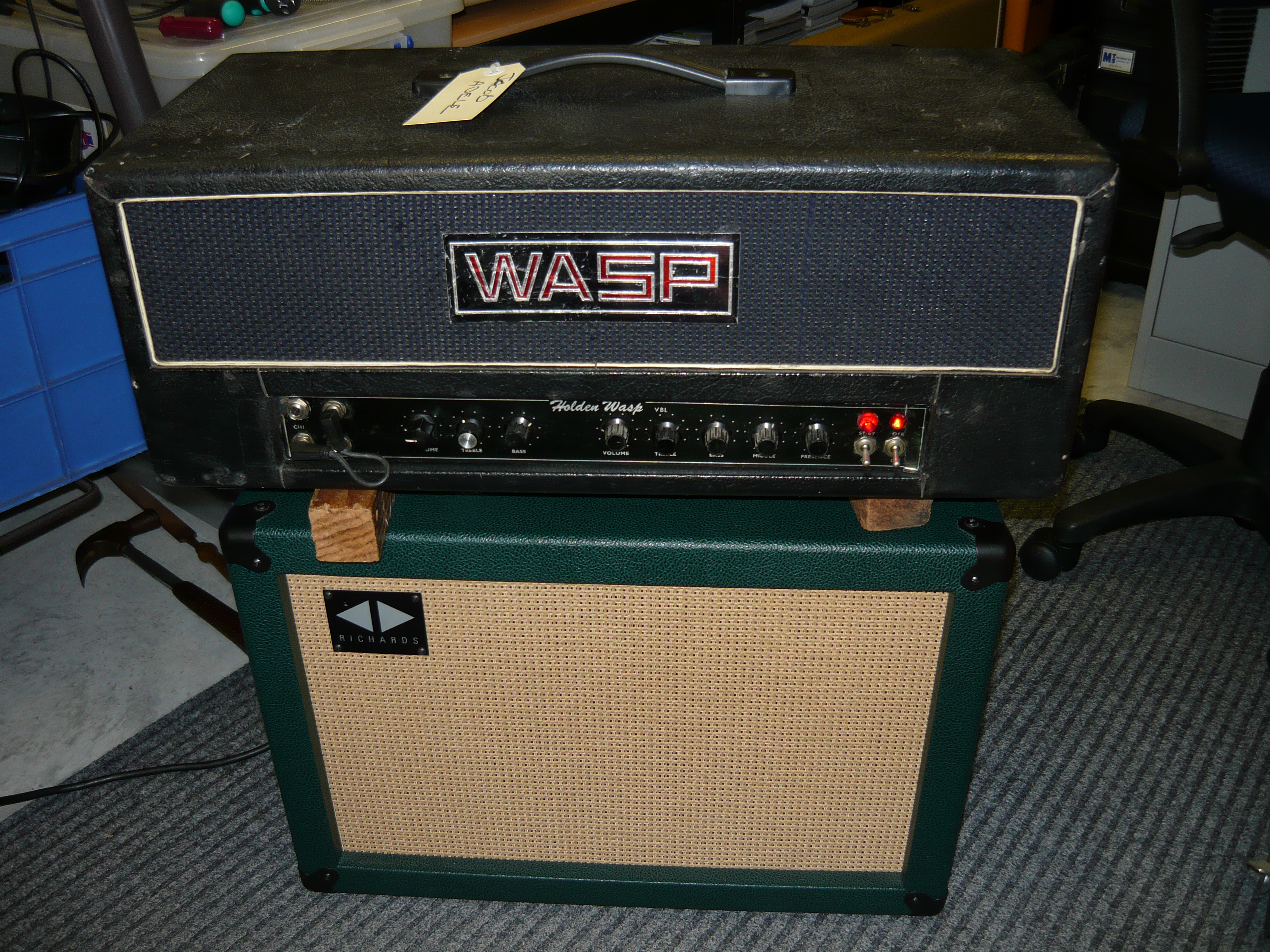
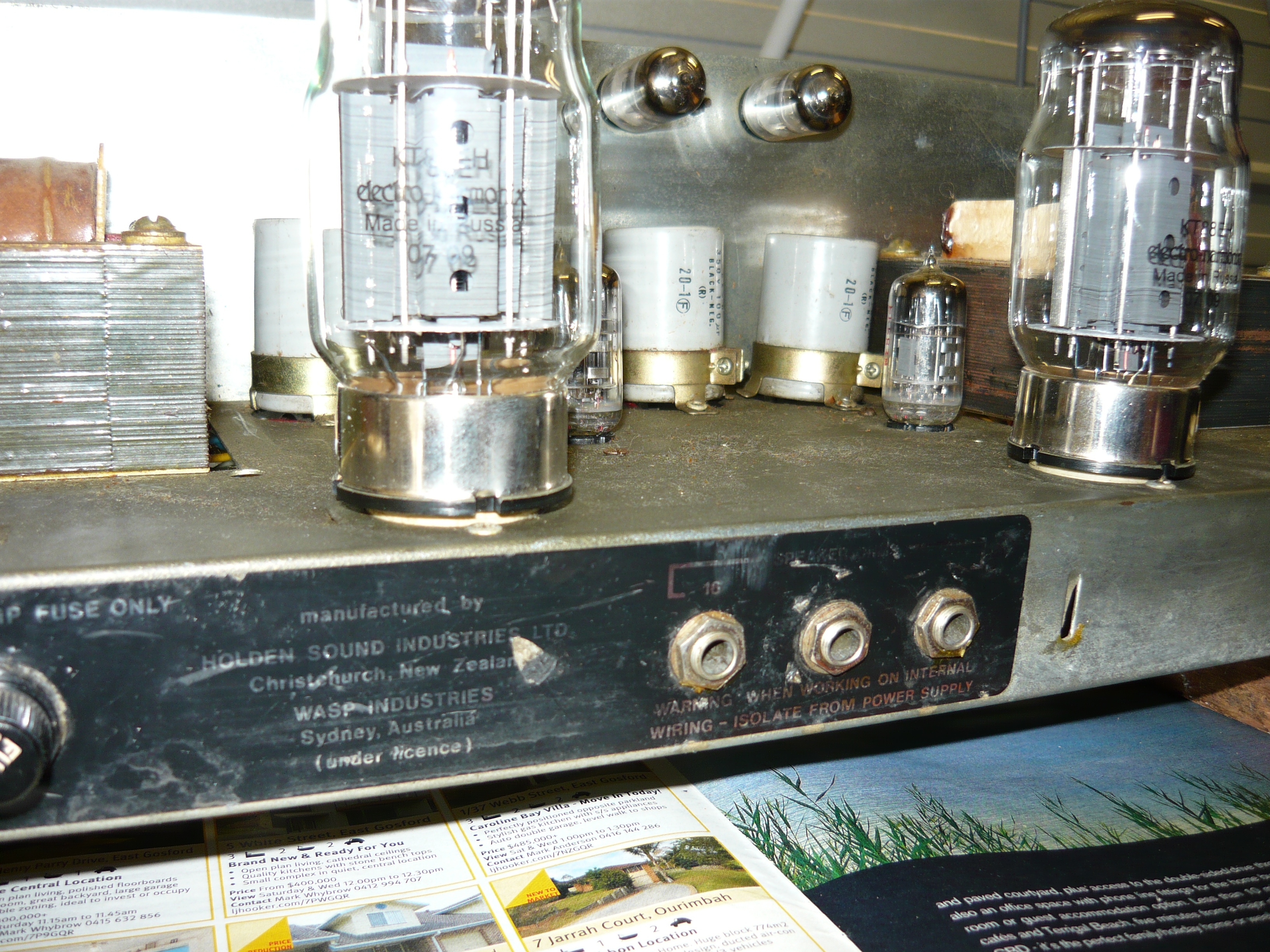
HI everyone – this week it is appropriate to mention the WASP amp, made in Sydney under licence from Holden Sound Industries in Christchurch, N.Z. We have been servicing the Wasp amp since the 80’s, and the occasional Holden amp that came across from N.Z., although we see them only occasionally lately (a couple of units per year ??). We still have all our schematics and service notes from back in the day, so if you are the proud owner of a Wasp and therefore Aust/NZ rock’n’roll history, we are the service workshop well qualified to restore your amp to full working order.

Ian Johnstone has stated on a forum that Wasp in Australia was started in 1967, and that they manufactured amps employing KT88, 6550 and EL34 power output valves.  I can remember from years back some references to people visiting the Wasp operation in Sydney’s inner-west, perhaps it was Leichhardt, perhaps it was Marrickville ? They stated seeing speaker cabs being assembled there. All the Wasp amps that I have ever seen were most likely manufactured during the 1970’s golden-era of rock, and were originally loaded with and biased for the great KT88 English-manufactured valves. This even applies to an obscure made-in-NZ Holden 75 watt amp with an excellent valve-driven tremolo (ie output valve bias modulation).

Of course, by the end of the 70’s the KT88 valve was becoming difficult to find and prohibitively expensive, so people starting substituting 6550 valves, which is OK with appropriate changes to the bias supply, and EL34/6CA7 valves, which  is really living on the edge, and in fact asking for a lot of trouble. Not everyone who serviced these amps from the 80’s onwards really knew what they were doing, and the Wasp amp became a liability in terms of on-the-road reliability, through no fault of its own. This design uses very high internal DC voltages, over 600V in fact on the KT88 anodes, and over 300V on the screen grids. This is how 100 watts output is achieved from a single pair of output valves, and 200 watts from a quad. So setting the bias at optimum for each change of valves is obviously important, and also the original value of screen grid resistors of 270 ohms is inadequate for modern valves, this should be increased to 1K (in my opinion). The Welwyn 7W W22 series ceramic body resistor is perfect for this application in such harsh conditions as exist in a high-power valve (tube) amp.

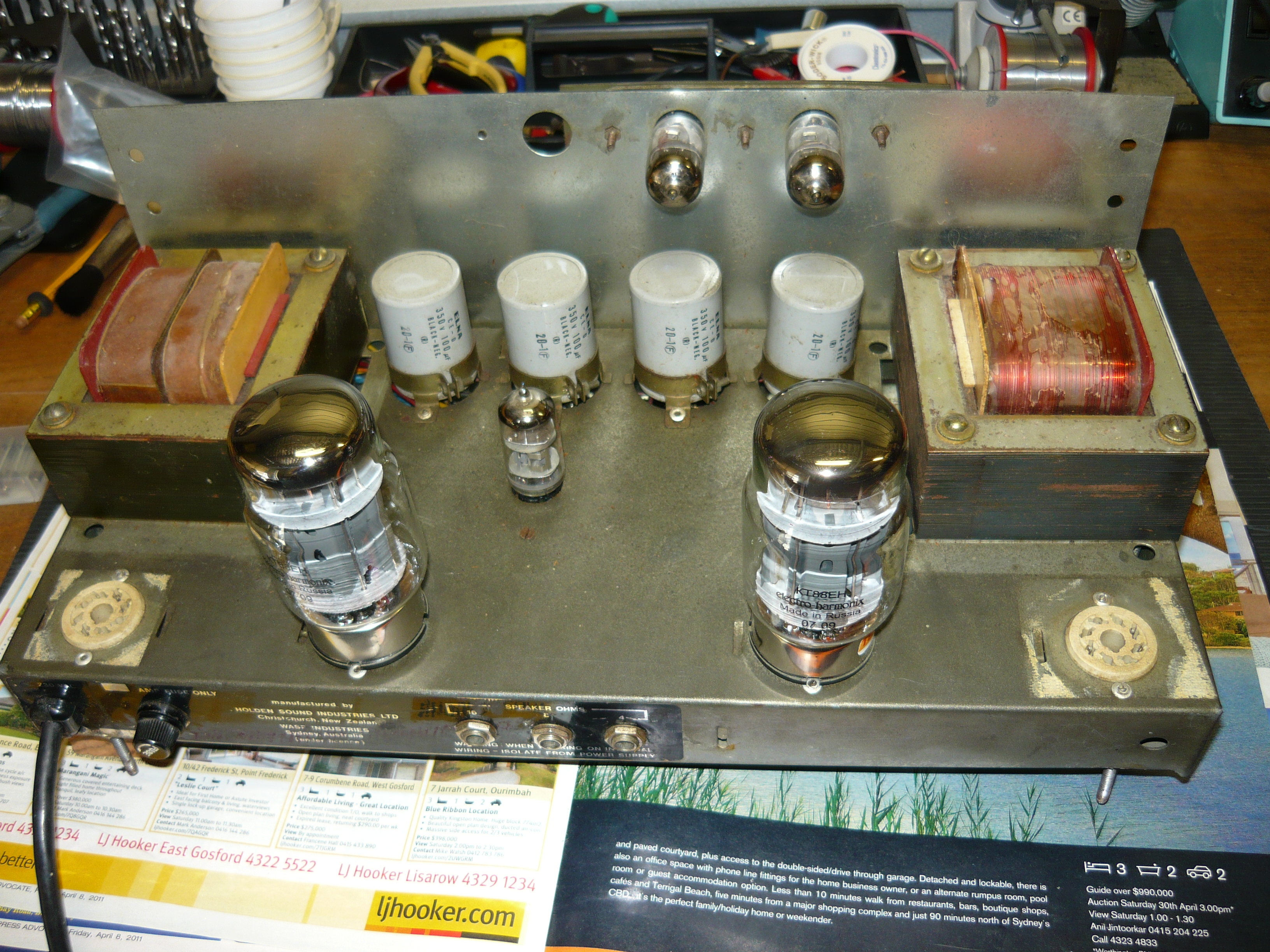
Ideally the screen grid supply should be regulated, and clamped at 300V maximum. With higher value screen grid resistors this would improve output valve longevity quite considerably. In recent times valve (tube) factories in Russia, Slovak Republic and China have been producing a KT88, so we now have more choices than ever before. Recommended brands include JJ, Sovtek/Electro-Harmonix, and Winged-C (formerly Svetlana). You can see in the photos an example 200 watt Wasp amp where I have installed a matched pair of KT88-EH with good results. 200 watts is way too much power, unless you’re the bass player, so the age-old trick is to install only a single pair of KT88 (6550) and then adjust the impedance the output valves are working into upwards by plugging your 8 ohm cab into the 4 ohm jack on the rear panel. This works a treat and delivers exactly 100 watts ! Still pretty damn loud, actually.

Unfortunately, the Holden/Wasp people saw fit to only provide a non-adjustable fixed-bias supply set to some arbitrary theoretical ideal value. Not a great idea ! Even in the golden age of valves (tubes), the parameters from valve to valve could vary quite significantly, so only a proportion of amps leaving the factory would have been correctly biased. HUH ?? In order to raise or lower the bias volts, we have to resort to this technique: add an appropriate value resistor across the series bias supply dropping resistor (470R) to increase the bias volts (decrease KT88 current draw), or add an appropriate value resistor across the 8.2K resistor that goes from the bias supply to ground, to lower the bias volts (increase KT88 current draw). The other alternative is to install a pot somewhere convenient on the chassis.

Any amp this old will need a lot of work in addition to new output valves, with particular attention paid to electrical safety issues. The 240V 3-pin plug will be pretty trashed and should definitely be replaced. The earth must be tested according to Australian Standards as specified by Workcover NSW, typically using a PAT (portable appliance tester). From the earth pin on the 3-pin plug to any exposed metalwork on the amplifier should read less than 2 ohms, otherwise we are not complying with the standard. Most of the electrolytic capacitors will be at the end of their working life and will need replacement/upgrade. This particularly includes the 4 x 100uF/350V can mounting capacitors you can see in the photos. The condition of the pots and jacks, including the wiring, in the preamp section at the front is always very poor. Asian sourced jacks were used, rather than Switchcraft. I definitely recommend replacement with Switchcraft jacks for improved connectivity. The toggle switches have often been replaced with cheapo units, and one of the neon indicators is usually smashed – this is a bit of a problem finding a suitable replacement that is an exact fit. At the very least, the jacks need to be cleaned with DeOxit, and the pots given a blast with FaderLube, which both cleans & lubricates.

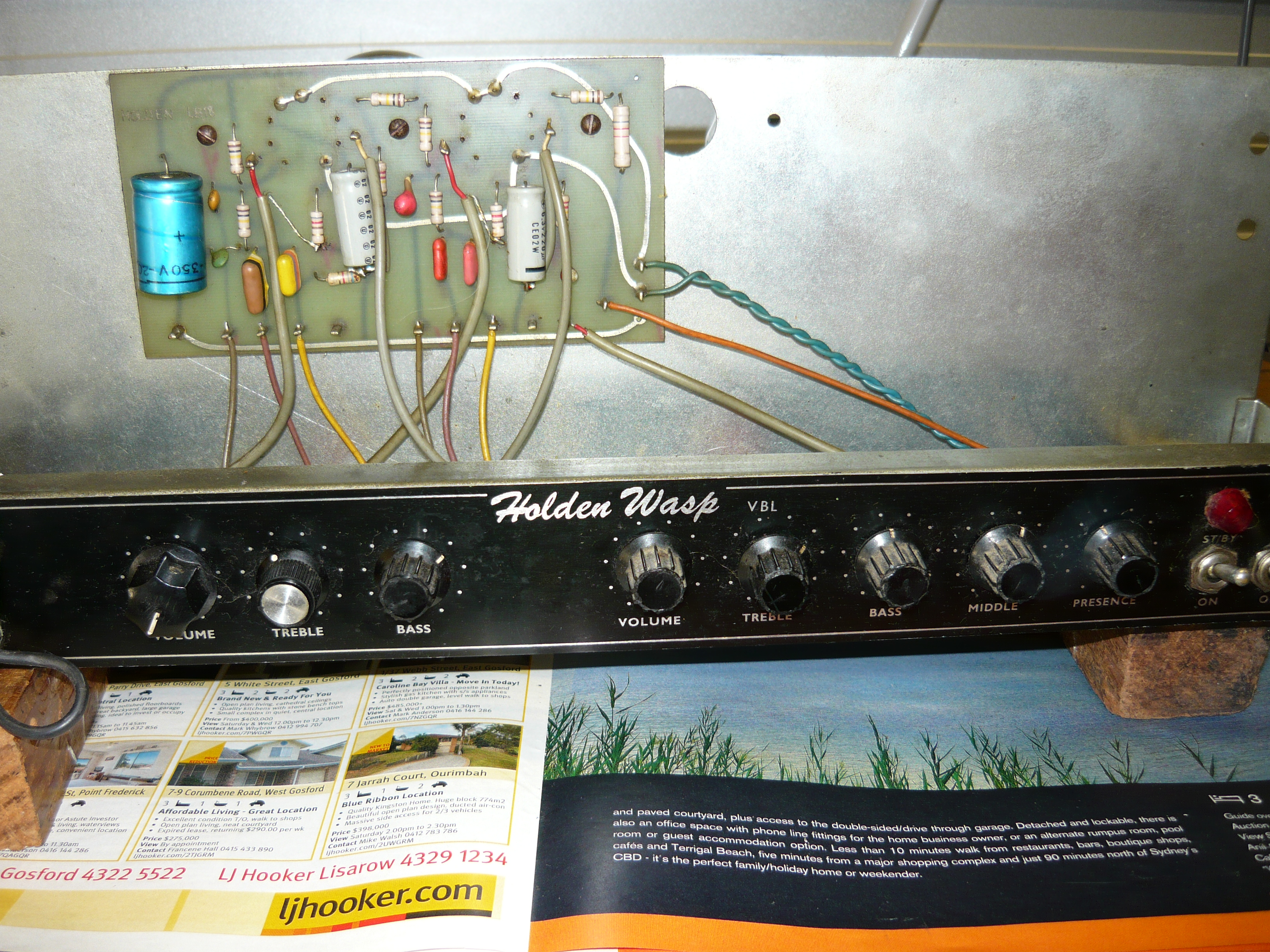
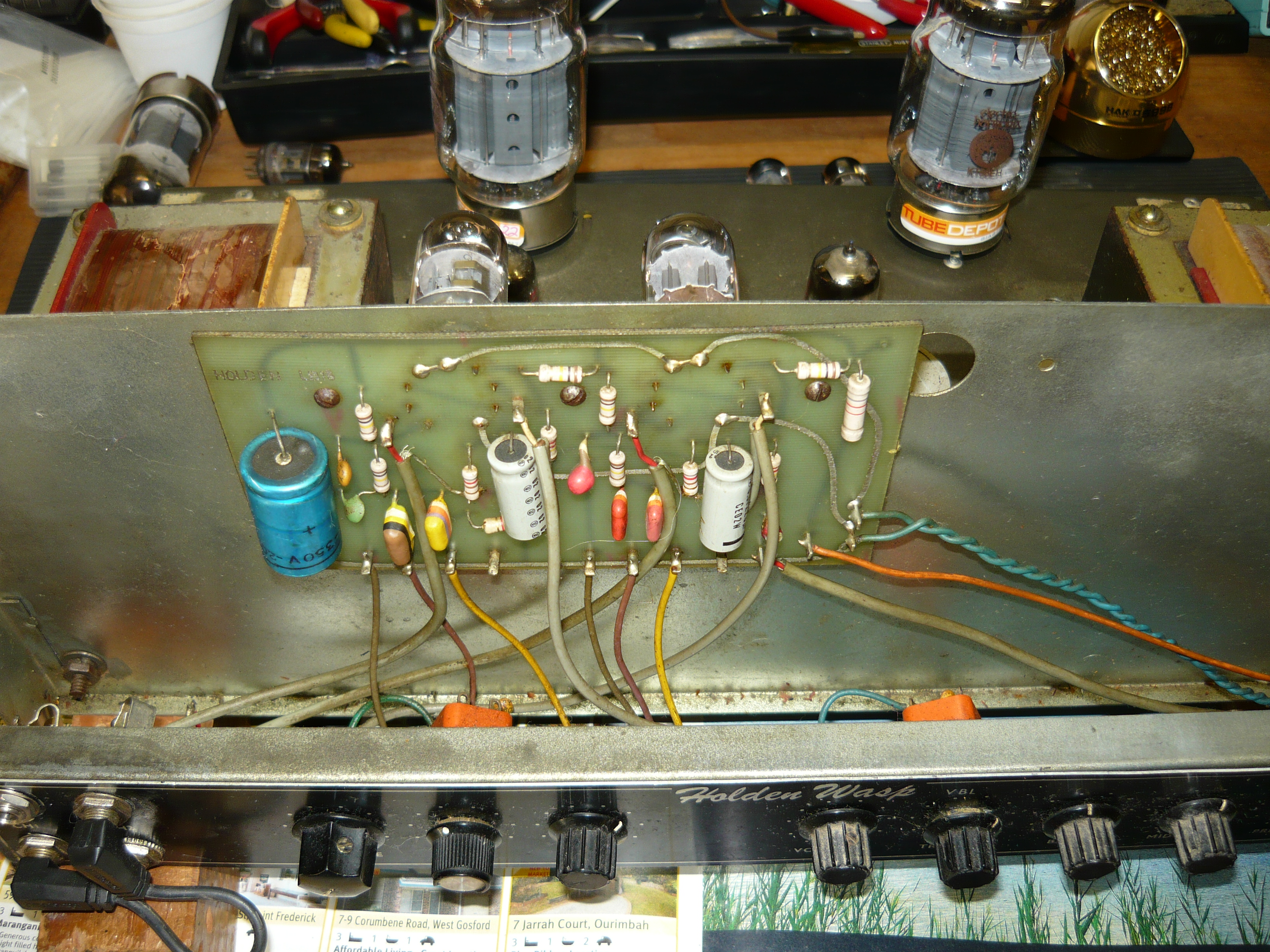
All the Wasp amps that I can remember seeing had two discrete preamps, a British voiced channel and a California voiced channel, with a 12AX7 valve (tube) each. There is an active prescence control in the power amp circuit as well. The preamps are in-phase so they can be patched together for a bigger sound. All circuitry is on p.c.b.’s. The preamp board is mounted vertically on a shield between the preamp and the transformers. Not a bad idea except that the shield is not very rigid. The valves are nearly always microphonic and well past their prime. The 9-pin sockets will benefit from a clean as well. The phase-inverter and driver stage valves are on p.c.b. mounted sockets as well, but closer to the output valves. A quartet of KT88’s benefits from being driven from a lower impedance. The Wasp amp used two valves to implement the phase-inverter and cathode-follower driver stages. Some amps used a pair of 12AX7 valves for this, and the later amps used a 12AT7/ECC81 phase-inverter, followed by a 12AU7/ECC82 cathode-follower. This is good engineering practice – 12AT7’s and 12AU7’s in particular are superior to the 12AX7 as a driver. Unfortunately, the chassis is NOT labelled to indicate which valve goes where, and just about every single amp I have ever seen has these valve positions accidentally reversed ! You can see what I mean about taking your amp to a tech who has the knowledge and experience to deal with the idiosyncrasies of your particular model. This particularly applies to VOX AC30’s/AC50’s down through the years, and all the vintage Aust/NZ valve amps.

The owner of the amp you see in the photos was on a rather tight budget, so we just took care of the most important things, and left capacitors/jacks/pots for another time. The work carried out included clean chassis and valve sockets, new 240V 3-pin plug, electrical safety testing, 1 very microphonic 12AX7 valve, replace pair of screen grid resistors with 1K w.w. ceramic, install matched pair KT88 valves & rebias amp, power output test 100W, burn-in test, final play test OK. Thanks to Jacob for providing us with today’s blog. Apparently Jacob inherited this amp from his dad, who must have been using it back in the roaring 70’s !