Archive for the ‘Amps’ Category

Major overhaul for a 1970’s MusicMan 130W amp

September 25, 2011

This week’s blog examines a major repair completed this week to a MusicMan 130W 2×12 combo, purchased brand new from Harry Landis Music in Sydney (Australia), and still owned by this customer. These 1970’s manufactured MusicMan amps were among the best of the American amps of that time, and were certainly built to last the distance. They were built to a very high standard by people who knew what they were doing. Probably the most popular and most collectable model was the 65W 2×10 combo.

The highly reliable and great sounding MusicMan chassis was let down to some extent by pretty average speakers, especially in the bass guitar models. You will often see that the original speakers have been replaced, sometimes quite early in the working life of the amp, or in the case of the amp heads you will almost always see them hooked up with a different brand of speaker cab. Not surprisingly, the MusicMan amps strongest appeal was their great “clean” tone, reminiscent of the very best of the Fender tones. When it comes to overdriven sounds………..forget it !  You will need your pedals for that.
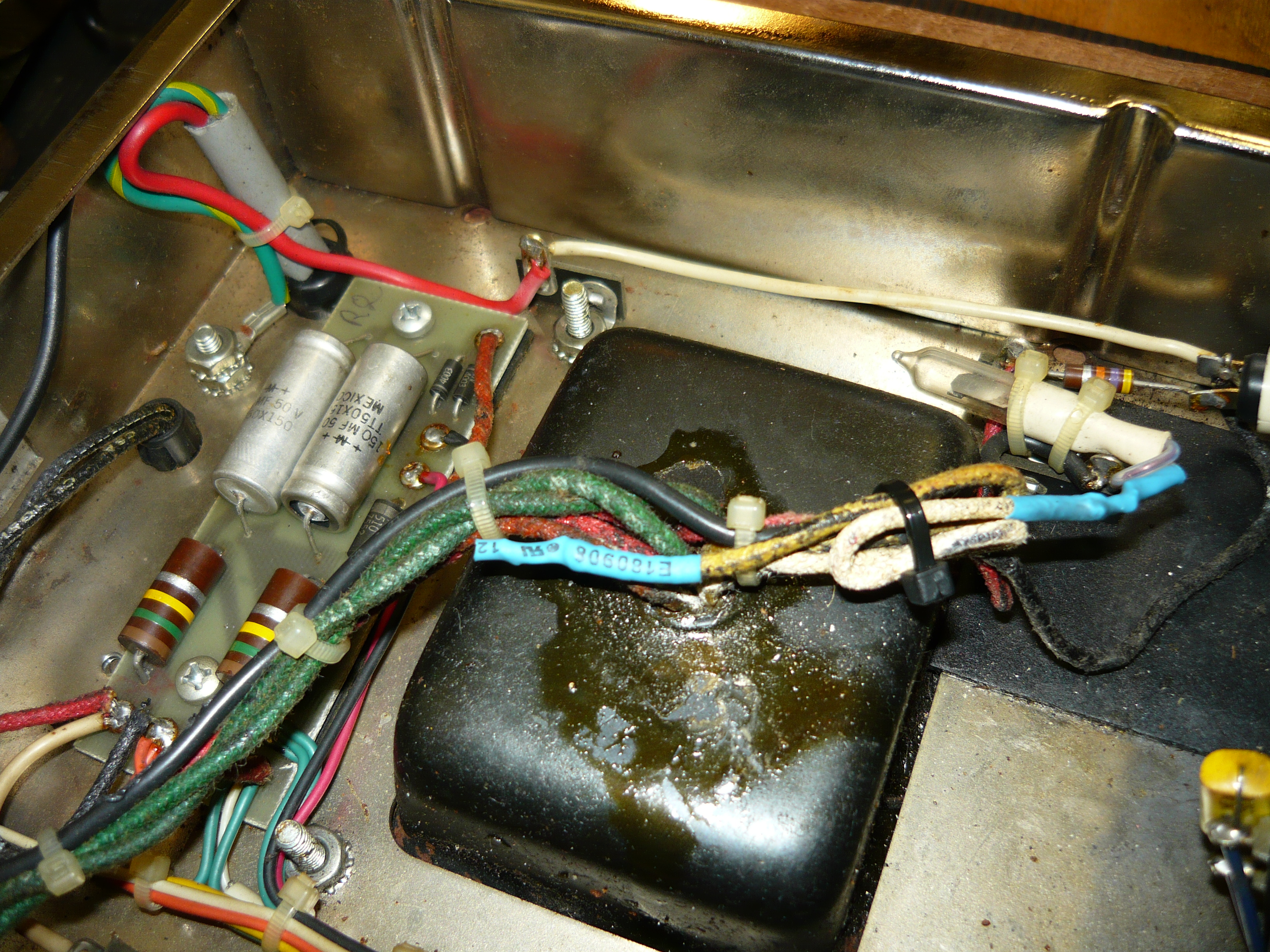
What style of guitarists love their MusicMans ? Most probably those playing country rock, rockabilly, old-school rock and blues and any traditional roots music styles. The 130W model is clean enough for keyboards, too. This particular example was damaged some years back at the Goulburn (NSW) Blues Festival. It was quickly patched up to get through the gig, but this amp as is would never pass an electrical safety inspection that meets Workcover NSW compliance.

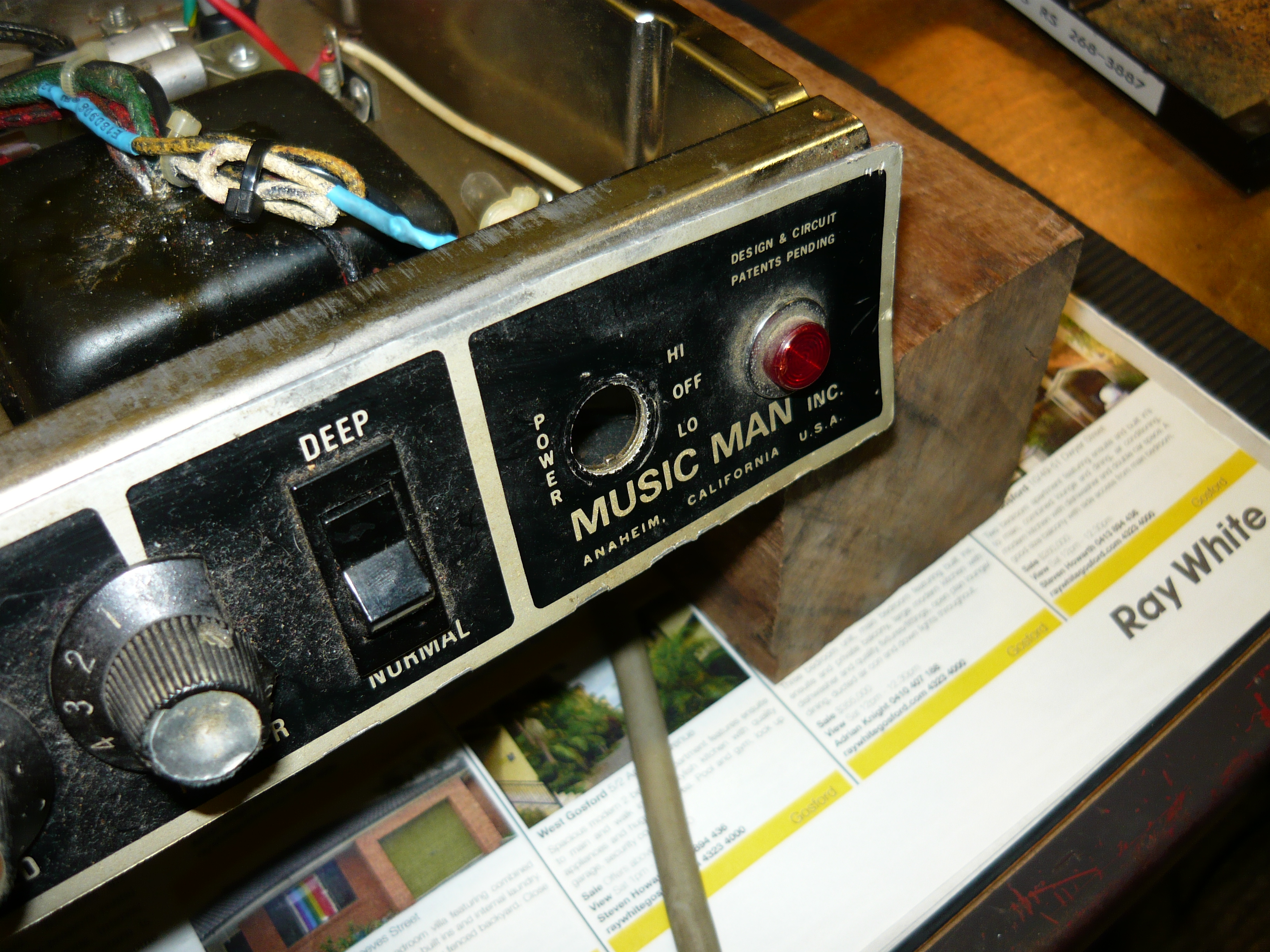
You can see from the thumbnails there are quite a number of outstanding service issues to be resolved. Firstly, there was some doubt as to whether the power transformer itself was 100% functional, as it had temporarily been rewired for half-power only. The wiring and general internal appearance of the transformer looked pretty crusty. I had to suss out the colour code for the primary connections in order to make any sense out of the situation.
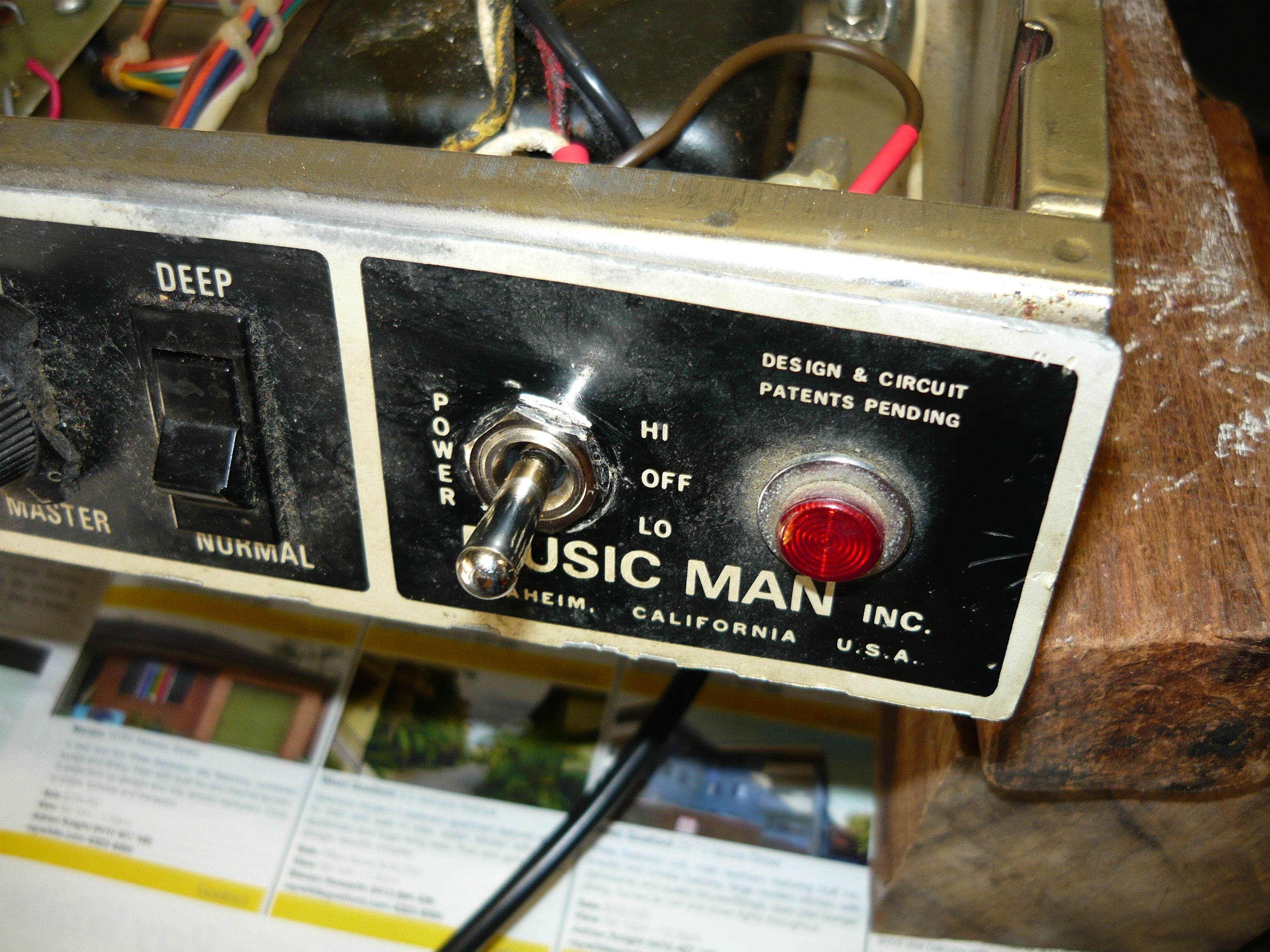
Having achieved that, the first step was to replace the damaged 3-core 240V flex and 3-pin plug, and to make a new chassis earth connection which would achieve compliance testing. This involved rewiring the fuseholder as well. Beware: the fuseholders in some older amps are not wired in a way that meets electrical safety standards, ie they are wired so that the outer part of the fuse remains active, even if the fuse is blown. If this is the case, the wiring should be reversed. The fuse should also be wired in series with the 240V active (brown), NOT the neutral (blue). Refer all such issues to an experienced and trusted technician !
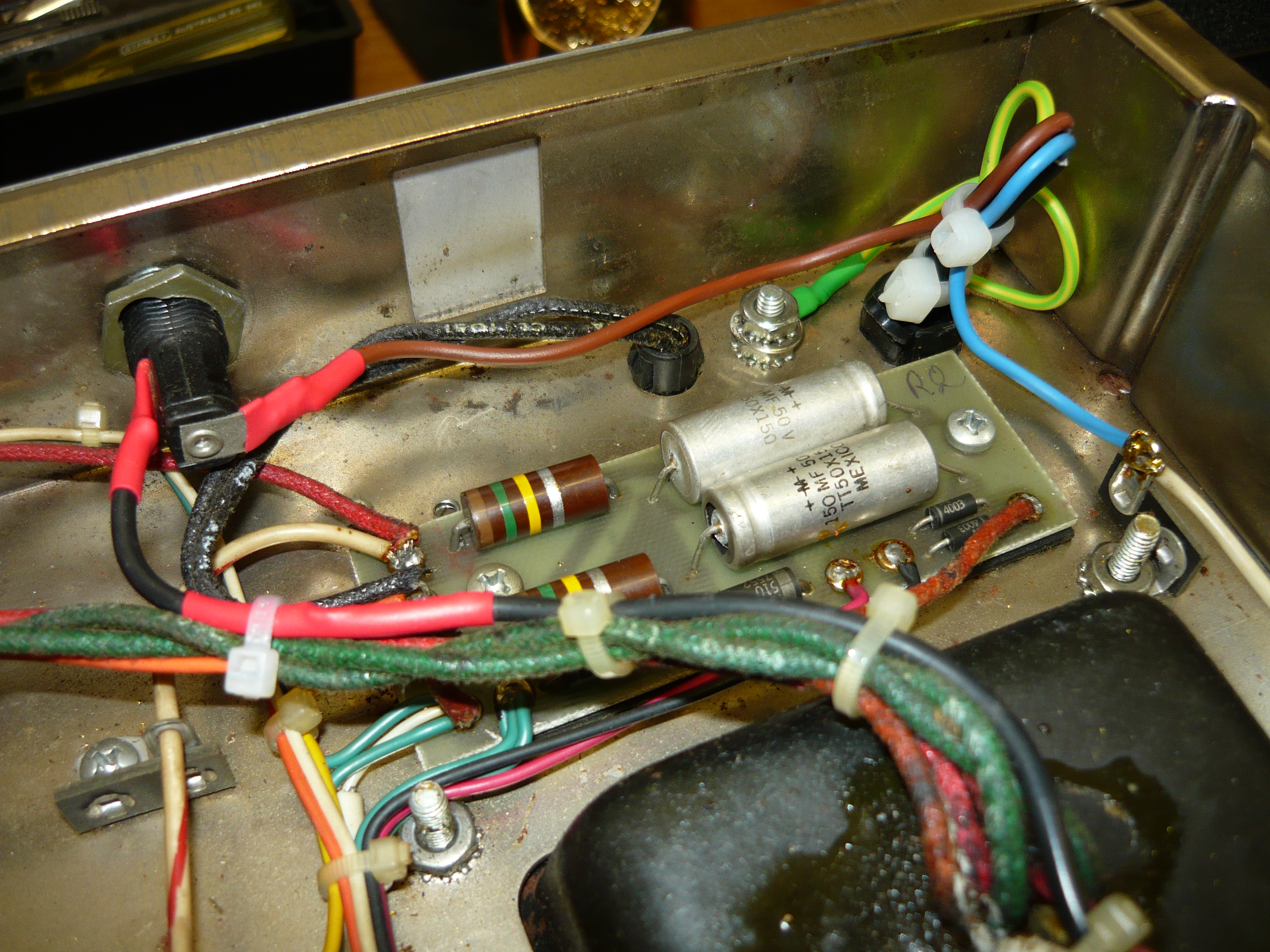
The next step was installing a new power switch on the front panel. This is actually a 3-way SPDT toggle switch with a centre-off position, labelled HI/OFF/LO. What is actually happening is the incoming 240V AC can be switched to either one of two primary voltage taps, which gives higher or lower internal DC voltages to power the EL34 output valves (tubes). In all cases we insulate the high voltage connections with heatshrink.

The unusual design feature of these amps, apart from a completely solid-state preamp, is the fact that on the HI power setting, the EL34 output valves have +700V DC on their anodes, and +350V DC on their screen grids. You cannot install cheapo valves in this amp and expect them to last very long ! Stick with brands that have a proven track record in reliability, for example JJ are a good choice for this amp. The next step was to replace a number of electrolytic capacitors in the high voltage (HV) and low voltage (LV) power supplies, all of which were still original and starting to look very crusty indeed.

The HV supply requires a pair of 100uF/500V capacitors in a voltage-doubler configuration for the 700V supply, and a pair of 22uF/500V capacitors after the filter choke for the screen grid and phase-splitter supplies. For the bias voltage supply we needed some 100uF/100V capacitors. The HV supply caps are mounted in their own “can” on the top side of the chassis.
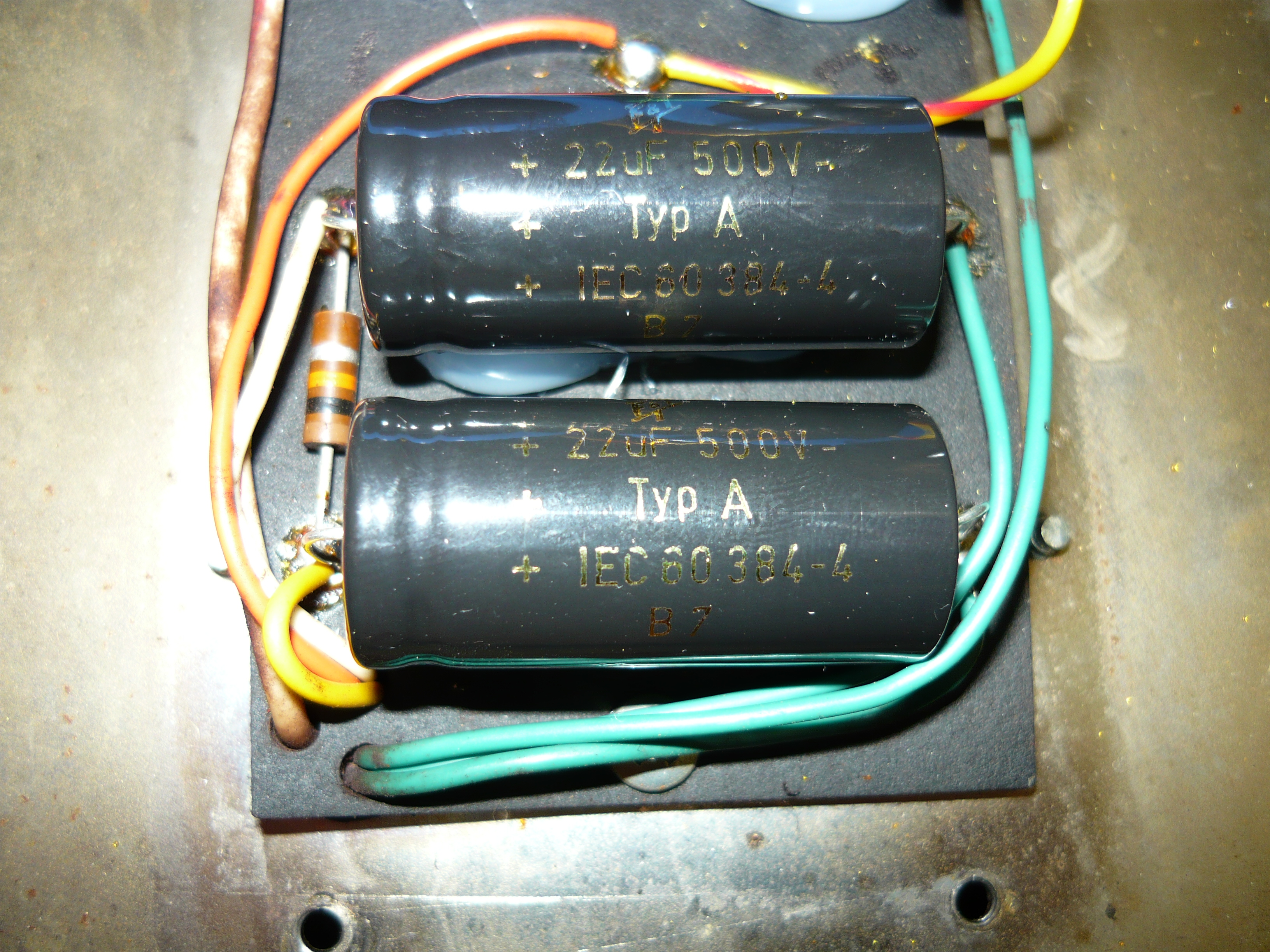
All the capacitors were bedded down in some silicone to keep them secure and to take the strain off the leads. For DIY people out there, always make sure that you use “neutral cure” silicone, ie non-corrosive, or you might be in for a nasty surprise in the long-term.
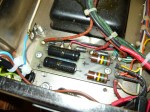
Equally as important as the HV supply capacitors, is the replacement of the LV supply caps, which in the case of the MusicMan amps, shares some common circuitry with the bias voltage supply for the EL34 output valves (tubes). Rock-solid biasing of the output valves will depend on the quality of the bias voltage supply.
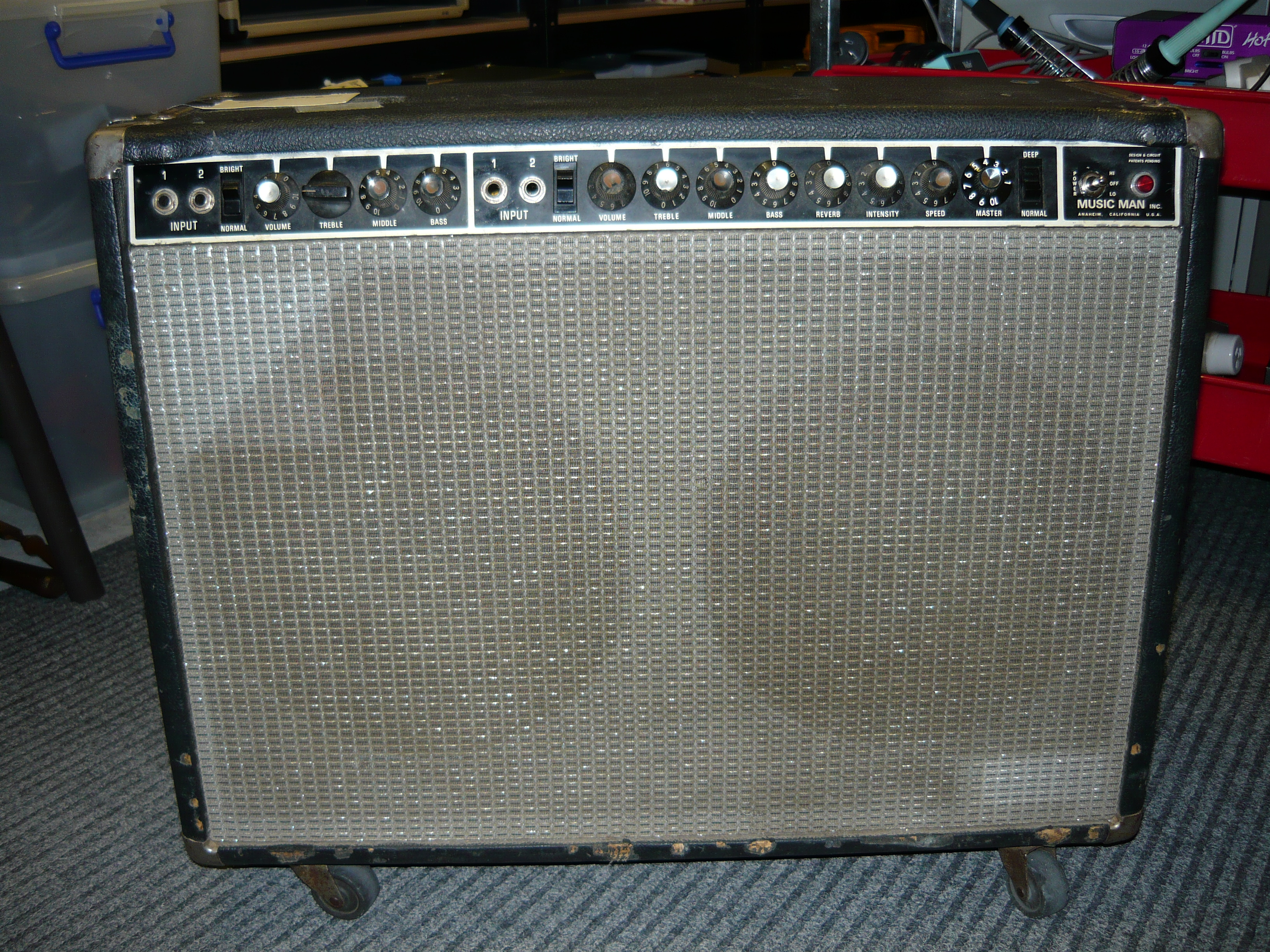
Well, to wrap it all up, I cleaned up the input and output jacks with DeOxit, and installed a JJ 12AX7-S in the phase splitter valve position, and installed a matched and burned-in quad of JJ EL34 valves in the power amp sockets. I set the bias for the EL34’s for 25ma cathode current each at 700V HT, as per the original spec. This is quite adequate at 700V. A power output test and burn-in test is then carried out – the amp is hooked up to an 8 ohm dummy load and a signal generator connected to the input jack. Observation of the sine wave output into 8 ohms reveals a clean signal and a power amp that reaches the onset of clipping at approx 120 watts rms. The power amp drops into “class-B” as we get closer to maximum power output, as expected.

The final play test was fine – the reverb and tremolo both work OK, although the solid-state reverb is not comparable to the valve-driven reverb on a Fender Twin, of course. You may notice the customer had removed the MusicMan logo (which was a bit toy-town looking), and the top strap handle, which he didn’t trust to carry the weight. The original speakers were replaced long, long ago with a pair of Etone 12-inch speakers, manufactured in Sydney. As a proud Aussie, I would like to say that the Etones sound great, but the reality is these speakers do absolutely nothing for this amp. They sound rather flat and overly bright. In order to demonstrate this to my customer, I played a TELE through the amp as is, then hooked up my workshop speaker cab, which is loaded with a 100W 12-inch Jensen NEO, and the difference in tone, complexity, and sheer volume was quite obvious. Perhaps this will be the subject of a future amp/speaker upgrade ?? See you next week – Ivan.
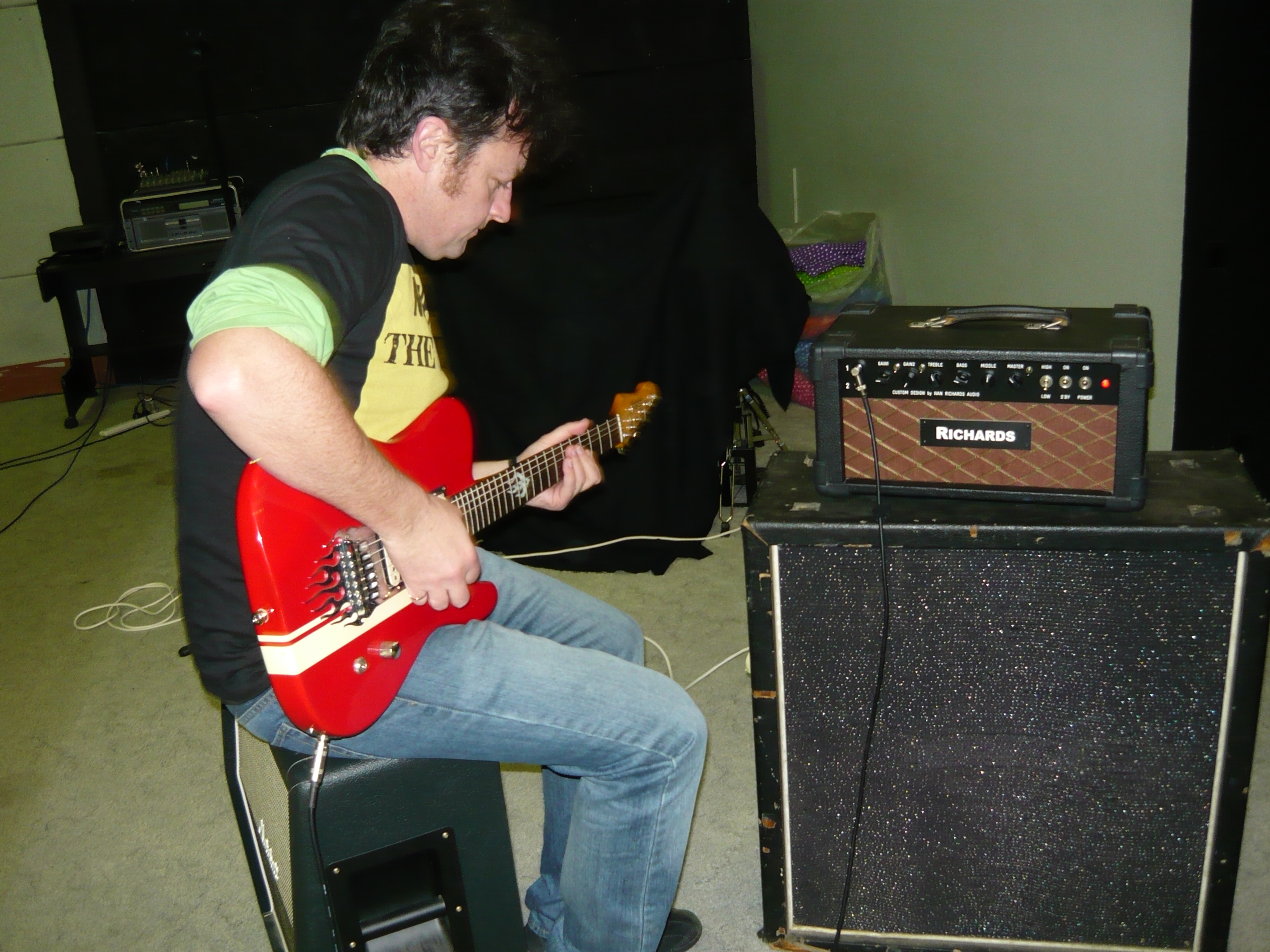
Bob’s “Lil’ Buddy” amp returns to HQ for a complete overhaul

September 17, 2011

This is actually the very first amp I designed and built for Bob Spencer, a much loved and admired Aussie rock guitarist formerly of such bands as Finch, Skyhooks, The Angels, etc, and more recently RAW BRIT, as well as facilitator/coach on the Weekend Warriors programme in Melbourne. This amp was built back in 1997. We actually met in 1995, when Bob was recording the Temple Gods album, in a studio somewhere on the Hawkesbury River. He showed up at my house in Gosford at about 11 o’clock at night, to get a modification done to his AC30 clone amp (built by Ross Nichol in Melbourne, I think ?). This is how you meet guys like Bob !!

This was at the time when I was working from the kitchen/family room of our house in Wyoming (NSW) – there were amps waiting repair from one end of the house to the other, and amp parts stored in every room of the house – even under the kids’ beds, etc etc. Not the ideal way to live, and eventually I rented my current workshop space. Anyway, Bob made himself at home in the kitchen, my wife made us cups of tea, and I got on with the job. Bob obviously liked what he saw and heard, and kept making the trip up to the Central Coast whenever he needed something done to his amps and pedals.

Bob was living in Katoomba (NSW) at the time, in a charming house built 100 years ago or so. Once he discovered I built amps/pedals/power supplies, he started getting stuff custom-built. First up, he ordered  two rack-mounting preamps – the first enabled him to switch between a Hiwatt voiced preamp and an Ampeg voiced preamp. The second one enabled him to switch between two AC30 voiced preamps. Bob was the first customer to purchase my first two successful pedal designs in 1997 – the Rich Drive and the Rich Fuzz. We kind of agreed on what we were looking for in a pedal, as well as what was missing from commercial pedals, and a lot of collaboration went into those two pedal designs, especially the Rich Fuzz. I love that kind of stuff ! Both pedals are still available today (2011), and the designs have not been altered in any way, although the cosmetics continue to change.

Bob was building a home-studio in the house at Katoomba, and ordered a low powered amp (6V6 output valves) to drive a 1×10 cab housed in an isolation box. I originally built a switchable 8W/4W push-pull amp, based on the designs I was using at that time. This was well before the current craze for low powered amps. We soon realised, however, that a mere 8 watts wasn’t driving the chosen 10-inch speaker hard enough to achieve the optimal recording results when mic’d up ! There is definitely a lesson there for everyone. The power output was increased to 12 watts, and then 15 watts, substituting different transformers. The circuitry itself stayed the same. Why is the amp called the Lil’ Buddy amp ? It’s because at that time I was calling everybody my little buddy – regardless of how tall they were. Something to do with a 70’s TV situation comedy called Gilligan’s Island. Thankfully, I have stopped doing that.

This amp was used for recording of course, but also gigs, rehearsals and teaching. I recall seeing Bob’s blues band in a pub at Crow’s Nest (Sydney) years ago, using the Lil’ Buddy driving a Wasp 250 watt/4 x KT88 amp used as a slave, into a pair of 2×12 cabs, loaded with Etone speakers (from Peakhust/Sydney, no longer manufactured). What a sound ! Some noise complaints, though. How rude ! At the beginning of this millenium, Bob & missus relocated to Melbourne and also ordered firstly an 85 watt/4 x KT66 amp which is currently Bob’s stage amp, and secondly a 28 watt KT66 amp. Both amps were custom designs employing baxandall EQ, and other features unique to Bob. The Lil’ Buddy amp fell into disuse for many years.

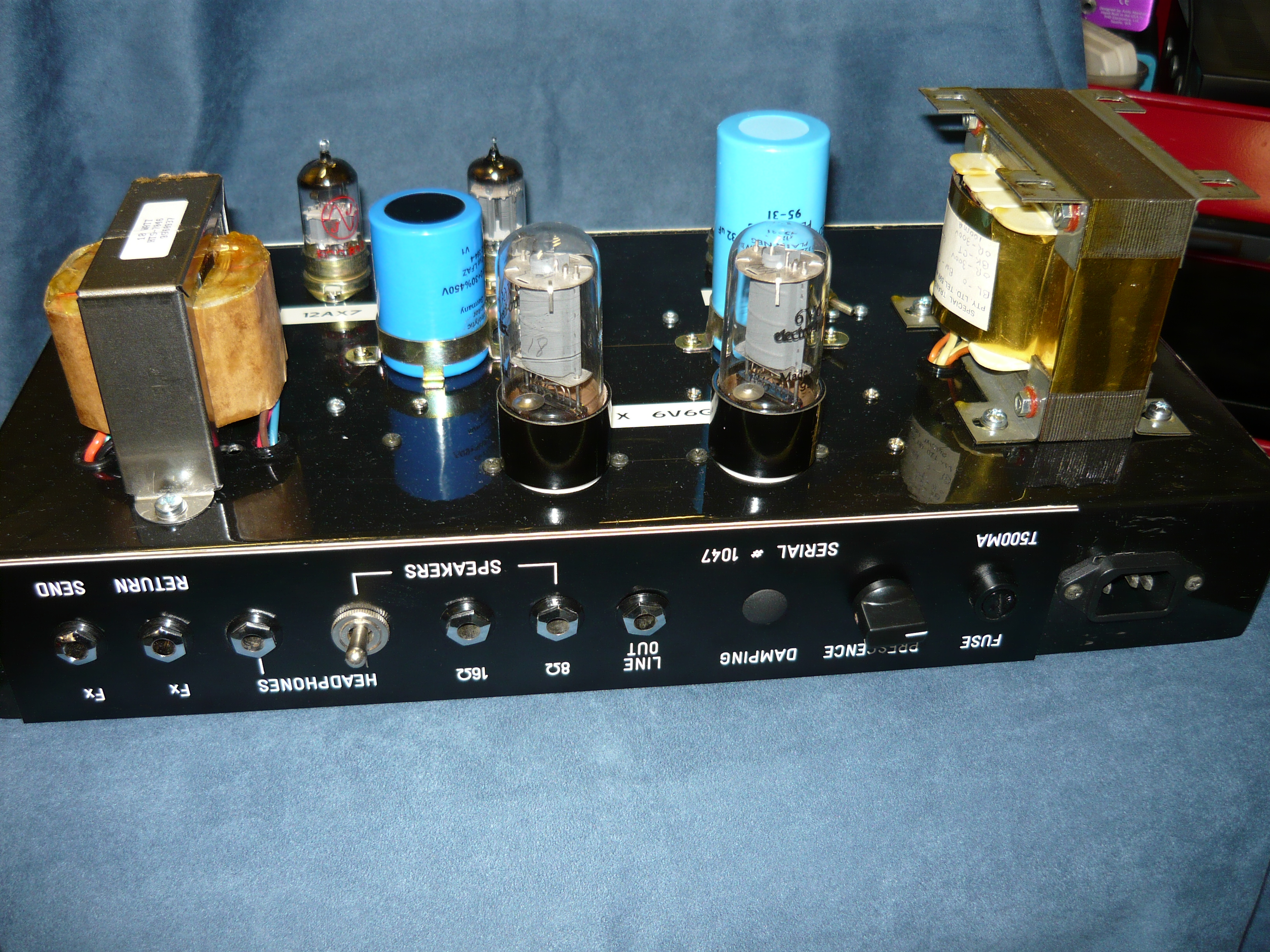
So where do we stand right now ? Well, Bob and Paulene are in their new residence in Melbourne, and Bob is setting up a new home studio and is preparing to do some recording, so there is a valid reason to refurbish this amp and bring it into line with the current Richards amp range. Although this is still a custom amp, it will be somewhat similar to our Blue Mood models. As you can see from the photos, new component panels have been pre-wired to install in the chassis. The amp also has received a new output transformer (a critical component in any valve amplifier), new pots/jacks/capacitors, and so on, plus a bit more attention to electrical safety issues, in line with today’s compliance environment. The power transformer on the chassis was the third such unit, this one giving us slightly over 15 watts rms.

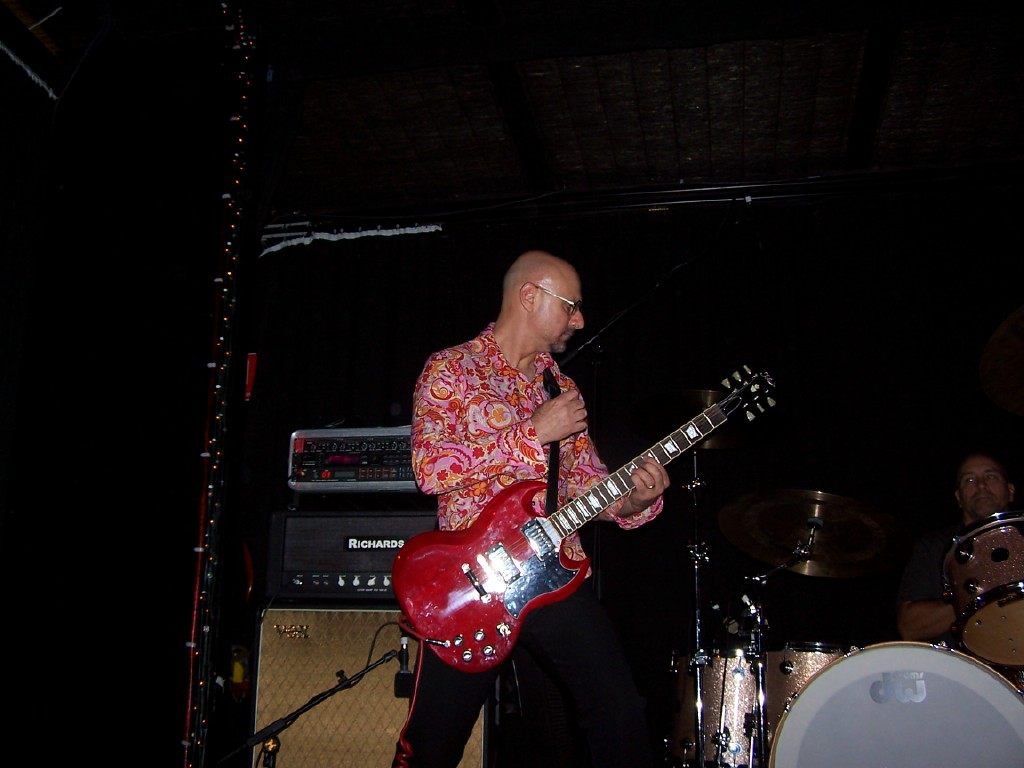
Some of you will have noticed a Headphones switch on the rear panel – unusual in a valve amp – this switches the ouput to a resistive load and attenuator, so the amp can be operated safely but at headphone levels. The Headphone jack can still be connected to a speaker in this mode of operation. So who is the guy playing the Craig Upfold custom Tele in the first photo ? This is Jonny Gardiner, creator of the Rock God Music School here in Wyoming, and also the singer/guitarist with successful Sydney-based band The Nevilles.

Jonny was kind enough to give us his review of this amp after the update was completed. These are his impressions:-

“this amp has the warmth of a Vox but with more clarity (and also more gain), ie the individual notes really ring through ! this amp’s forte is those delicious sounds inbetween clean and dirty, ie the crunch sounds ! a satisfying aspect of the amp’s performance is that you can control your dynamics with pick attack ! (ie the amp has great touch sensitivity)”

To finish off the blog, we have a photo of Bob playing with RAW BRIT in Melbourne with his Richards 85W/4 x KT66 amp head. Some great live videos of RAW BRIT in action have been uploaded to youtube.com, so you can check out these great players doing their thing.

Do we cater for the metal head ?

September 11, 2011

Yes !  We offer our repair services and custom-design/custom-build services to every type of musician who is reliant on musical-instrument amplification, and in particular amplification that is based on vacuum-tube (thermionic-valve) technology. As it happens, there is also a breed of amplifiers out there, marketed at the heavy-metal guitarist, that is primarily solid-state in design. We will also service many of these products. Check with us first, if in doubt.

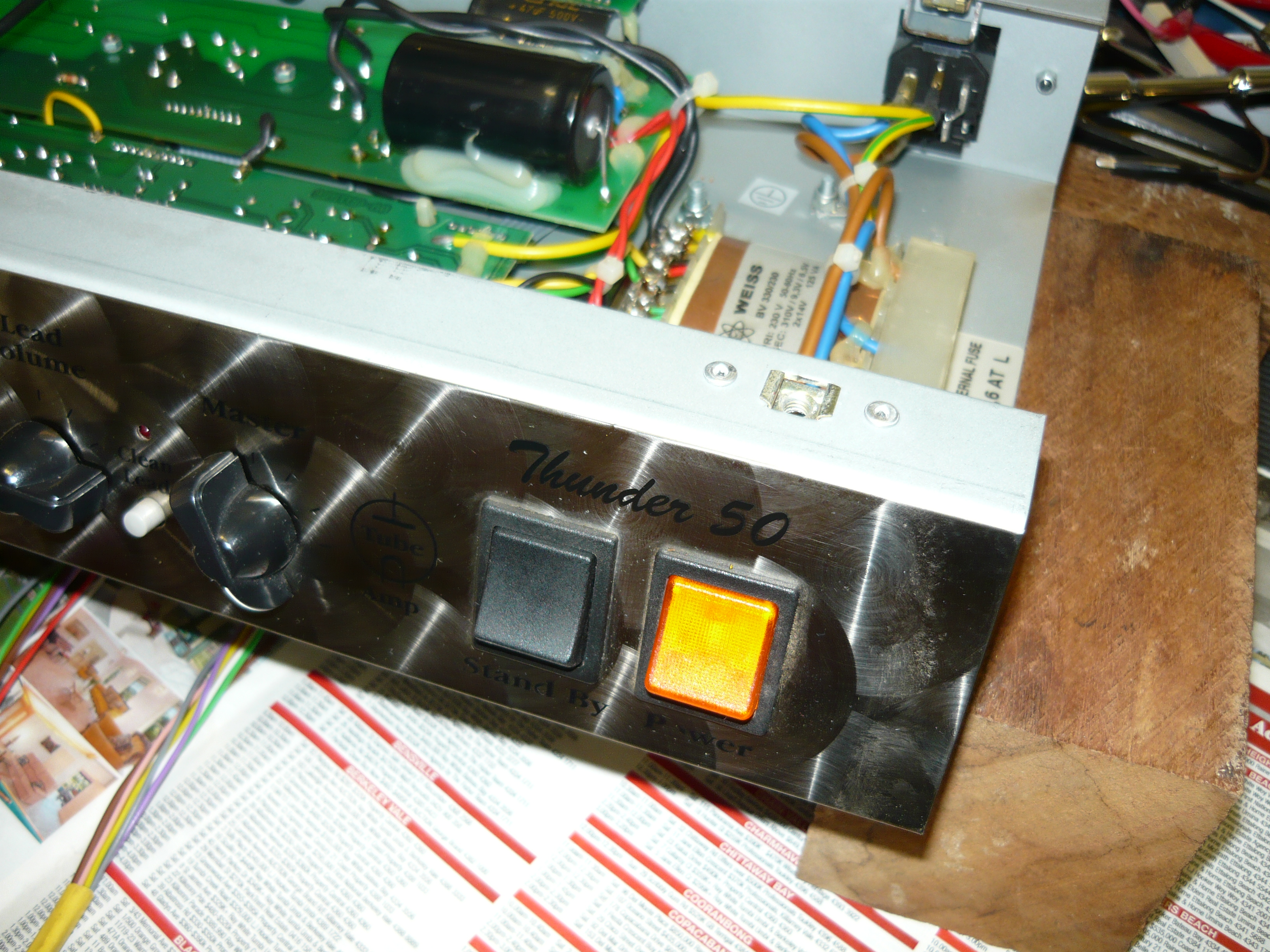
As you can see from the photos, the inspiration for today’s blog is a recent repair to an Engl 50 watt (all-valve) head. My general impression of the Engl amps is that the standard of construction is a bit cheap and there have been some reliability issues along the way. This is all the more surprising considering they are designed and manufactured in Germany. Every Engl repair we get seems to require a mod to the power supply and/or the bias supply, in the latter case this is because usually you can’t get a wide enough range of adjustment to bias up an amp with new output valves properly (normally Engl’s are loaded with 6L6GC valves, or equivalent). I have found the JJ 6L6GC to be the ideal replacement output valve for these amps. If you have more money to spend, a great sounding alternative is the Winged-C 6L6GC (formerly SED), from St Petersburg, Russia.

The single biggest problem impacting on long-term reliability is the fact that the power output valves are printed circuit board mounted. Given that the Engl chassis is top-mounted in the cab, and the power output valves hang down from the chassis, then the heat from the valves naturally goes up into the chassis, and in particular into the printed circuit board. The output valve board can get so hot that critical components actually desolder themselves ! This was a common fault when these amps were first introduced into Australia a few years back – the screen grid resistors would desolder themselves, possibly even falling off the board, and the affected valves would stop working. The good news is we can do our best to bullet-proof your amp to improve reliability.

Some other brands of amps that we have serviced that are appropriate to this genre of music woud include (in no particular order):- MESA, Blackstar, Laney, Hughes & Kettner, Randall, Crate Blue Voodoo (serious reliability issues), Bugera (serious reliability issues), Egnater (serious reliability issues), Cornford, Marshall JCM800, JCM900, JCM2000 (some models of JCM2000 reliability issues), and also the JCM600 (serious reliability issues). There are others, this list was just off the top of my head.

No discussion of amps for the metal player would be complete without the mention of the Peavey EVH120, known variously as the 5150, 5150 II, 6505, 6505+ amps. The 5150 II model seems to have got the thumbs up from any of my customers that own this amp. In response to customer demand, from young metal bands recording their own material and wanting to achieve the best recorded performance from these amps, we have been offering a range of mods and upgrades to these models.

Any upgrade would obviously include valves (tubes). There is such an excess of gain in these amps that valve (tube) microphony becomes a major issue. Therefore we have put the replacement 12AX7 valves through our own selection test. On the short list of valves are the JJ 12AX7 and 6L6GC, also the Winged-C 6L6GC, the Tung Sol reissue 12AX7, and we are about to trial a new 12AX7 valve (tube) released by TAD, specifically intended for such demanding applications.

Other requested upgrades include power supply capacitors, bias circuit modification for greater range of bias adjustment, and the installation of a Mercury Magnetics MC10 power choke in the power supply, in lieu of the standard resistor. One last upgrade for those of you resident in the land of Australia who have purchased their amp via the internet – we can install the factory supplied 240V AC mains transformer, so you don’t have to lug around that heavy and inconvenient step-down transformer.

That’s it for tonight’s blog – please feel free to submit suggestions re other amps that you feel should have been mentioned, and/or contact us re your specific amp problemos. Perhaps we can make a big difference. By the way, for those of you who are into 70’s and 80’s metal, we do build amps to special order which are inspired by the great Marshall JMP amps of the mid 1970’s. We can nail that sound plus no more reliability issues.

Barry takes delivery of his new 2X12 Tone Cabinet in white tolex

September 8, 2011

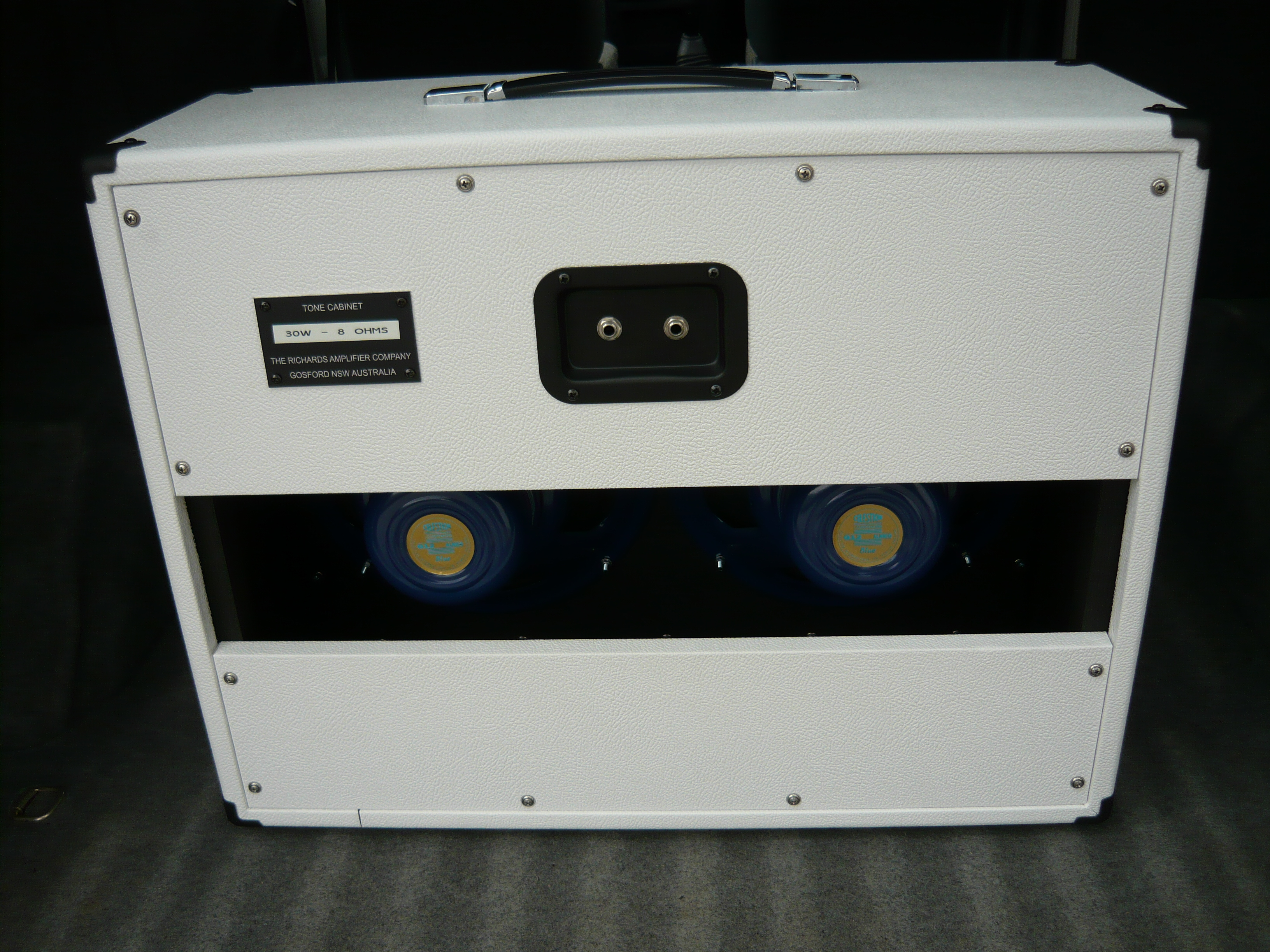
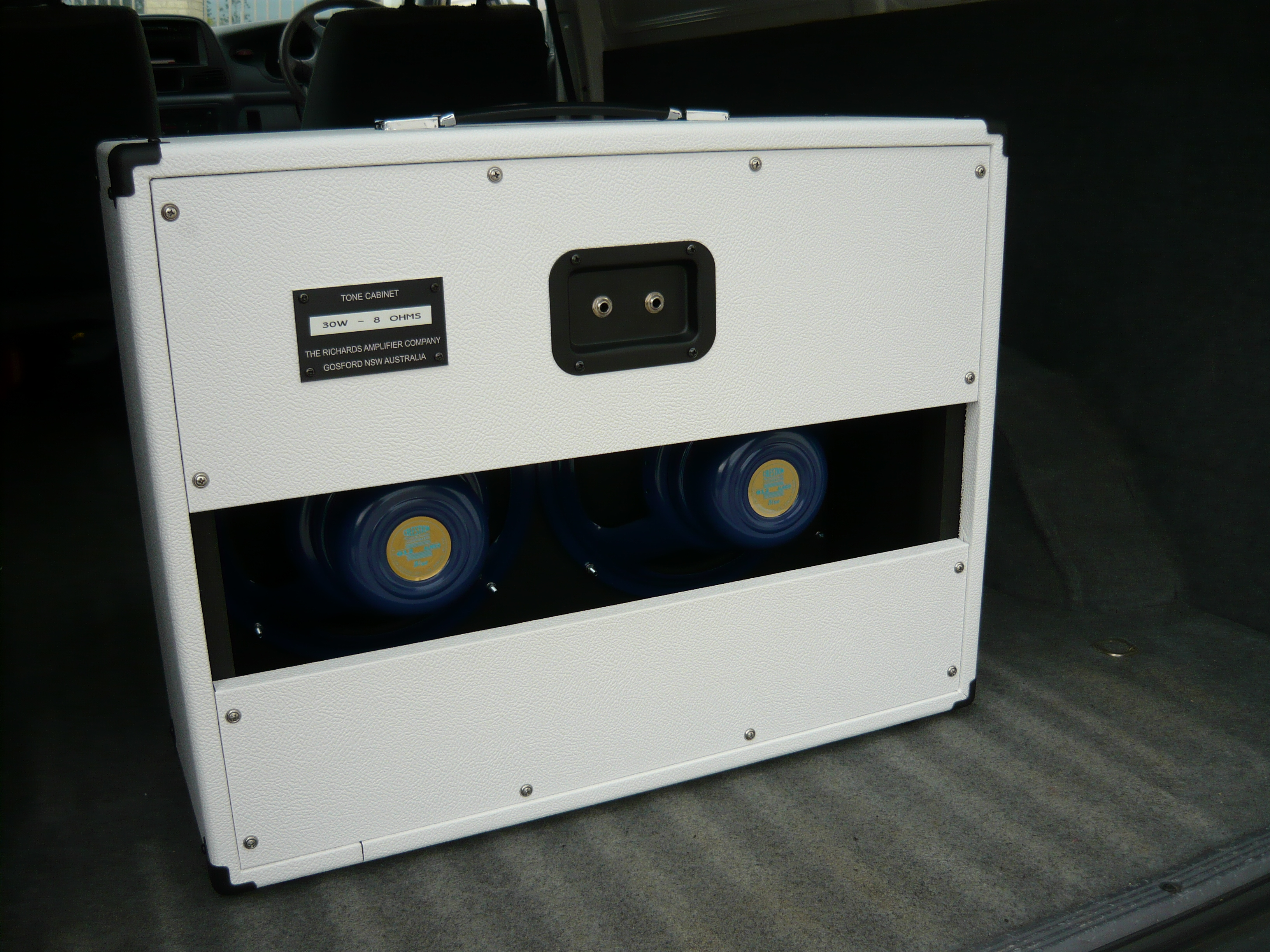
Barry Wellard, one of our local rock’n’rollers here on the New South Wales Central Coast, today took delivery of his 2nd 2×12 Tone Cabinet. This cab features vintage white tolex covering, nicely contrasted with a black & gold speaker grille, top strap-handle at Barry’s request (we also offer heavy-duty metal side-handles from Penn), and is presented in the TV Front style. Various other options are available.

The cab is loaded with a pair of the wonderfully musical Celestion G12 “Blue” Alnico speakers, resulting in a cab power rating of 30 watts total, and a cab impedance of 8 ohms (parallel-wired 16 ohm speakers). The rear panel heavy-duty metal jack plate features a pair of parallel-wired jacks to facilitate connecting an additional cab. These speakers will enhance the tone of just about any amp !

The dimensions of this cab were optimised to suit the chrome-plated speaker stands made for members of The Shadows club in Sydney. These stands replicate the look of the stands used by groups such as The Shadows & The Beatles with their Vox amplifiers back in the 60’s.

Barry currently owns two Richards amplifiers: a 30 watt Expressionist (4 x EL84) head with EF86 and 12AX7 channels, plus the custom addition of reverb, as well as a custom-design variation on the Blue Mood series amps loaded with a quartet of 6L6GC output valves for a very conservative 60 watts output. This latter amp was specifically design for Barry’s rhythm guitar playing style to facilitate huge chord sounds with lots of clean headroom.

Every purchase of a Tone Cabinet from the Richards Amplifier Company Australia includes a complementary speaker lead. Heavy-duty lined covers are available as an optional upgrade. Cabinets are available in 1×10, 2×10, 1×12, 2×12 and 1×15 semi-open-back format, constructed either from furniture-grade ply with a choice of tolex coverings or exotic Australian natural timbers as an optional upgrade.

Barry is a founding member of The Rebel Rousers, a 50’s/60’s rock’n’roll band, and has recently acquired celebrity status by appearing in the pages of The Australian Women’s Weekly Magazine, see page 257 of the September 2011 issue. Barry has become famous not for his guitar playing, but for his dahlias, a variety of flower as supplied to Saskia Havekes, a prominent Sydney florist.

A Dr-Z MAZ38 (Senior) major repair completed

August 6, 2011

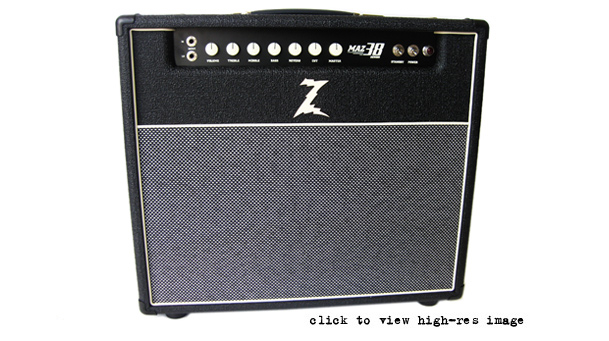
Yes, we specialise in the service & repair of boutique, ie hand-wired, all-valve (tube) musical-instrument amplification, including Dr-Z from the USofA. The subject of this week’s amp repair blog is a Dr-Z MAZ38 (Senior) 2X12 reverb combo, shipped up to our Wyoming (NSW) workshop from Sydney by a regular customer.

This particular MAZ38 was blowing fuses. There are actually two fuses fitted on the rear panel, one is the 240V mains fuse, the other is a secondary fuse for the high voltage supply, and would normally be around the 0.5A (500ma) value. In this case the mains fuse was blowing, although when I examined the HT fuse I found an 8A fuse rather than a 0.5A fuse, which would result in negligable protection.

The fact that the mains fuse was blowing tends to suggest a fault in the power supply, and this proved to be correct. The fault was isolated in a series of diagnostic steps to the power transformer itself, which had developed an internal short-circuit. The quad of EL84 output valves was still serviceable, but the GZ34 rectifier valve was definitely short-circuit. Was the GZ34 the original problem, or the transformer ? We shall never know, but this was developing into an expensive repair job for the customer.

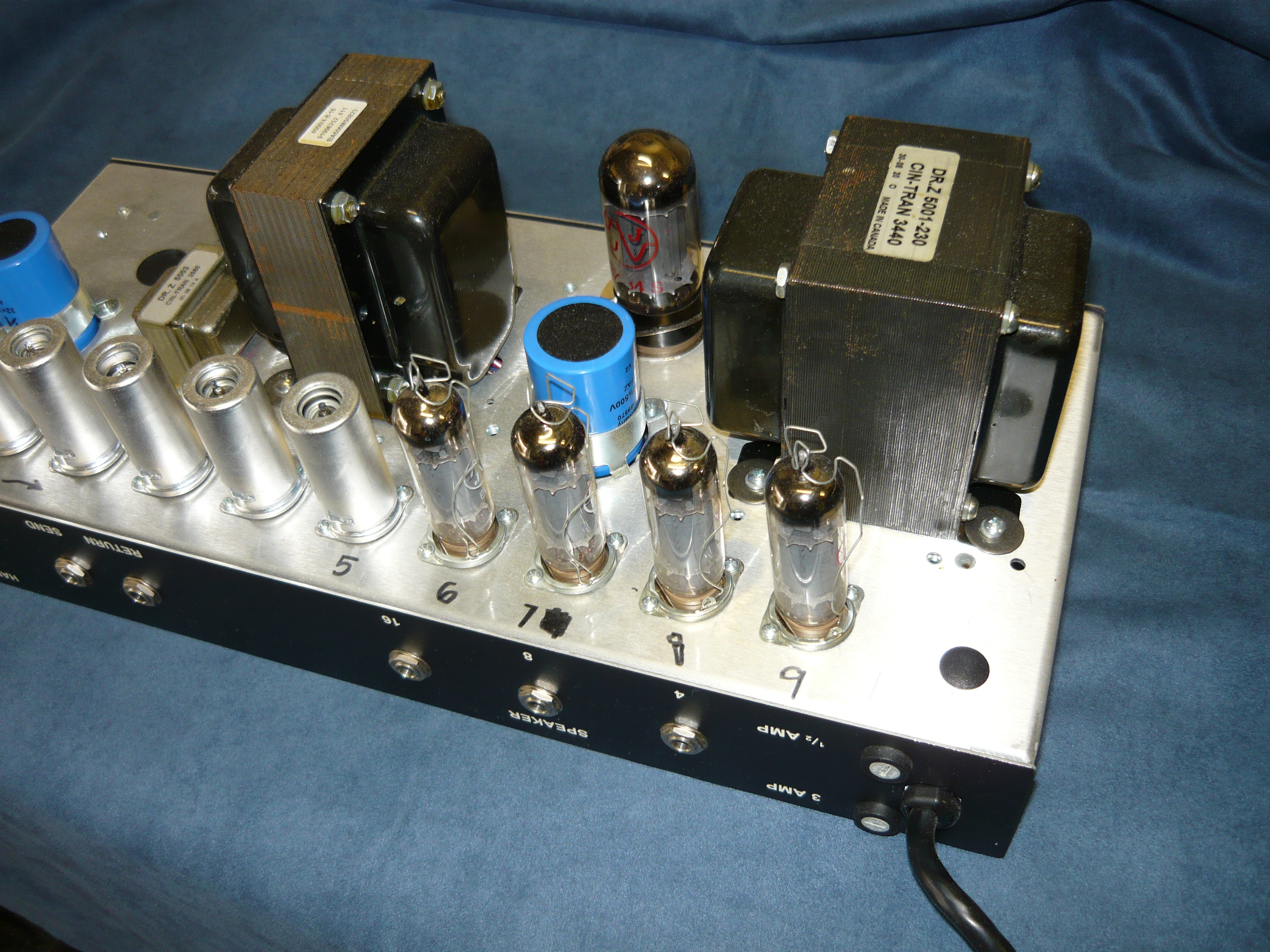
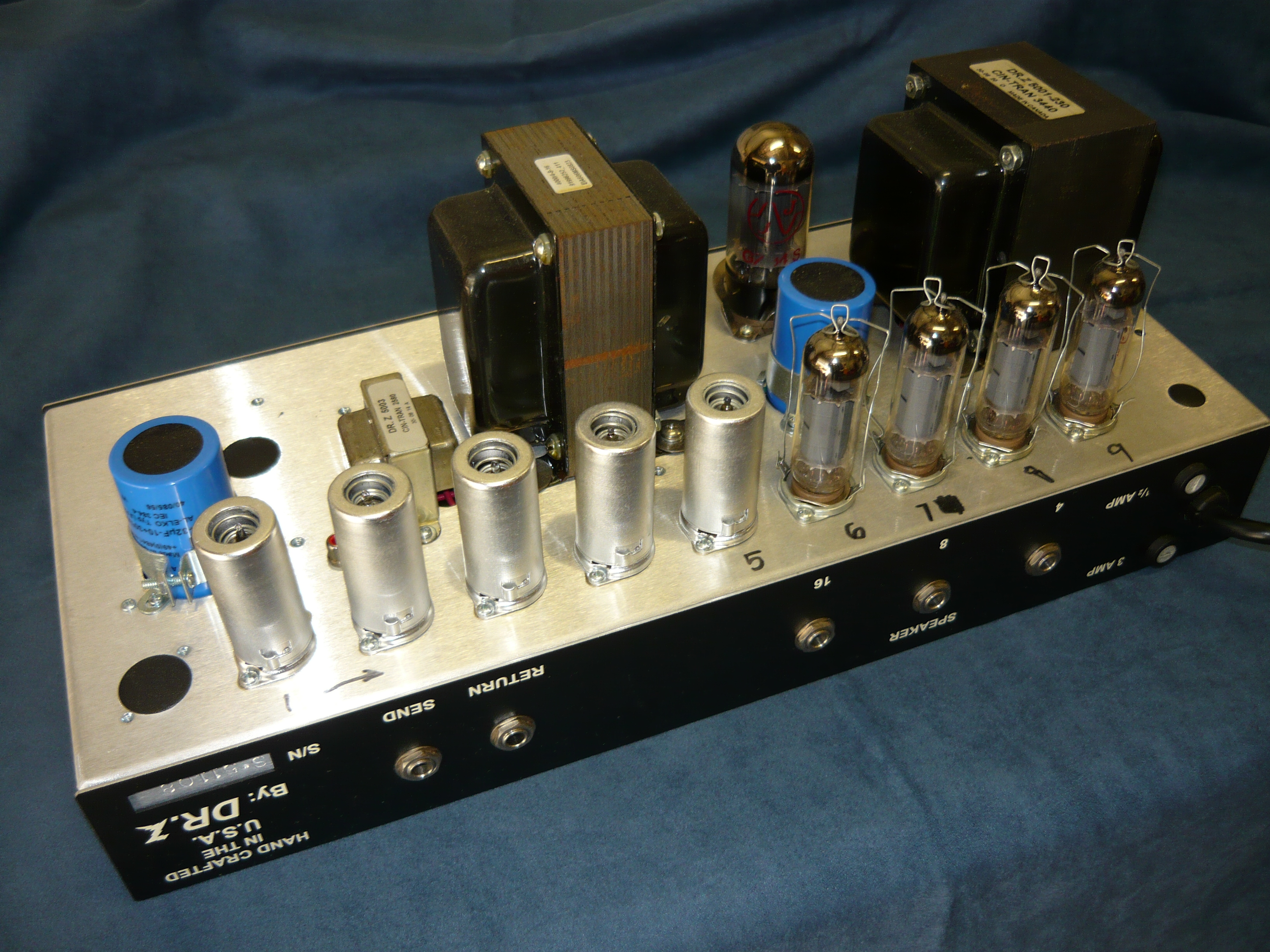
Removing the faulty transformer and installing a replacement was going to be a tricky operation, as access to where wires need to be disconnected and subsequently reconnected is limited. Most of the internal space within the chassis is taken up by a single large board holding the majority of the resistors and capacitors, with hand-wired connections from both sides of the board. The standard of construction as well as components is high, as you would expect, but access to some components for service is poor.

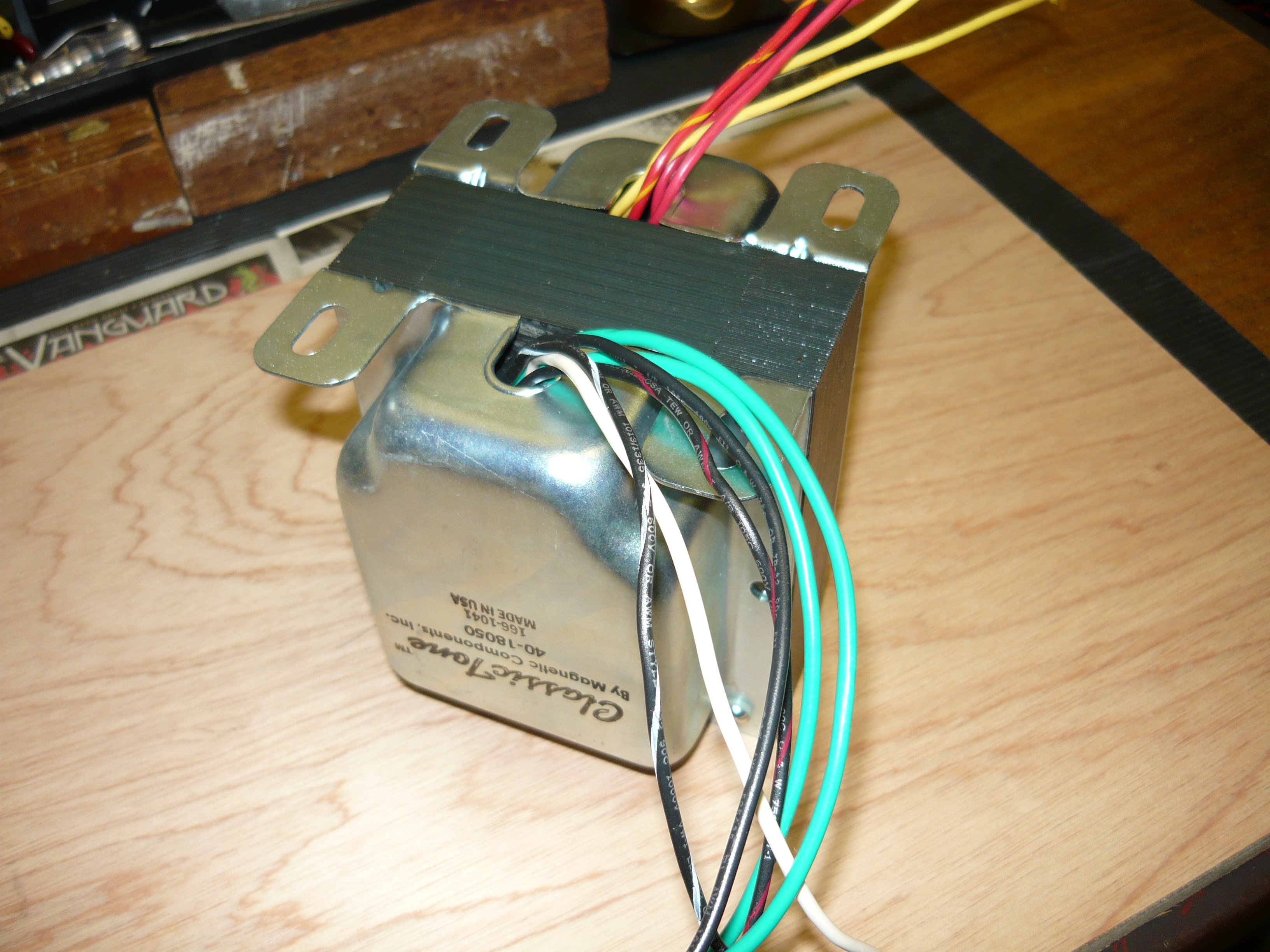
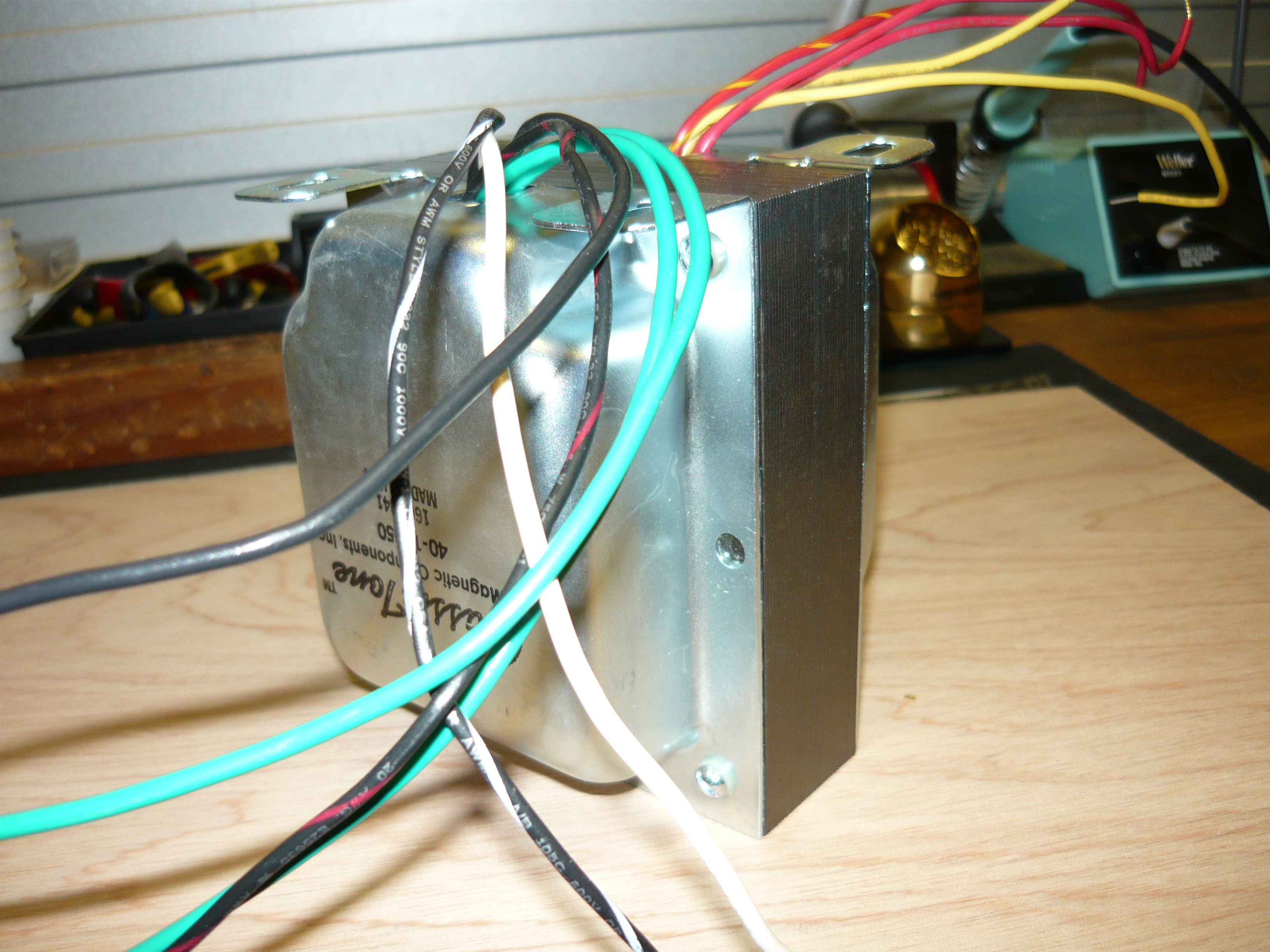
It turned out upon investigation, that the power transformer is rated at 230V AC. But, here in OZ our mains voltage is actually 240V nominal, but is often quite a bit higher than that, especially over in W.A. There was going to be a delay sourcing the original transformer from the factory anyway, and we wanted to move quickly on this job, so at the customer’s suggestion I selected an after-market replacement power transformer. I chose to install a Vox AC30 replacement manufactured in Chicago, Illinois USofA, by Magnetic Components Inc, and marketed under their “Classic Tone” series. I have sourced a transformer from this manufacturer previously with success, so I had no hesitation to use them again.

I originally read about Magnetic Components in TQR, by the way. Check out the transformer photos ! This monster is spec’d as per the original Vox AC30’s, but most importantly it is rated for 240V AC, by means of connecting the two 120V primary windings in series. In spite of the imposing bulk of this transfmr, I was able to locate it on the existing MAZ38 chassis, with a couple of additional mounting holes, and nylon grommets to feed the wires safely through the access holes. After making all the necessary connections, which included adding a pair of 100 ohm resistors to provide a centre-tapped ground connection for the 6.3V AC heater supply, and also installing a new JJ GZ34 rectifier valve (tube), we powered up the amp without any further dramas.

The amp chassis was subjected to the usual range of quality-control testing: power output test into a resistive load, burn-in test, electrical safety test (to Workcover NSW standard), and final play test into the amp’s own speakers. I was pleased to find that the new power transformer remained relatively cool during all this, one obvious advantage of bulky 50’s/60’s spec’d units with a lot of iron !

Many thanks to Shane for his continued custom and for providing us with this week’s amp repair blog. Please visit us again soon for more amp and pedal blogs, we try to create a fresh blog every week, time permitting.

Regards, Ivan.

A Testimonial to the Richards Expressionist Series Amps

July 24, 2011

Here is a testimonial ref the Studio Expressionist model amplifier, rated at 15 watts into 4, 8 or 16 ohms, designed and hand-wired, one at a time, by the Richards Amplifier Company – Australia.
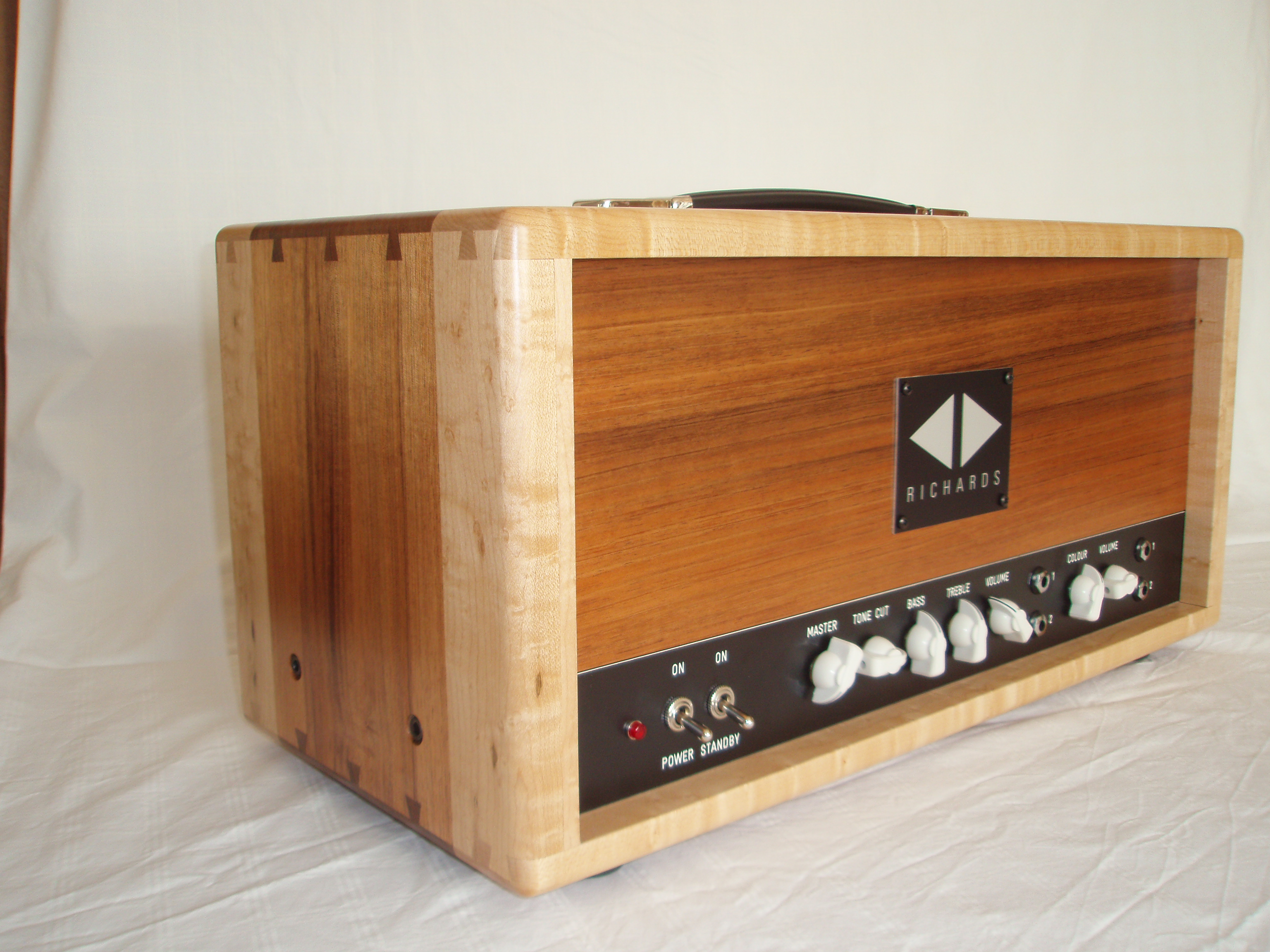
 

The testimonial was written by ARIA Award winning producer, Jonathan Burnside and is reproduced here in its entirety, without any editing. Jonathan is an American producer, has worked with Nirvana, Faith No More, etc, but has also produced a number of successful Aussie bands, including The Sleepy Jackson, Dallas Crane, Eskimo Joe, The Grates, The Living End, Dan Sultan, The Melvins, Grinspoon and many more, most recently Cold Chase. My aplogies to any names I have overlooked.

Recently I was engineering and producing the Australian band Slow Chase at Mixmasters, an excellent studio in the Adelaide Hills. Being a lover of fine low-wattage amplifiers, I encouraged guitarist Adam Gresty to bring along his new Richards Expressionist 15W model amp head. I had heard great reports about the amp but had not yet used one. Adam was able to fly with the amp with no excess baggage charges, another perk of a low-watt head !

We were in a studio equipped with a million bucks worth of audio goodies, but the Richards Expressionist proved to be the most important piece of gear in the house. The songs were glam-boogie-rock-and-roll and I was able to dial in that fat Marc Bolin/T. Rex Les Paul sound perfectly. Some of the leads involved more of an eighties Van Halen tone, and again I was able to dial in Eddie’s famous ‘brown sound’ in a matter of seconds.

I find amplifier tube (valve) saturation generally more pleasing than pedal distortion, and the beauty of a low-watt amplifier is that you can get output tube (valve) saturation in on the game without risking permanent ear damage. The Expressionist was a champ at this (pun intended), and I loved being able to flick a switch to choose between output tube (valve) types for significantly different sounds.

I also favour using guitar amps for recording bass guitars in the studio, because I like the punchier, more even tonal balance they supply in comparison to a huge bass rig. The Expressionist was wonderful for this and using the tone selector I was able to come up with the perfect midrange/low frequency balance for every song. Even though I also used a high-quality direct-box for the bass as well, and phase-corrected it to the amplified bass mic, I ended up using only the mic’d Expressionist bass track in the mixes for all the songs. As we say in America, it covered all bases.

Ivan Richards has nailed down many a guitar (and bass !) sound in one classy package. In an age of anaemic digital amp simulators and cheaply constructed reissue amps, it’s great to hear this level of quality from a new (to the USA) amp maker. During the entire project, I was able to imagine a guitar sound and then dial it in easily, varying from retro to modern at will. A big win for the studio-time budget !

Jonathan Burnside,

San Francisco, USA.

Thanks, Jonathan !! That brings this week’s blog to a close, please tune in again next week. Please check out the Jonathan Burnside/Producer website. Please also check out our earlier blog ref Aussie band Slow Chase in the studio, plus all our other amp and pedal related blogs.

http://jonathanburnside.com

http://www.mixmasters.com.au

http://www.slowchase.com

http://www.ivanrichards.com

A Richards ‘Expressionist’ amp with very expensive mics in the studio.

July 10, 2011

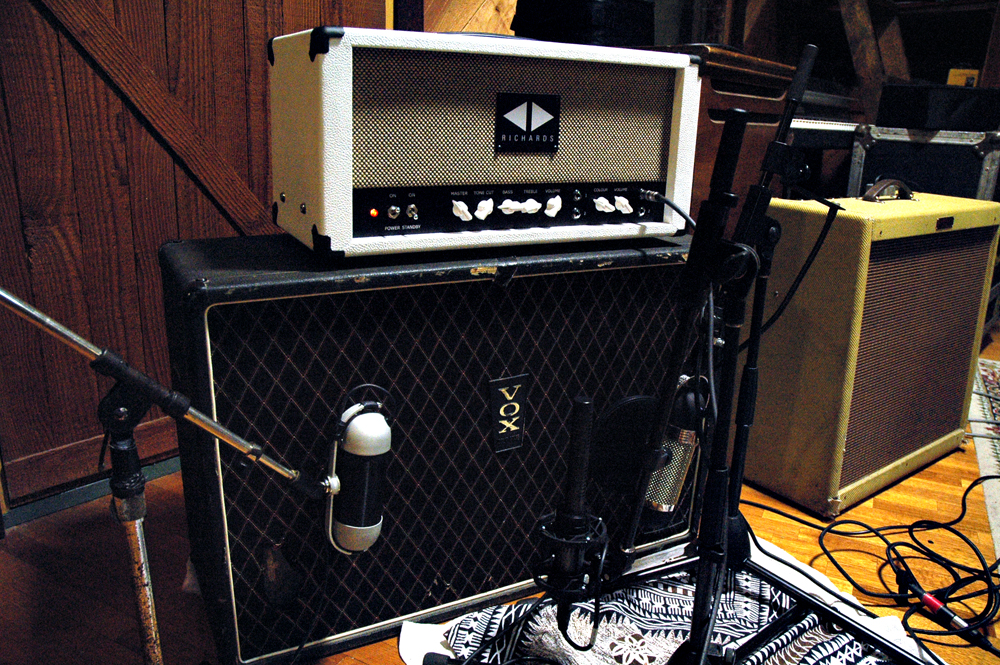
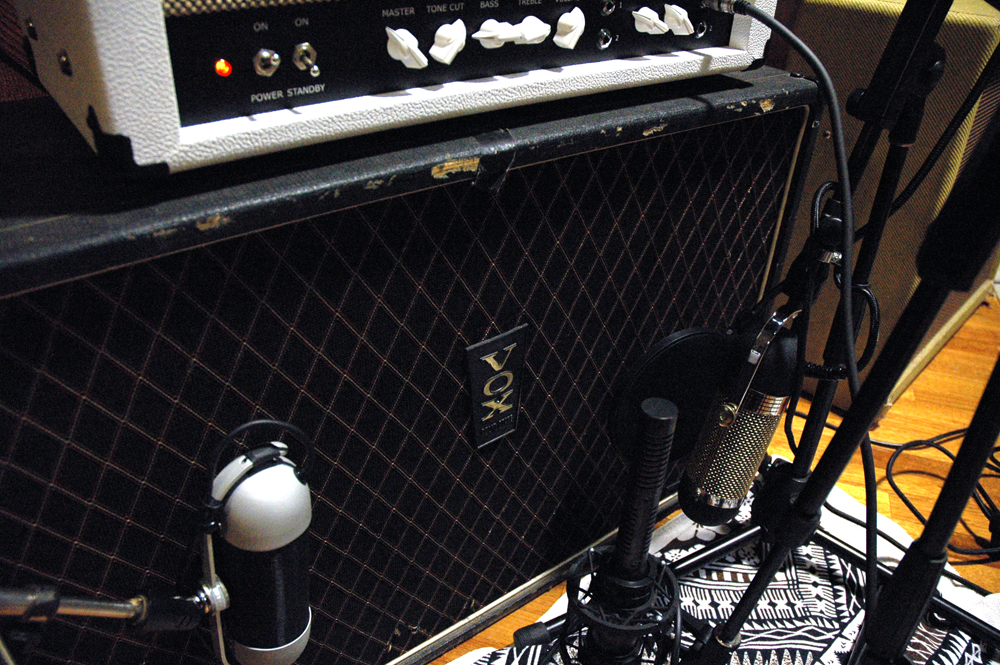
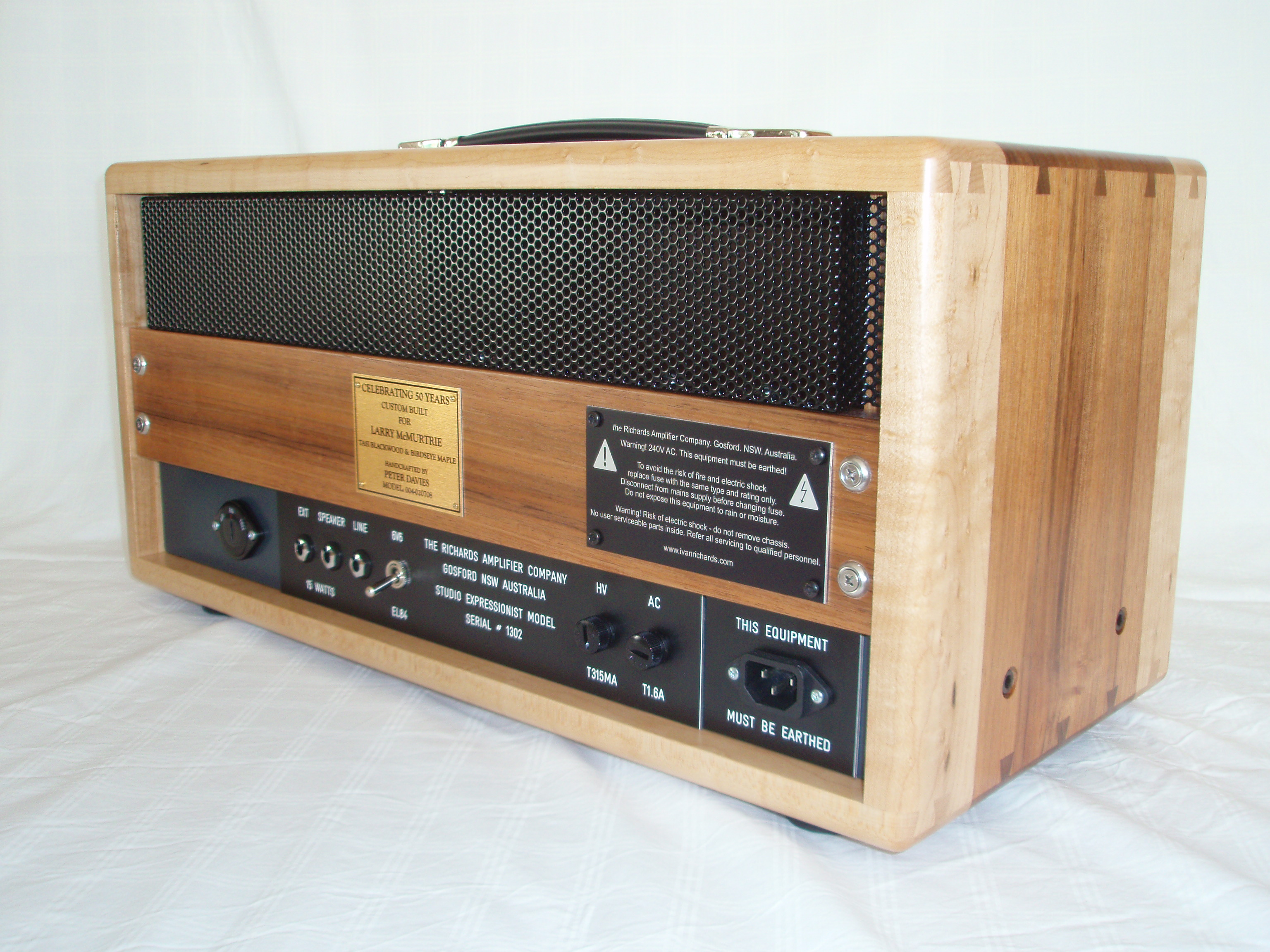
Here we have some photo’s of the 15-watt Studio Expressionist model amplifier (head), one of the range of hand-wired, all-valve (tube), custom musical-instrument amplifiers from the Richards Amplifier Company – Australia. The photo’s were taken by Adam Gresty, during the recording in Adelaide, South Australia, of the debut album by Slow Chase.
Slow Chase are a rock-band from Melbourne, Australia, featuring drummer Emily Shaw and singer/guitarist Adam Gresty. The band’s sound has been described as T-Rex meets The Pixies, but has also drawn comparisons to modern British rock-band Kasabian, and West Coast hard rock bands like Spinnerette, Sweethead and Eagles of Death Metal.

Recorded with ARIA award winning producer Jonathan Burnside (The Living End, The Sleepy Jackson, Fu Manchu, The Melvins, Grinspoon and more), Slow Chase are due to release their debut The Blind Spot EP during 2011.

This is what Adam had to say:

Ivan, I’ve just got back from recording my band’s debut album in Adelaide. I’ve attached some photo’s I thought you would like to see. Unfortunately I wasn’t able to take the Richards 1×12 Tone Cabinet with me, but the Studio Expressionist head did make the journey and I’m very pleased to tell you it was an absolute bloody triumph. The photo’s show the amp with, oh, y’know about $15k-$20k worth of microphones on it.

*Mic details:  AEA A840 large diaphragm powered ribbon mic, plus AEA R92 large ribbon studio mic, plus Royer SF24 phantom-powered stereo ribbon mic, plus a vintage Neumann U67 for room ambience !

The story continues:

My producer Jonathan (I think I told you he’s an American guy, worked with Nirvana, Faith No More, etc, but has also produced a lot of successful Aussie bands, and received the Aria awards for The Sleepy Jackson, plus Dallas Crane, Eskimo Joe, The Grates, The Living End, Dan Sultan, Whitley and loads more), well, Jonathan was completely enamoured with it. Couldn’t get over how easy it was to dial in a killer tone and the flexibility the different voiced channels plus the switchable output valves (tubes) in the power section offered. From vintage to modern. We even used it for doubling up DI’d bass parts. It was the only amp we used on the album. So thrilled I managed to get it to the studio and it’s now the heart and soul of the first Slow Chase album ! Jonathan christened the amp Jagger, which I thought was hilarious, ref Jagger/Richards. Can’t wait for you to hear the album, although it will be well into 2011 before it’s been mixed down and mastered.

Well – many thanks to Adam for that great story which now features as this week’s Blog. I’m sure that list of mic’s will make many a home-studio owner envious. In a forthcoming Blog, we will feature a testimonial from producer Jonathan Burnside, so watch out for that. Until next week, thanks for checking out the Blog and please feel free to contact me by email re any enquiries.

http://www.ivanrichards.com

http://www.slowchase.com

http://jonathanburnside.com

A tale of two “Champs”.

July 2, 2011

A pair of Fender “Champs” arrived at the workshop this week for servicing. Actually, one of them is a Silverface Bronco amp, which to all intents and purposes is a Fender Vibro-Champ. The other is a current manufacture (ie, China) Champion 600 amp. Both amps have very similar electronic design excepting that the Vibro-Champ has valve (tube) driven Tremolo, and a valve (tube) rectifier, whereas the Champion 600 has solid-state rectification, printed-circuit board construction and a preset tone-stack so there is only a volume control presented on the front panel. The Bronco has a much larger cabinet, which helps enormously to develop a bigger sound.

The Bronco needed a fairly comprehensive service. This not only included replacement of all valves (tubes), but also damaged pots (potentiometers), ageing electrolytic capacitors, and a 9-pin valve socket which was no longer providing reliable connection. Our usual electrical safety standards inspection and testing revealed that the 240V 3-pin plug was due for replacement, too.

The Chamion 600 was powering up but nil output, ie the lights are on but nobody’s home, as they say. The cathode-bias resistor for the 6V6 valve (tube) in this amp is a little under-rated for the job, especially if the 6V6 suffers a catastrophic failure, so I replaced it with a ceramic-body 7 watt resistor intended for the most demanding environments. I use these resistors where appropriate in my own Richards custom amps. The 2 x boards checked out OK, as did the jacks, interconnects, and so on, but the 2 x valves (tubes) were cheapo examples of Chinese origin, and the volume control was very scratchy indeed, so these items were replaced.

Both these amps have small, very cheapo speakers, so naturally the amps sound much bigger and better through a decent quality external speaker. However, many people love how compact and lightweight these amps are, and of course 1000’s of recordings over the decades have been done with the Champ amp. So in the final shoot-out, how did these amps compare ? The basic tonality is very similar. They common circuit design is quite low gain, so you have to turn up the volume control most of the way to get much of a vibe happening. The Bronco/Vibro-Champ has a bigger sound with greater prescence and throw, and the advantage of 2-band EQ, but most of all it has a great valve-generated tremolo which is superior to any stompbox tremolo that I have heard so far. The tremolo is of the direct-modulation configuration, which varies the bias and gain of the 2nd stage of the preamp 12AX7 valve (tube). For tremolo lovers, it doesn’t get much better than this.

For all owners of small valve (tube) amps such as those described above, I offer world-class professional amp repairs from my workshop located in Wyoming (Central Coast) NSW. We have couriers delivering and picking up to this site every working day, so please consider the level of service and value add that we can supply. That’s all for today’s BLOG, please check in every week or so for more news and info. regards – Ivan.

Do we cater for the jazz guitarist ?

June 19, 2011

Yes !  It’s not just about rock’n’roll, we offer our repair services and custom-design/custom build services to every type of musician who is reliant on some form of amplification/sound-reinforcement. This would include jazz, jazz/rock/fusion, country, alt-country, folk-rock, pop, blues, soul, rhythm & blues, roots music/world music………………..the list goes on and on.

Actually, the Richards family has always been into jazz, swing, big bands, hawaiian steel guitar, etc,  all the way back to the 1930’s. I am the black-sheep of the family, I am the one who was seduced by the music of the British Invasion bands from the mid-1960’s onwards. I just couldn’t get enough of The Beatles, The Yardbirds, The Animals, Cream, Hendrix, The Who, The Small Faces, Led Zep, Jeff Beck Group, Jethro Tull and many more, and I’m still hooked !

However, getting back to the jazz musicians out there – we pretty much have the cream of the Australian contemporary country music scene resident here on the NSW Central Coast, but we also have a few jazz orientated players here as well. What kind of equipment issues do they have ? Getting a warm, satisfying tone is a prerequisite as is having enough headroom to voice those complex chords with clarity and authority. Getting a balanced tone and levels across the 6-strings and in fact the entire guitar spectrum is another major issue, particularly if you are playing a hollow-body instrument, eg an arch-top.

Most jazz guys would probably favour a guitar amplifier that is light and compact. A valve amp of something in the order of 20 watts with a single 10-inch or 12-inch speaker would seem a logical choice. For whatever reason that I don’t yet understand, there is a trend among jazz guitarists towards the Rivera amps from California, USA. Perhaps an influential player chose one of these amps and then others followed his example.

A customer recently brought a Rivera Clubster 20 watt 1×10 combo to the workshop. The amp had certainly been reliable and is commendably light and compact. However, the tone was very thin and also lacking in headroom. The overdrive channel was really too high gain to be useable, and did not lend itself to modification, so I concentrated on the improving the clean channel in whatever way I could. I substituted another brand of output valves which gave slightly later break-up, ie more headroom. However, the biggest limitation of this amp is the speaker unit itself. If you are going to have a 1×10 combo, then that 10-inch speaker needs to be a good one ! The stock speaker does not have a good, balanced tone across the guitar spectrum, in fact it is rather thin and generally lacking in tone and dynamics. The biggest possible improvement to this amp was always going to be upgrading the speaker.

I have had some experience with the Jensen NEO speakers, which unlike some of the various Jensen alnico and ceramic magnet reissues, have a very full balanced tone, without particularly favouring any frequency over another, and also good sensitivity. In other words, both the 10-inch and 12-inch Jensen NEO models are well suited to low powered amps, even though they are rated for 100 watts. After installing the NEO-10, both the customer and I agreed the tone of the amp was greatly improved as also was the sensitivity and headroom.

I would like to also remind jazz players that I custom design and build valve amps for guitarists of all persuasions. Not as light and compact as the amp described above, I must admit, but designed and built to last the distance and achieve the desired tonality and performance levels. Possible design criteria might include the use of 6V6 power output valves for their very sweet tones, optional valve-driven reverb, and baxandall e.q. for a more balanced frequency response.

For distortion tones that complement those jazz/fusion explorations, you won’t find a better overdriver than our Class-A Distortion pedal, which achieves a very natural, very organic quality of distortion, with fine control over both level and tone. It never sounds harsh ! In fact, one of the first guitarists to purchase this pedal was Carl Dewhurst, a player and teacher well known on the Sydney jazz scene.

Please take the time to check out our website: www.ivanrichards.com and please feel free to contact us if you have any suggestions and/or useful comments about any issues in the preceding paragraphs. Your own experiences in the world of jazz guitar amplification may well assist other players.

Regards,

Ivan.

Authorised Service Centre for CARR Amplifiers.

June 18, 2011

We are pleased to advise that as of December 2007 we have been appointed as the factory-authorised service agent in Australia for Carr Amplifiers of North Carolina, USA. Carr amps display a unique and highly individual approach to guitar amplification, and are completely valve (tube) in design (some models do have a solid-state rectifier), and are completely hand-wired.

The most popular Carr models have been, and probably always will be, their hot-rodded Princeton-Reverb style amps, however some of their other models defy the usual trends and offer something quite different in both style and tonality.

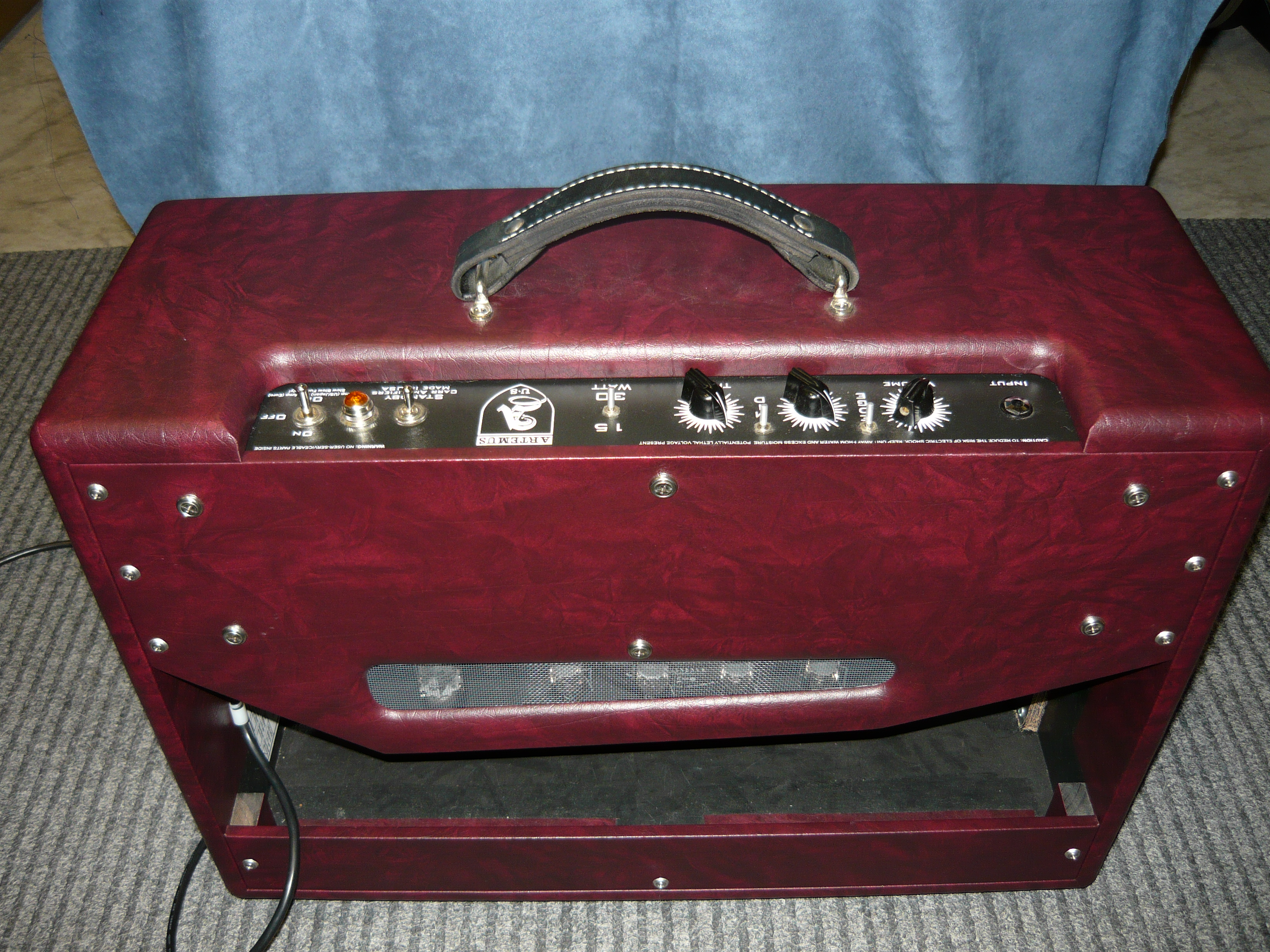
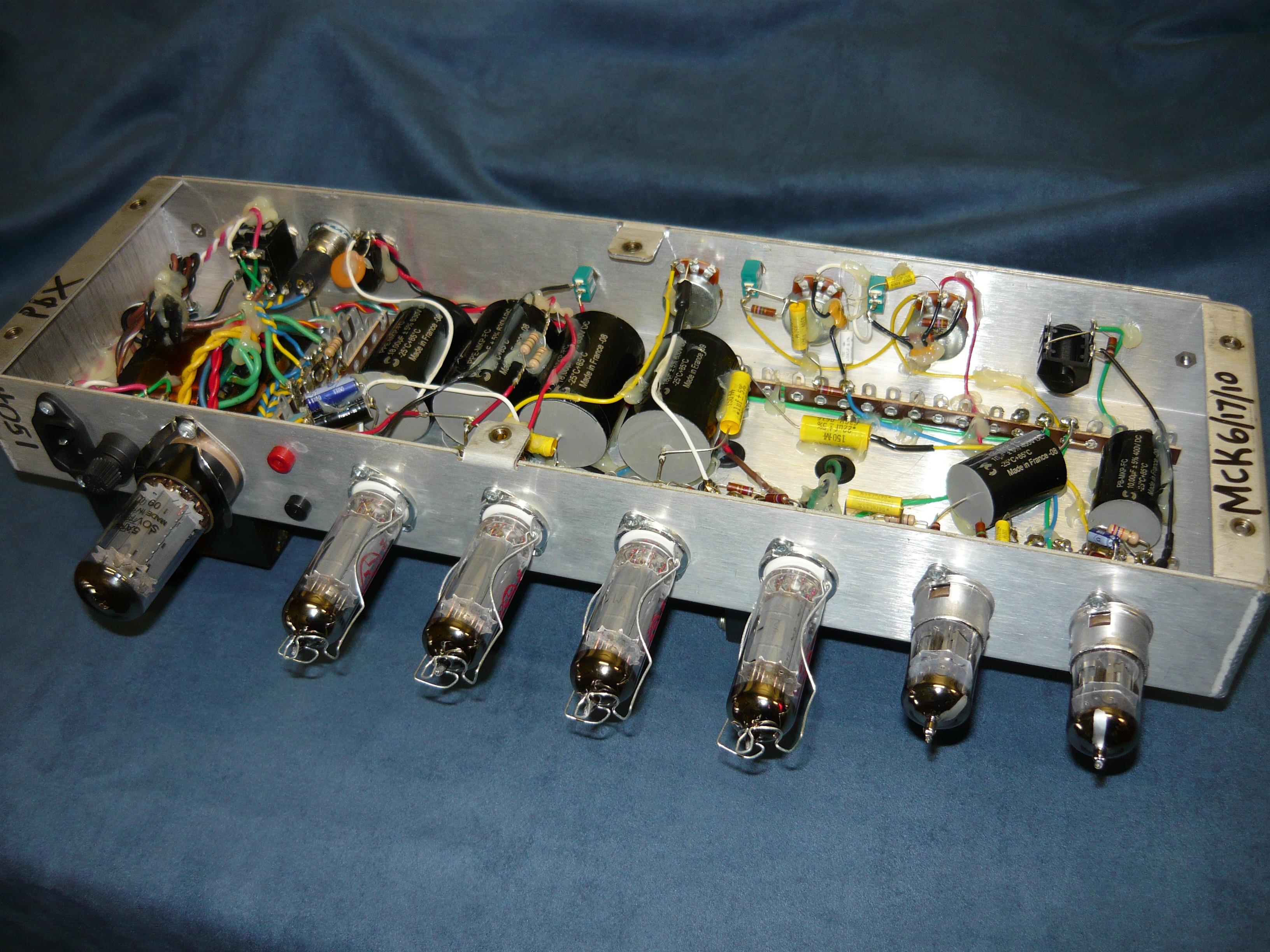
Pictured here is the subject of a recent repair, the Carr Artemus. This is a 30 watt output, class AB/fixed-bias, 4 x EL84 design with an unusual front-end design. This amp would obviously have a fairly specialised appeal, and is quite different to the many AC30-influenced amp designs on the market. Cosmetically, the amp has an attractive art-deco style cabinet which has been faultlessly presented.

Here is what Carr amps had to say as part of our original communications:

hello Ivan:  Great to have you on the case ! You certainly come well recommended and it’s wonderful to have people like yourself work on our amps – Steve Carr.

If you have any service enquiries and/or service issues, please contact us via email address info@ivanrichards.com for world-class service and support, including full backup as required from Carr amps, USA. Our workshop is located in Wyoming (Gosford), New South Wales, just north of Sydney. Alternatively, you can make arrangements via Bondi Intermusic of Oxford Street, Bondi Junction (Sydney). Mobile number for urgent enquiries is 0418 862 034 (within Australia), and 61 418 862 034 (international).

Note:-  for those of you out there that may have a Carr amp purchased direct from the USA and therefore operating on 120V AC via a stepdown transformer, we can offer a permanent solution by installing a 240V power transformer supplied by Carr amps via their Australian distributor, Bondi Intermusic. Please enquire as per the preceding paragraph.