Archive for the ‘Amps’ Category

another Laney AOR Series ‘Pro Tube Lead’ amp in our workshop

July 20, 2014
the Pro Tube lead 100 head

the Pro Tube lead 100 head

Hello and welcome to the blog. Once again we have completed major repairs to a Laney (UK) “AOR Series” amplifier – model name Pro Tube Lead, this time a 100 watt head for customer Ben Rabey. We previously published blogs on 14/5/2013 and 10/7/2012 describing repairs and MODs to Laney amps in detail, including the AOR Series 50 watt combo, and also the LC30-II combo.


Pro Tube Lead 100 head sitting on a Hame speaker cab

Pro Tube Lead 100 head sitting on a Hame speaker cab

The fault description from our customer was that the amp plays OK for a while, and then the output drops markedly ! Upon removing the chassis from its sleeve, the first things we noticed were that the mains fuseholder was loose and could not be tightened satisfactorily, plus the amp was seriously under-biased resulting in a much higher than normal current draw by the quartet of EL34 output valves (tubes).


removing and reinstalling the board is quite a task, but has to be done !

removing and reinstalling the board is quite a task, but has to be done !

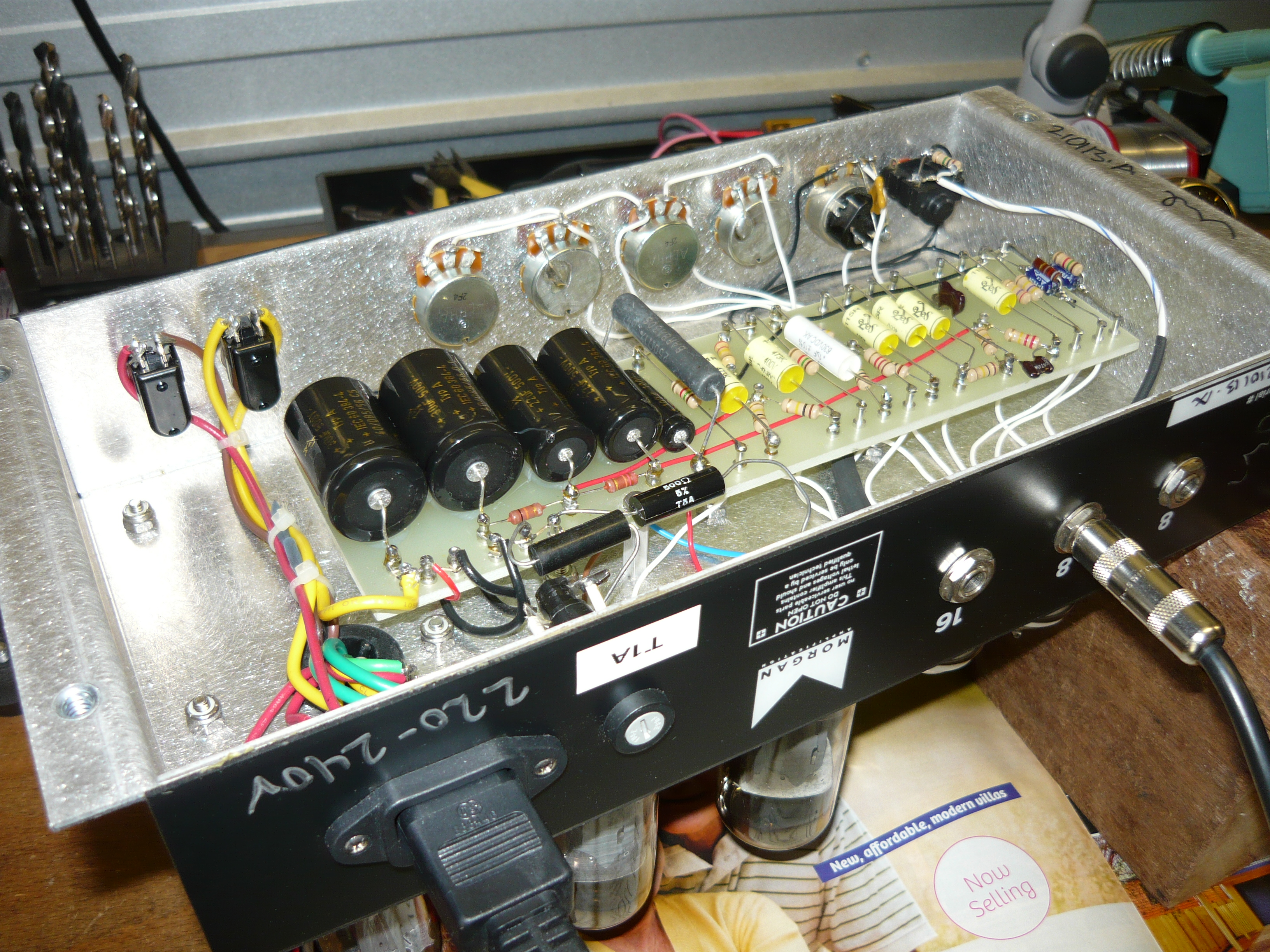
We replaced the fuseholder altogether with a current production unit that complies with contemporary electrical safety standards. We also installed the correct value HT fuse – T1A. Following this, the amp passed electrical safety testing to Workcover NSW standards. This is all important stuff, and should never be overlooked. We tested the quartet of EL34 valves and all the 12AX7 preamp valves externally to the amp with no apparent problems revealed.

access to much of the wiring is under the board, but available space is very tight !

access to much of the wiring is under the board, but available space is very tight !

After re-installing the valves (tubes), we rebiased the EL34’s to a sensible current draw. The amp tested both very low and very distorted output signal into a dummy load. We observed a good drive signal to the EL34’s from the phase-inverter stage, with a signal injected at the FX Loop ‘return’ jack, so we had every reason to suspect that the output transformer had broken down internally. We quoted Ben on replacing the output transformer plus other tasks, and the project proceeded.


the new output transformer installed on the Laney chassis

the new output transformer installed on the Laney chassis

As we are an authorised repairer for Marshall amplification, we therefore have access to the full stock of Marshall spares for current and vintage models. It just so happens that the 100W output transformer for the JCM800 series, designated C2668 (by Dagnall Electronics), is a perfect match and perfect fit for the 100W Laney. This is hardly a surprise, as the Laney is very obviously based on the JCM800 design, but with additional gain and additional features.

repairs completed and board reinstalled

repairs completed and board reinstalled

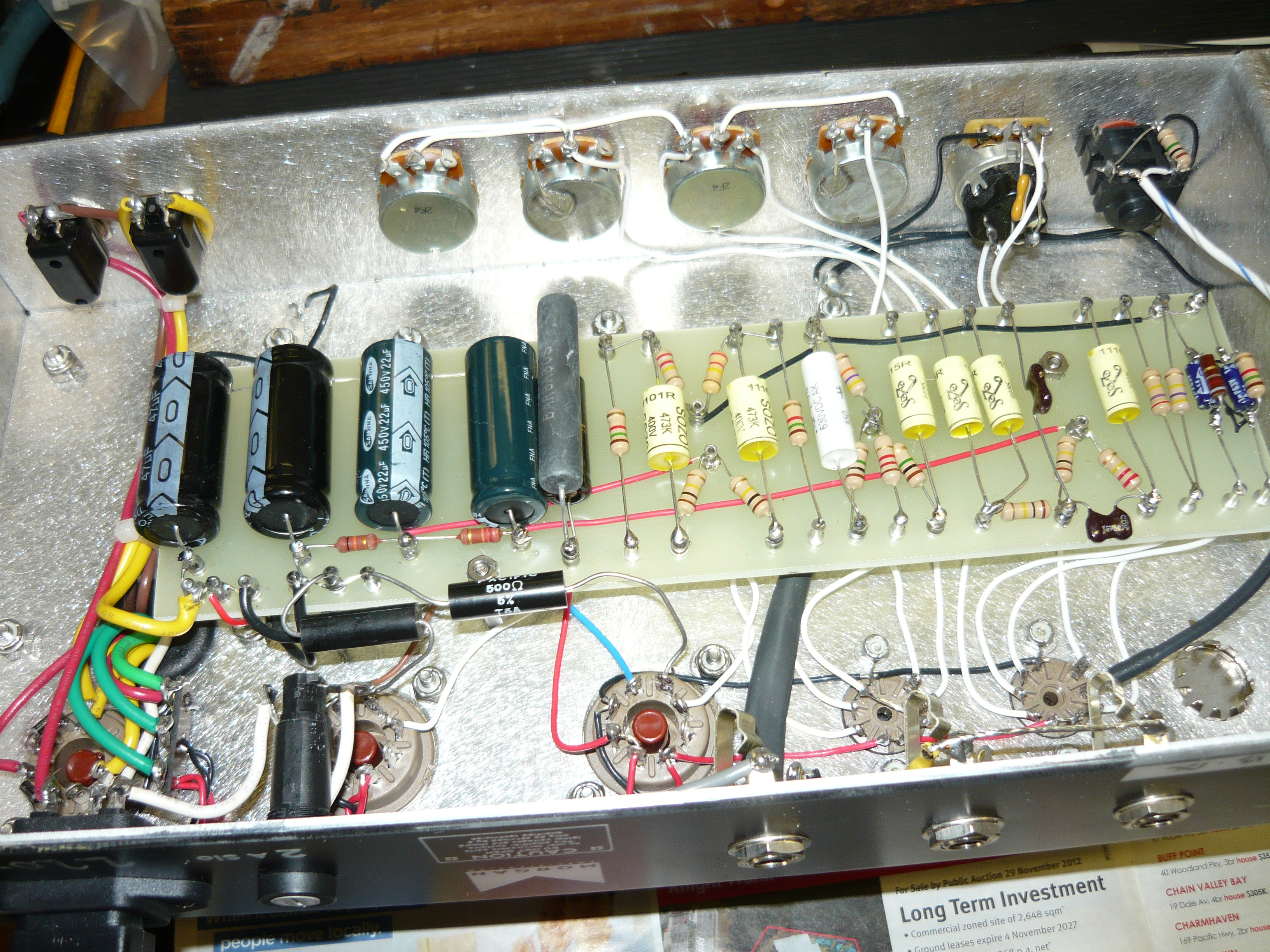
Getting access to the wiring to carry out this task is not easy, as much of the wiring passes underneath the single large printed circuit board (PCB). Definitely not mil-spec wiring, but the JCM 800 amps are exactly the same (although their wiring is somewhat tidier). Removing the board requires removing a number of fasteners, plus also removing all the front panel controls, as all these controls are hard-wired to the board, as you would expect.
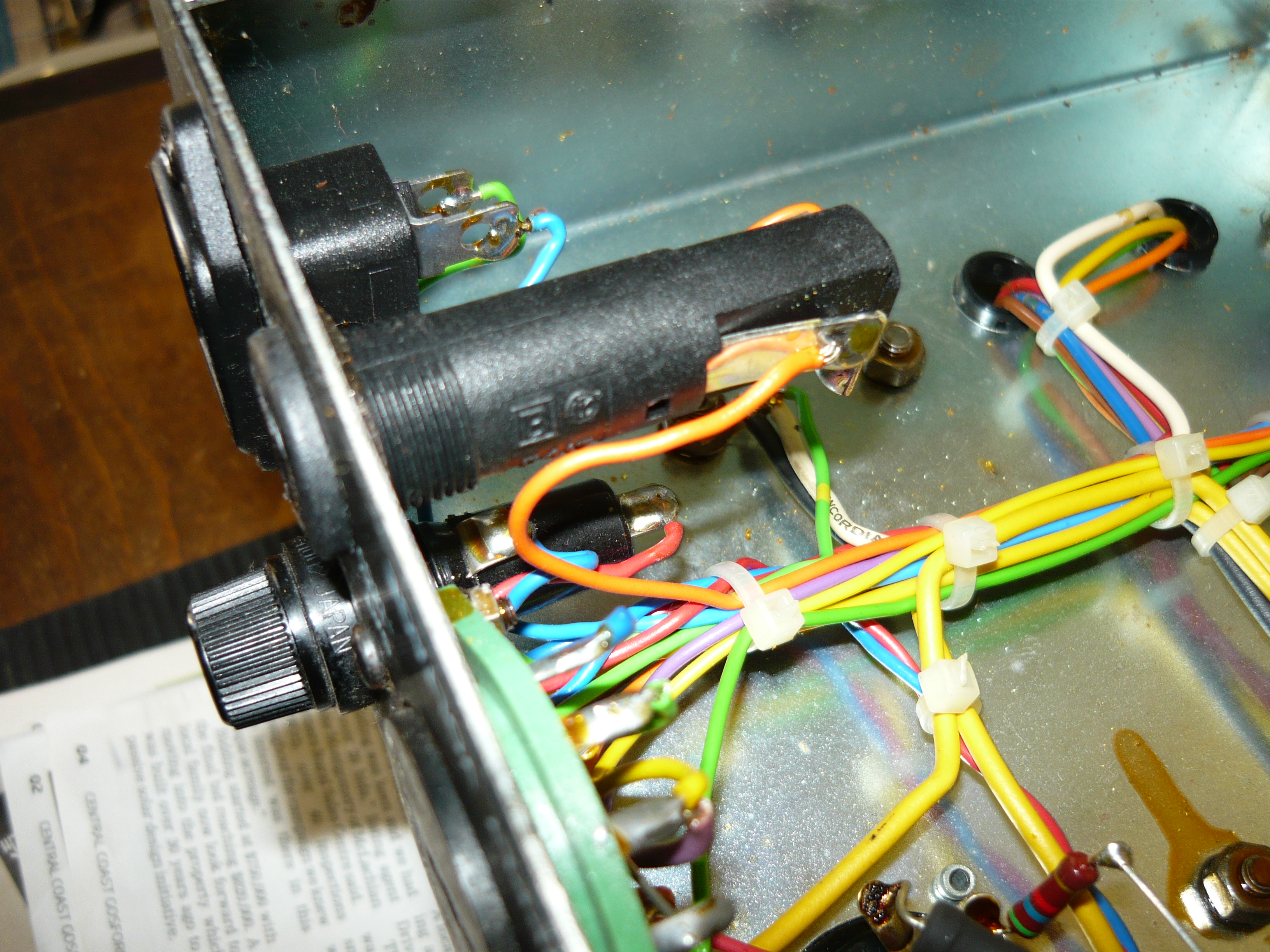
new 'touch proof' mains fuse installed

new ‘touch proof’ mains fuse installed

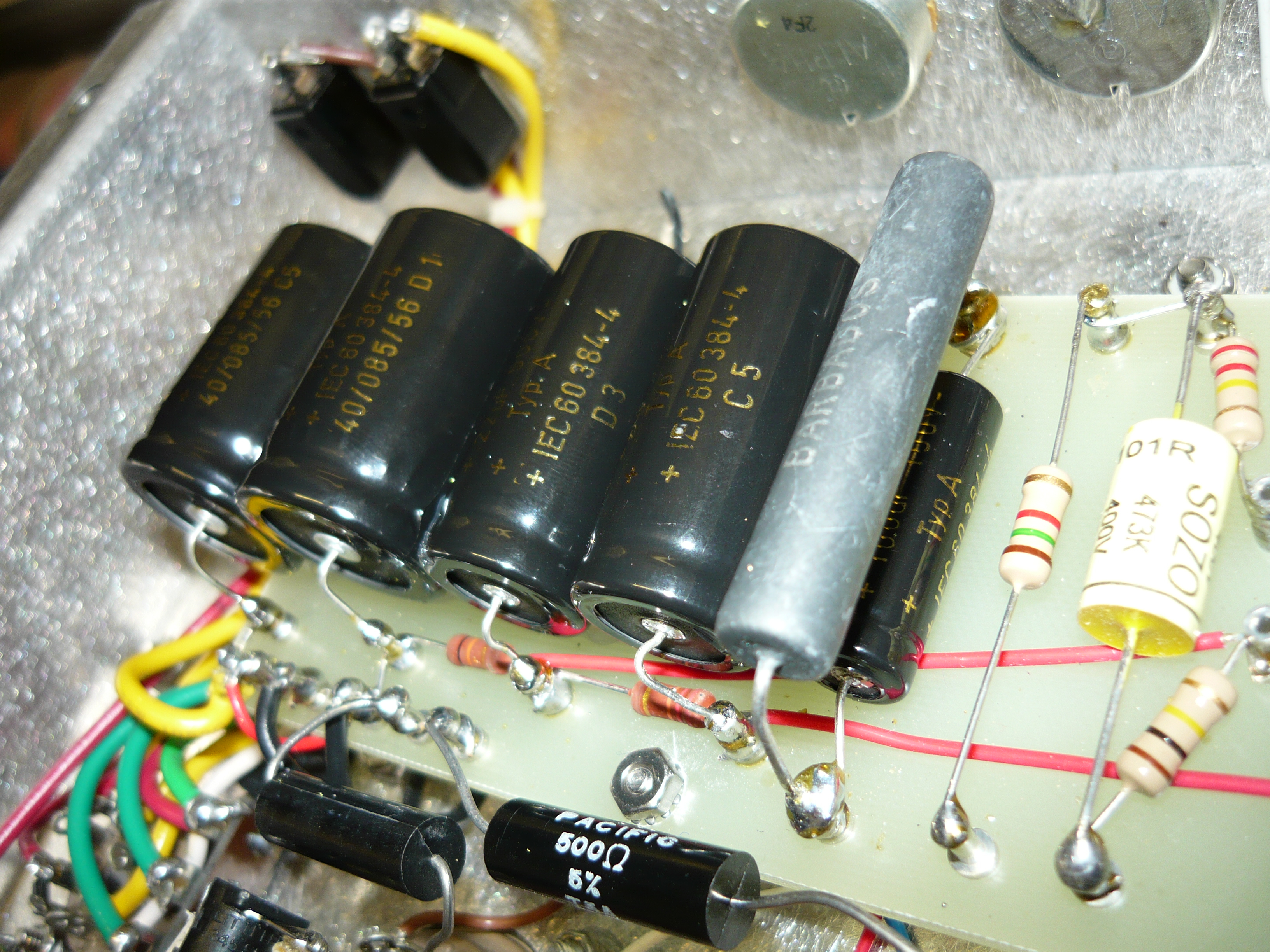
The replacement C2668 transformer wiring of course has a completely different colour code to the original Laney unit, which required some additional investigation to complete the installation successfully. While we had both sides of the board exposed, this was the perfect opportunity to replace the bias supply filter caps, plus some of the low-voltage supply components (as per the previous Pro Tube Lead repair job). You can see a burn mark on the component side of the board under a power resistor in the low-voltage supply, so this appears to be a common problem in these amps.
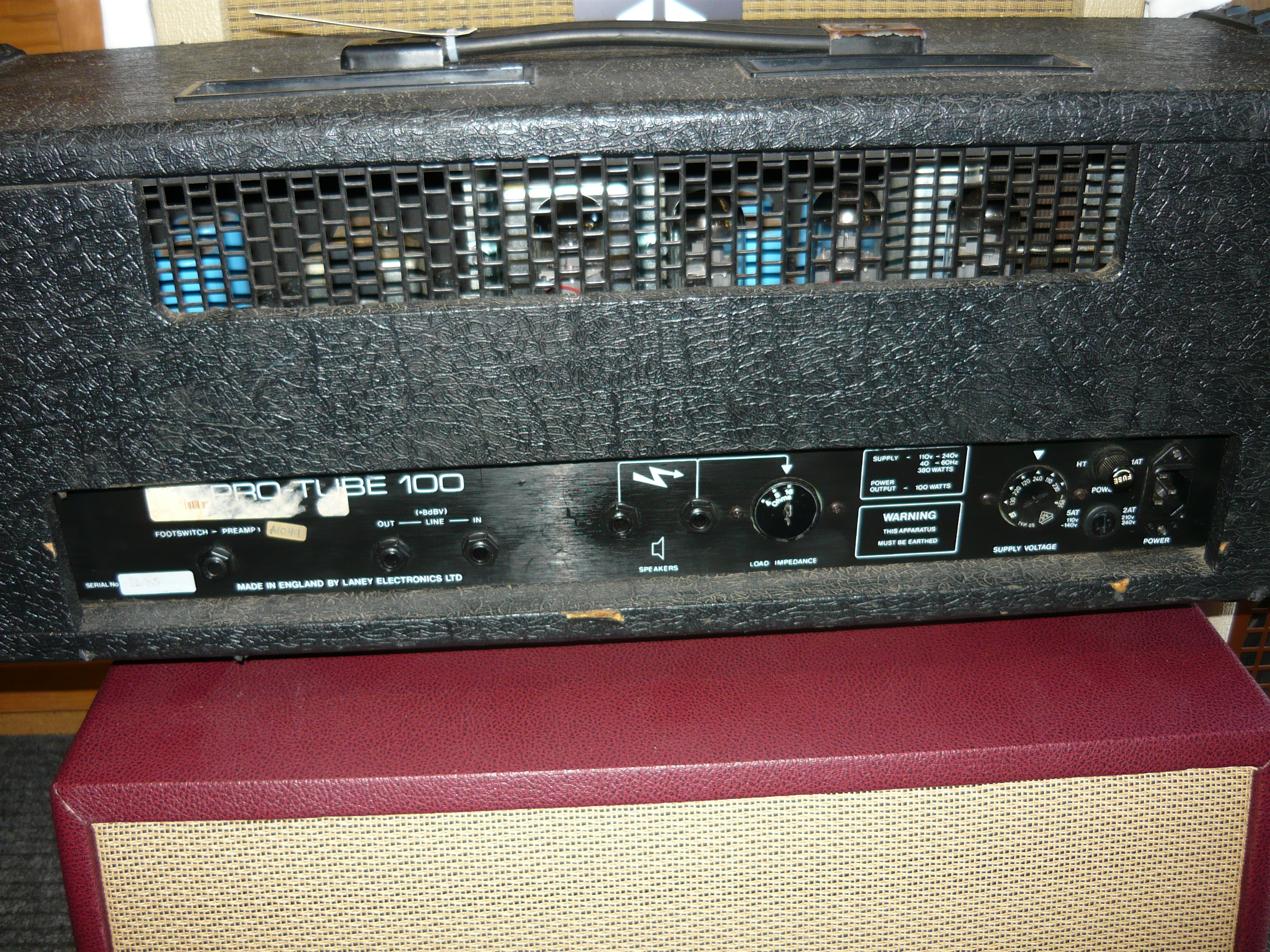
rear view Laney 100W head

rear view Laney 100W head

For those interested in technical matters, this amp was serial # 2685, and appears to have been built in 1988. After installation of the new transformer and rebias of output valves (tubes), we had a high-tension voltage supply of just under +470V, and a bias voltage of -38V. The amp delivered 43V into 16 ohms @ the onset of clipping = 115 watts. Was the blown audio output transformer a direct result of the under-biased output valves ? We will never know – sometimes these are just random events. Many thanks to Ben for his continued custom. As always with these models – once set up and running properly the amp sounded huge !   IR.

Servicing the Carr ‘Sportsman’ amp in Australia

July 5, 2014
the Sportsman logo

the Sportsman logo

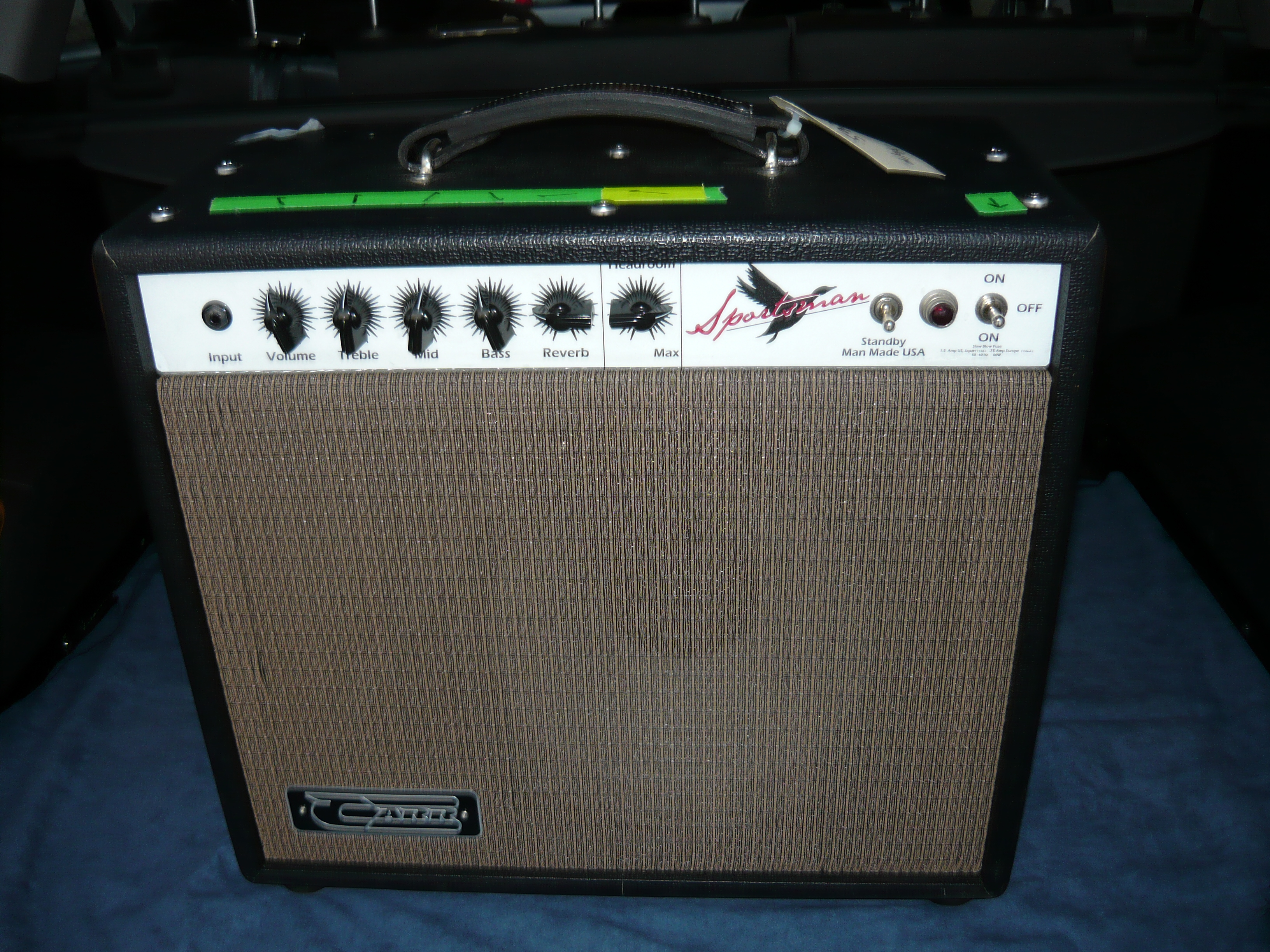
We have had a relationship with Carr amplifiers of North Carolina, USA, going back several years to when the former Bondi Intermusic Australia began importing these amps. Of course Bondi is long gone, so therefore we are no longer the national warranty service agent as the brand has been taken over by another distributor. However, with the full approval & support of Carr USA, we are still providing post-warranty after-sales-service to the entire range.

the Carr Sportsman 1x12 combo

the Carr Sportsman 1×12 combo

We have previously published blogs re the Carr Artemus and other models in the range. The Sportsman model is a relative newcomer to Australia, and this is our first servicing experience with this model, for new customer Matt. The design of the Sportsman follows on from Carr’s most successful models, being somewhat like a hot-rodded “blackface” Princeton Reverb amp. That’s the best way we can describe it, although there are some differences, particularly in the phase-inverter and power amplifier circuits.

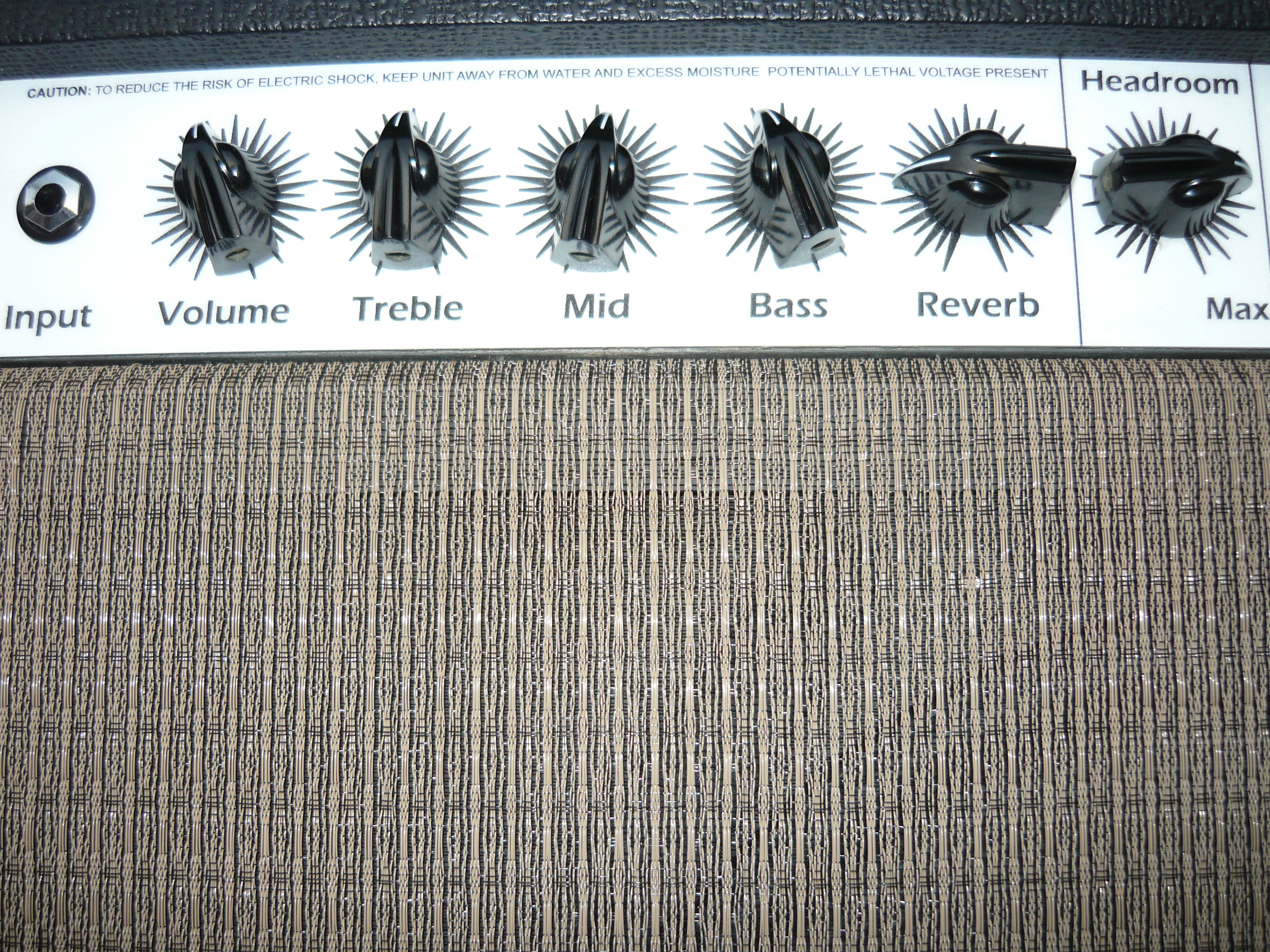
the Sportsman front panel

the Sportsman front panel

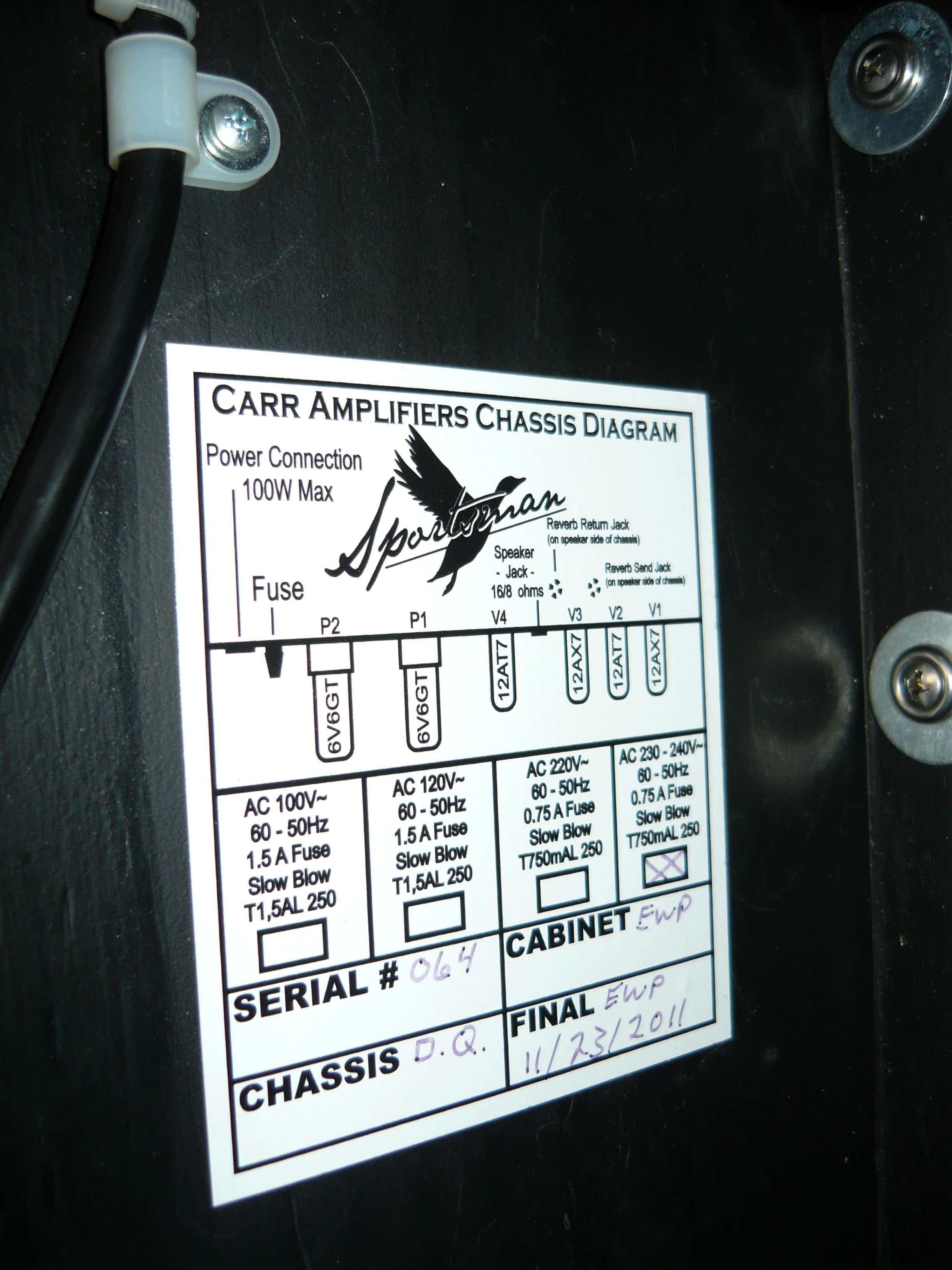
The power amplifier is designed around a pair of 6V6 output valves, employing a form of compound bias – combining both fixed bias & cathode bias, with a power output @ the onset of clipping of about 16 watts into a 16 ohm load. This arrangement seems to work well in practice, although when Fender (as a division of CBS) tried something similar in the late 1960’s the results sounded so bad they had to implement a redesign of the “Silverface” models.

the Sportsman from the rear

the Sportsman from the rear

The power supply uses solid-state rectification, as opposed to valve (tube). The “headroom” control is actually a master volume with some tone shaping, following on from the final preamp gain stage. As per the Two-Rock amp discussed in the previous blog, this control is intended to manage the gain structure of the amp, rather than introduce distortion, hence the “headroom” label.

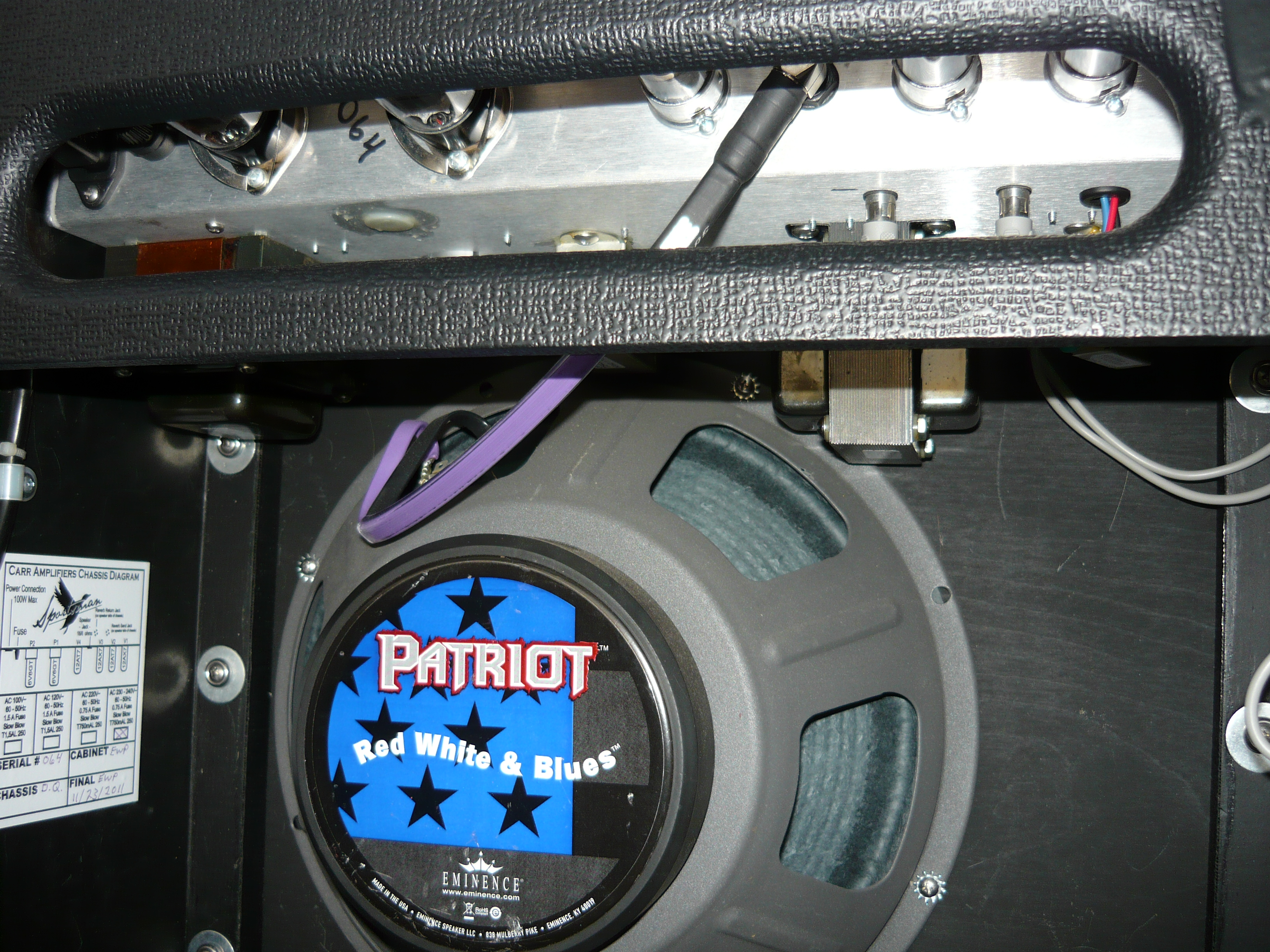
Sportsman chassis & speaker

Sportsman chassis & speaker

The reverb on this amp is exemplary, which is a real contrast with the many current production guitar amps offering really poor reverb !! There is no tremolo on this model. The chassis is completely hand-wired. Matt reported that although the amp was still functioning, the sound of the amp had deteriorated markedly. We examined the interior of the chassis looking for any signs of component failure or drift, but chassis checked out A-OK.

Sportsman 006We carried out a full re-valve and once more the Sportsman was delivering the kind of attitude that Matt was missing. The one and only concern we might have with this amp is the minimal ventilation for the horizontally mounted 6V6 output valves, which are biased to run quite hot. We have to thank new customer Matt for providing us with the subject matter for this blog. I think the only remaining question for Australian guitar players would be – could you buy an amp with a duck on the front panel ??    IR.

Sportsman 008

Service centre for Two-Rock amplification in Australia

July 5, 2014
Two Rock 001

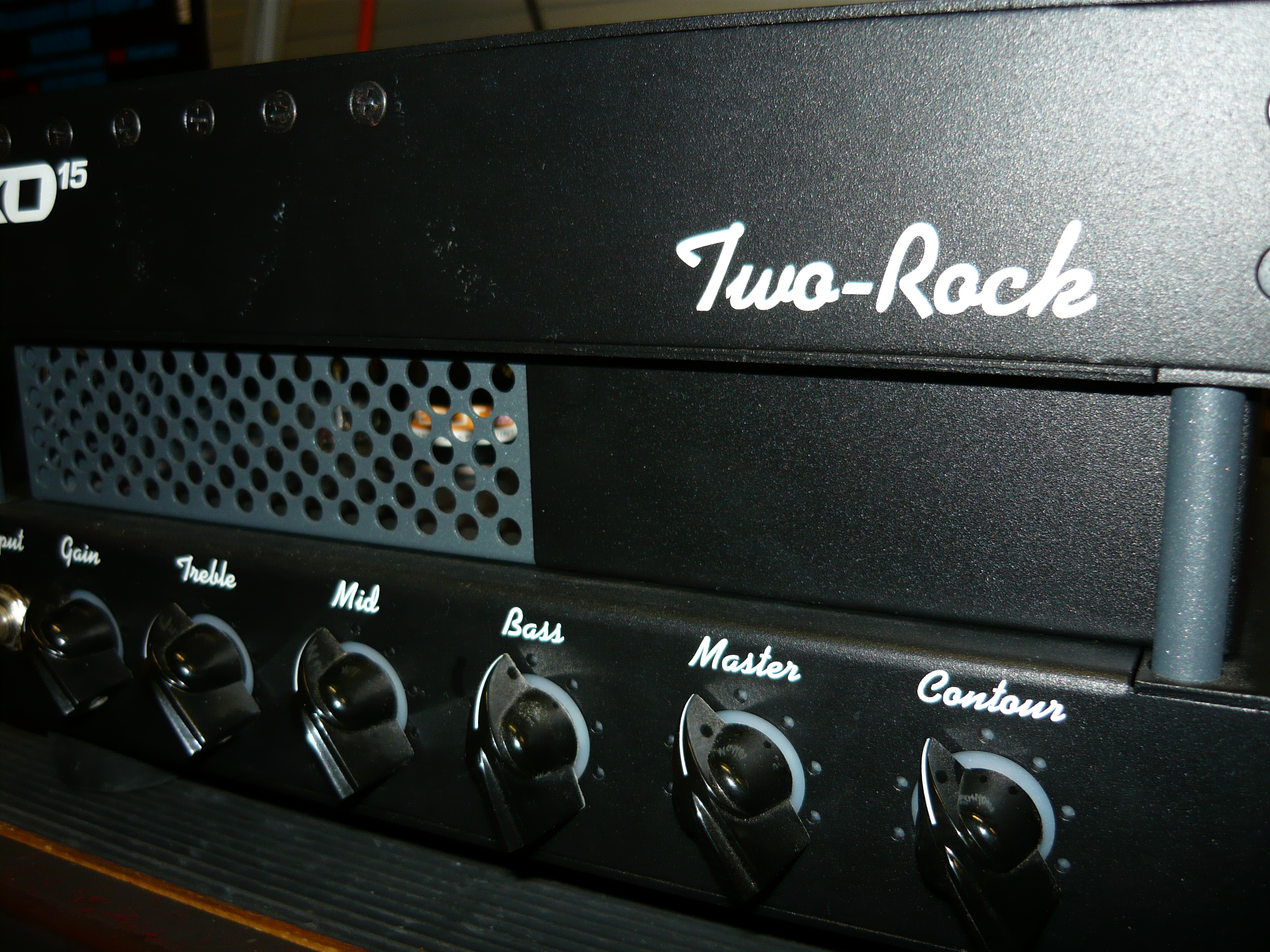
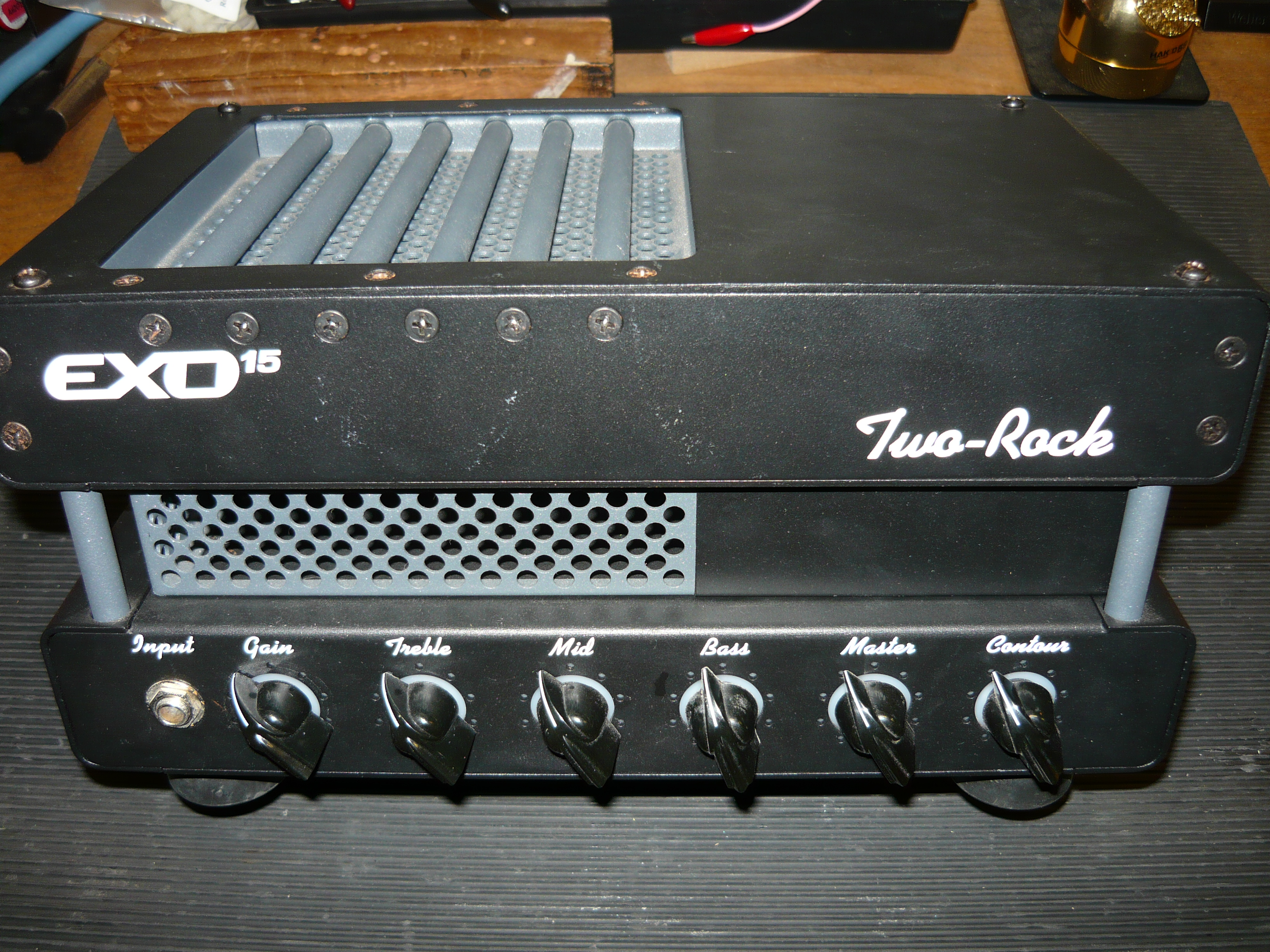
Two-Rock EXO15

Hello and welcome back to the blog after a long break. We are now offering world-class (non-warranty) service & repairs to the range of valve (tube) amplifiers from Two-Rock guitar amplification of California, USA. We should point out that we have no official relationship with Two-Rock Amplifiers, so we cannot accept any warranty repair claims without the endorsement of their Australian distributor.

Two-Rock EXO15

Two-Rock EXO15

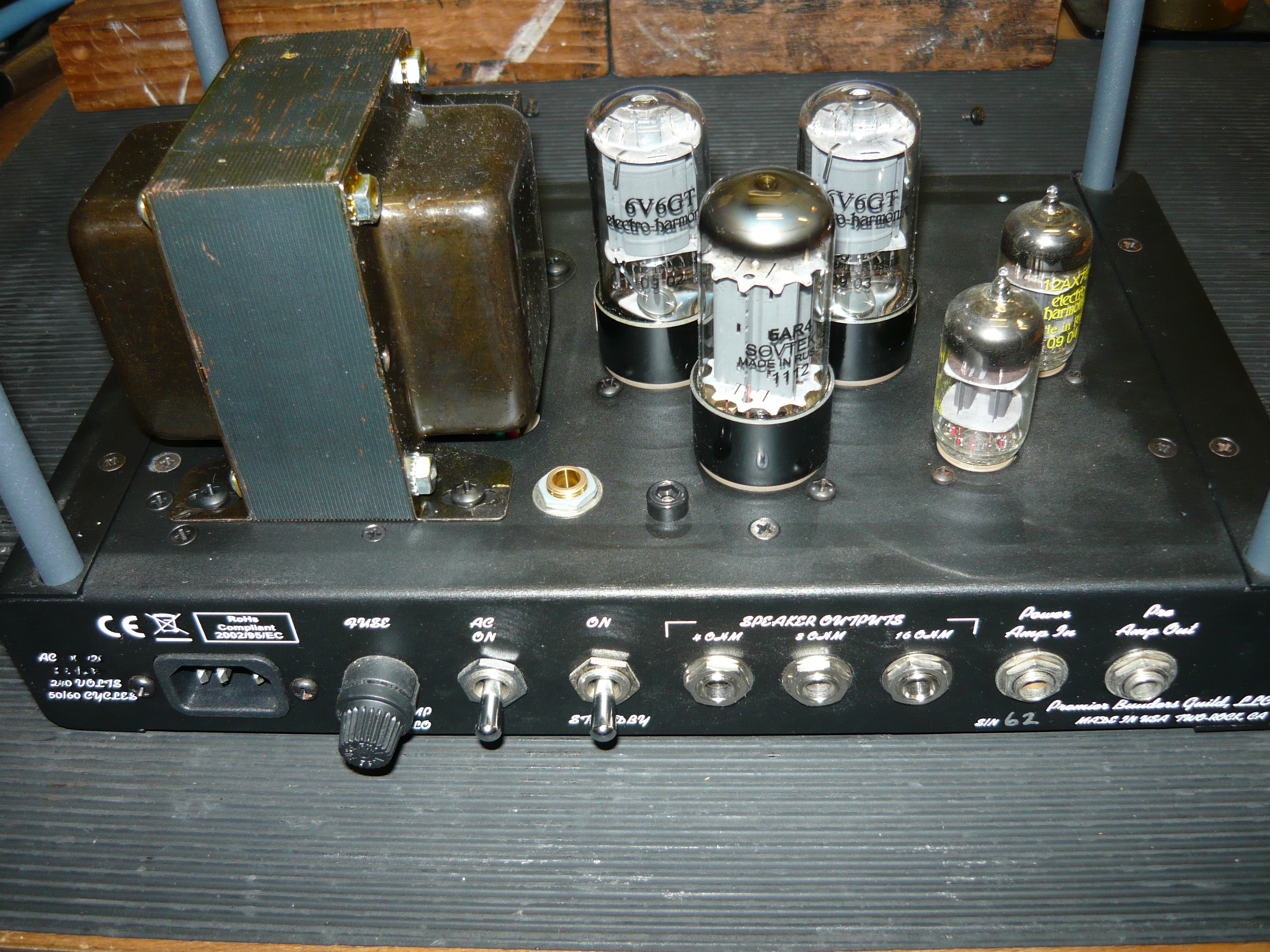
We recently serviced the Two-Rock EXO15 head (serial # 62) for Sam, one of our regular customers – the amp is featured in the accompanying photos. Sam advised us that the amp ‘just stopped’, which is a fairly common amp fault description, and in most cases would suggest a valve (tube) or other component failure, or at least a blown fuse.


6V6 powered EXO15

6V6 powered EXO15

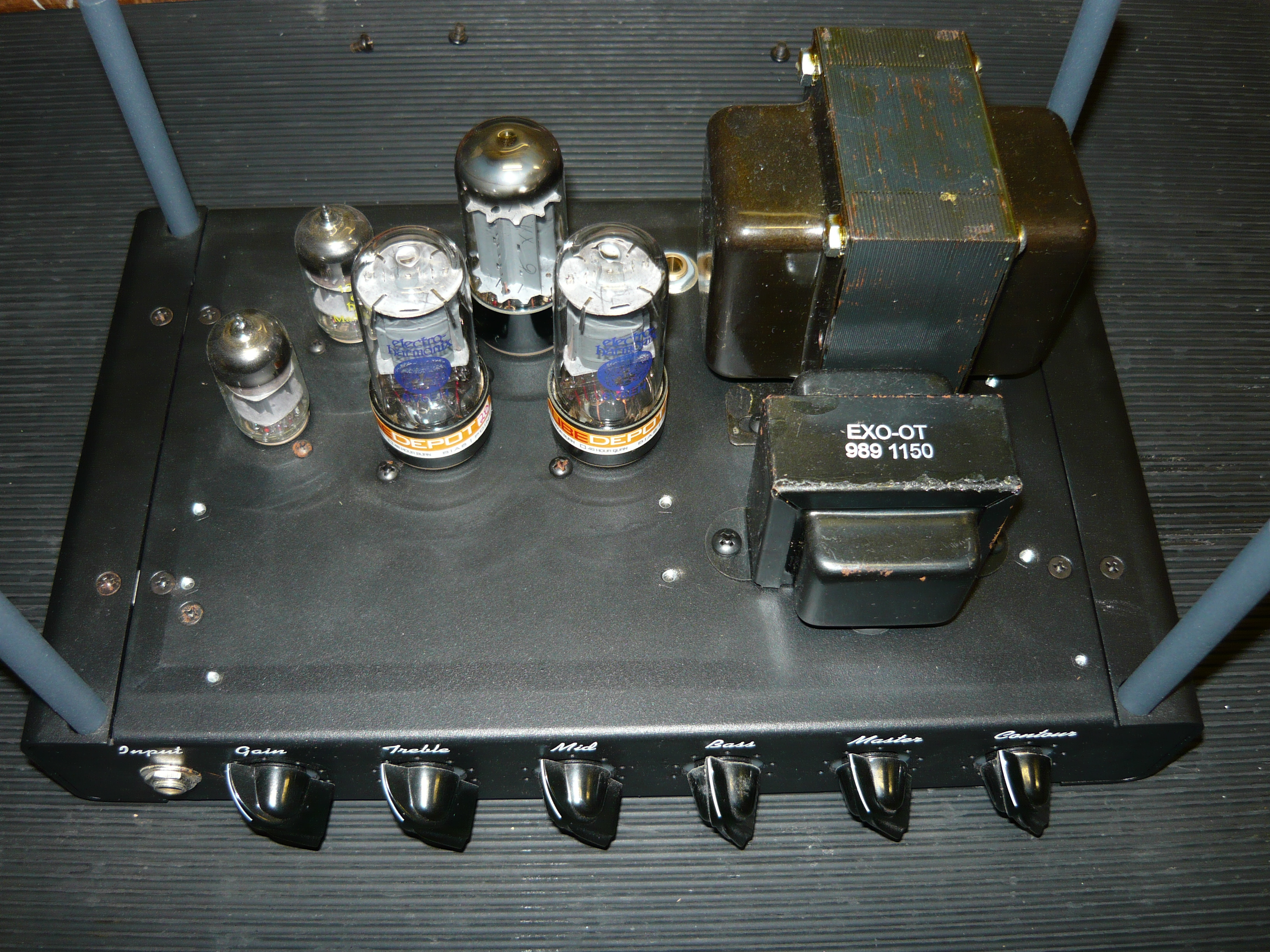
The EXO15 is a single-channel, 15 watt 6V6 powered and valve (tube) rectified class AB amp, designed in an all-metal enclosure,  with a pair of 12AX7 preamp valves (tubes), one of which functions as the phase-inverter. The preamp design is somewhat similar to the “clean” channel in a Dumble guitar amp, as per the Two-Rock heritage, and the 3-band passive EQ is also voiced along similar lines.

5AR4/GZ34 rectifier

5AR4/GZ34 rectifier

The master-volume is placed directly after the 2nd gain stage, and is therefore intended more for managing the gain structure than generating massive amounts of distortion (a design approach which we endorse). The master feeds a passive FX Loop, for time-based FX devices that can accomodate line levels. In spite of the name & description, the “contour” control is in this case a simple passive high frequency roll-off, as per the vintage VOX AC15/AC30 amps. We heartily endorse the inclusion of a GZ34/5AR4 valve (tube) rectifier in an amp of this power rating.

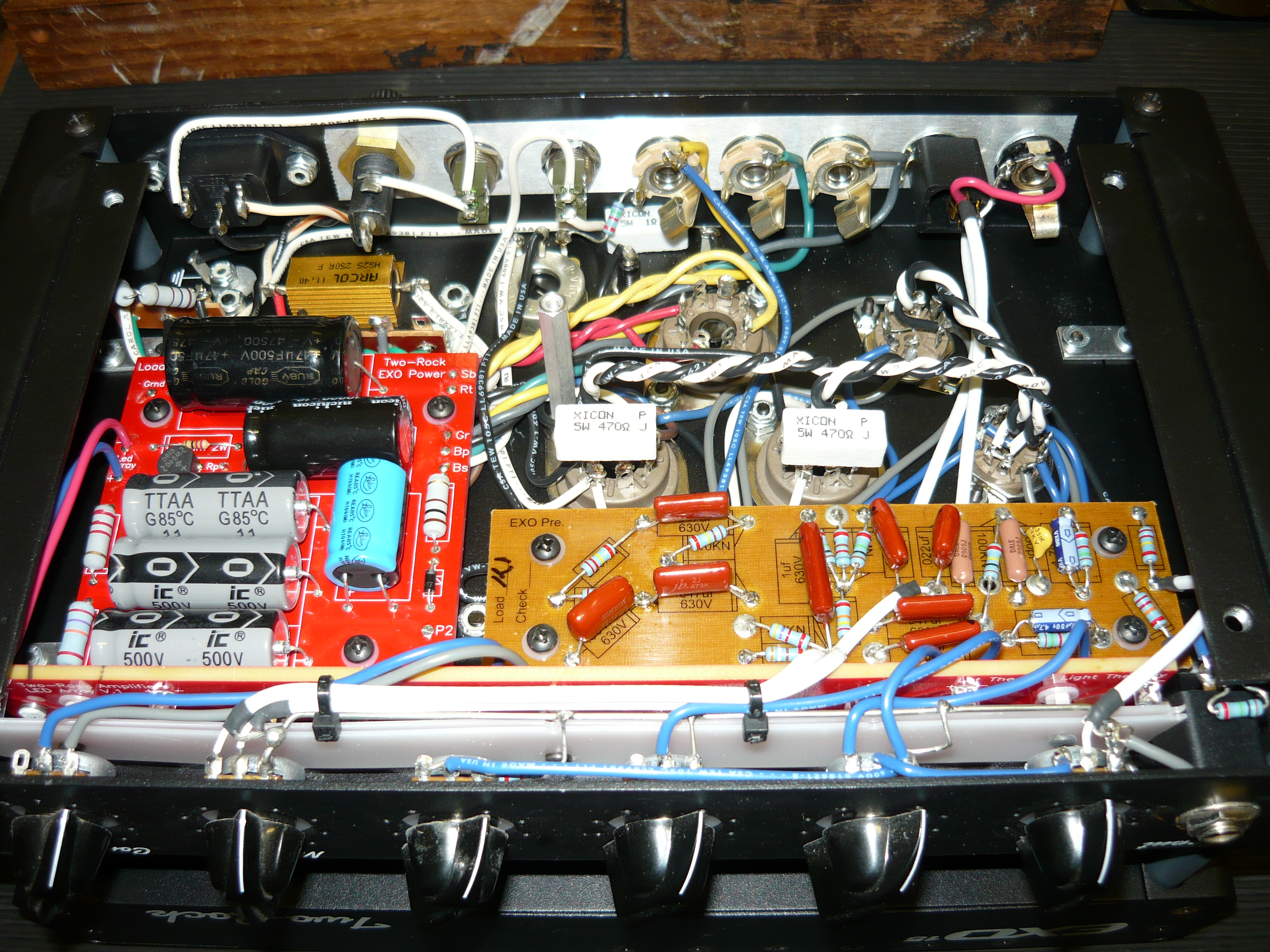
under the chassis view from the front

under the chassis view from the rear

Anecdotal evidence from the customer suggests this hasn’t been a particularly reliable amp. As this is our first service job on this particular amp, we are not familiar with its previous service history. Assembly is a combination of circuit boards and hand-wiring. All connections to valve sockets, jacks/pots/etc are hand-wired which of course we endorse. Components are of commercial standard but not “boutique” standard, with no apparent design problems.

under the chassis view from the front

under the chassis view from the front

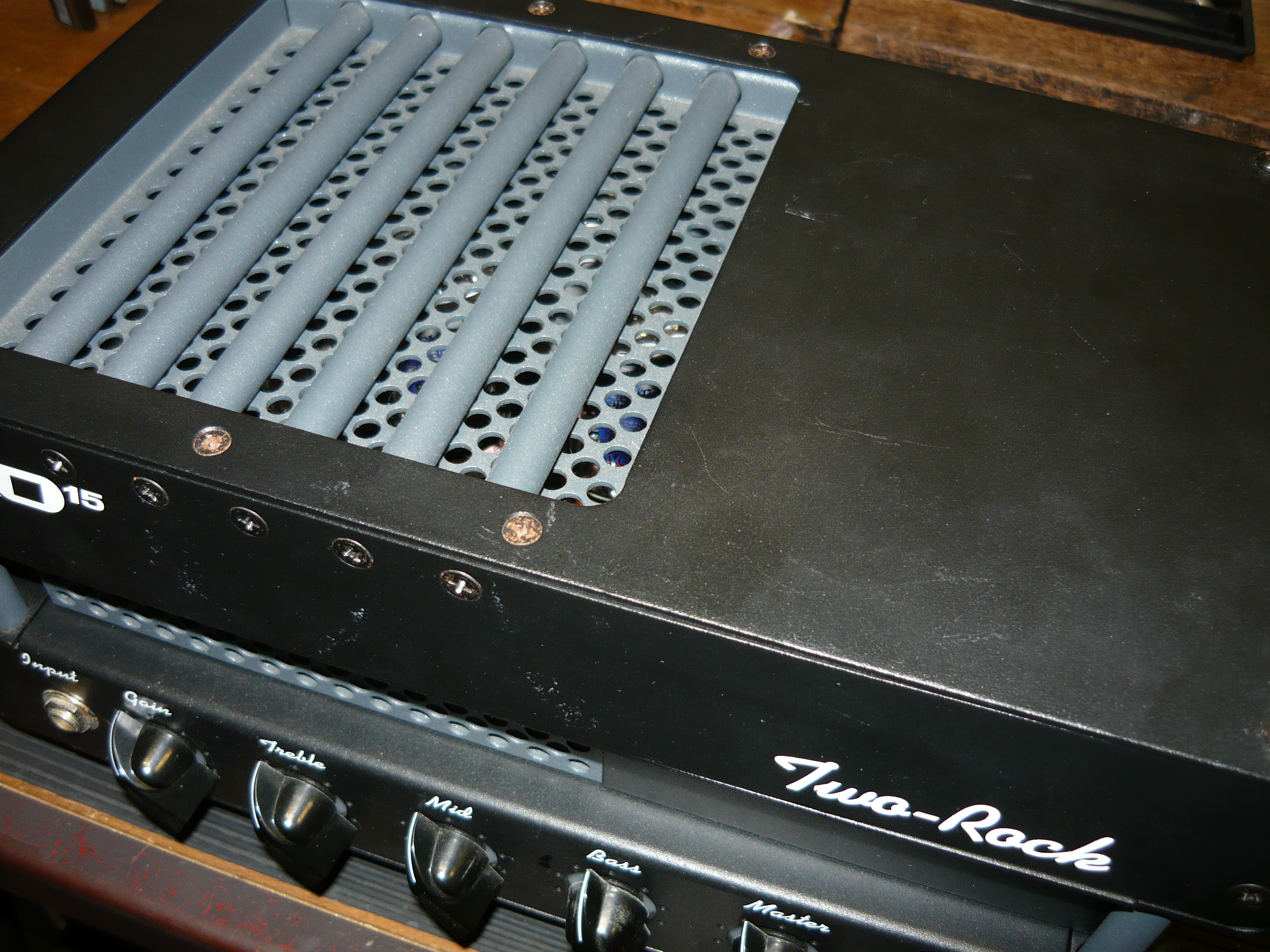
We replaced the blown mains fuse, and also the output valves & rectifier valve just to be on the safe side. Our initial choice of JJ 6V6 output valves was not a success, as they are too tall for the cover to fit back on !! We ended up installing a matched pair of 6V6GT by Electro-Harmonix, which have been pretty reliable at the voltages within this amp (+440V DC in our Wyoming NSW workshop). We rebiased for a sensible current draw with the 6V6’s (this may have been the problem all along ??), and measured the power output @ the onset of clipping = 22 watts.

ventilation grille at the top of the reassembled enclosure

ventilation grille at the top of the reassembled enclosure

We were looking for any other factors which may have contributed to the unreliability factor, at Sam’s request. When we looked at the speaker output jacks (4, 8 & 16 ohms), we were really disappointed at the nondescript quality of the jacks installed, and their current condition. We installed a trio of the very fine Switchcraft jacks, which grip the speaker plug very firmly for a positive connection. H/R (high resistance) or O/C (open circuit) speaker connections can cost you not only your output valves, but potentially also your output transformer. Always use the best available jacks & plugs for such critical connections.

Thankfully, no further problems have been reported with this amp. Many thanks to Sam for his continued custom, and for supplying us with the subject for this week’s blog !   IR.
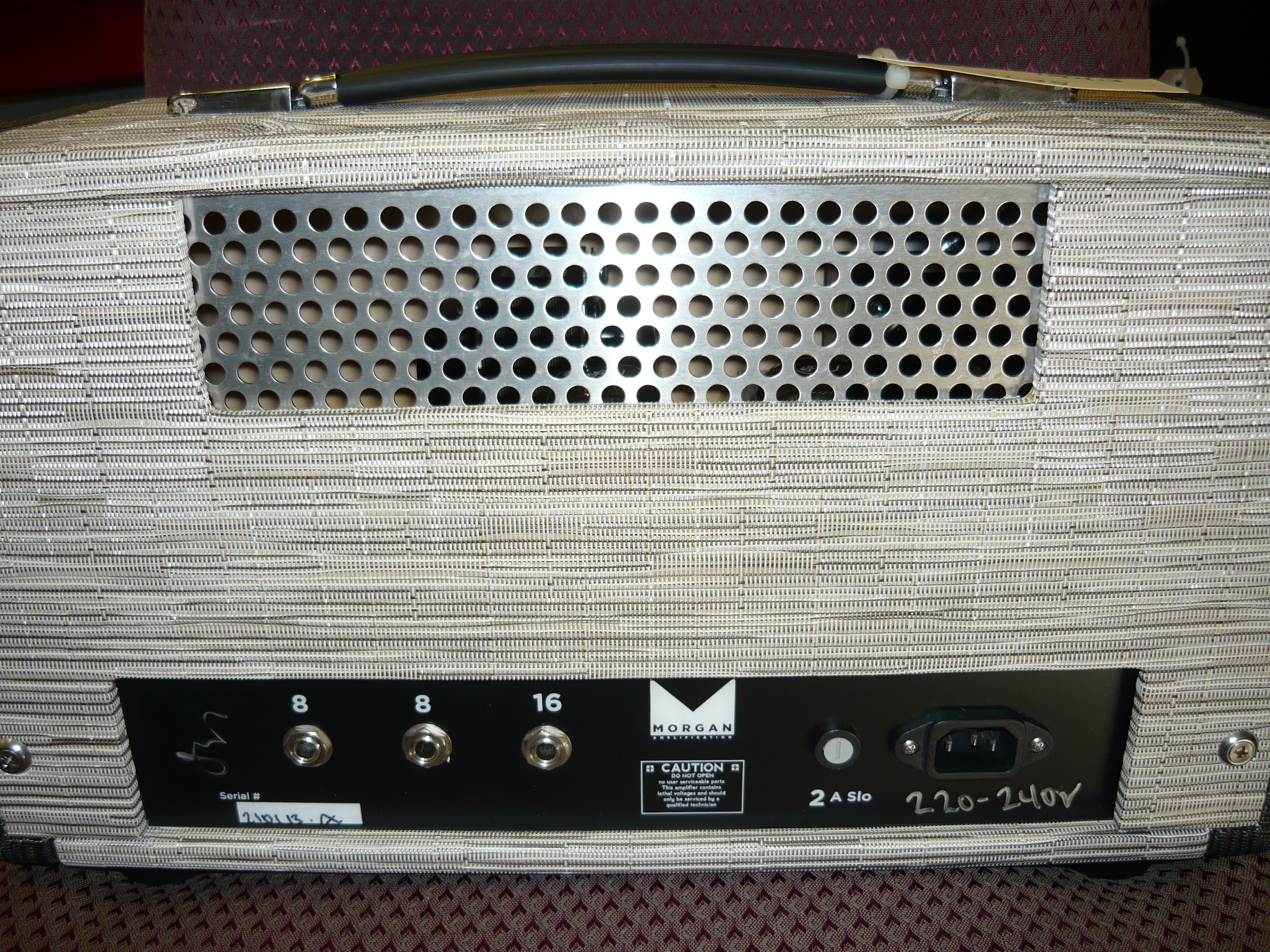
the WGS G12C/S specialist guitar speaker

April 16, 2014
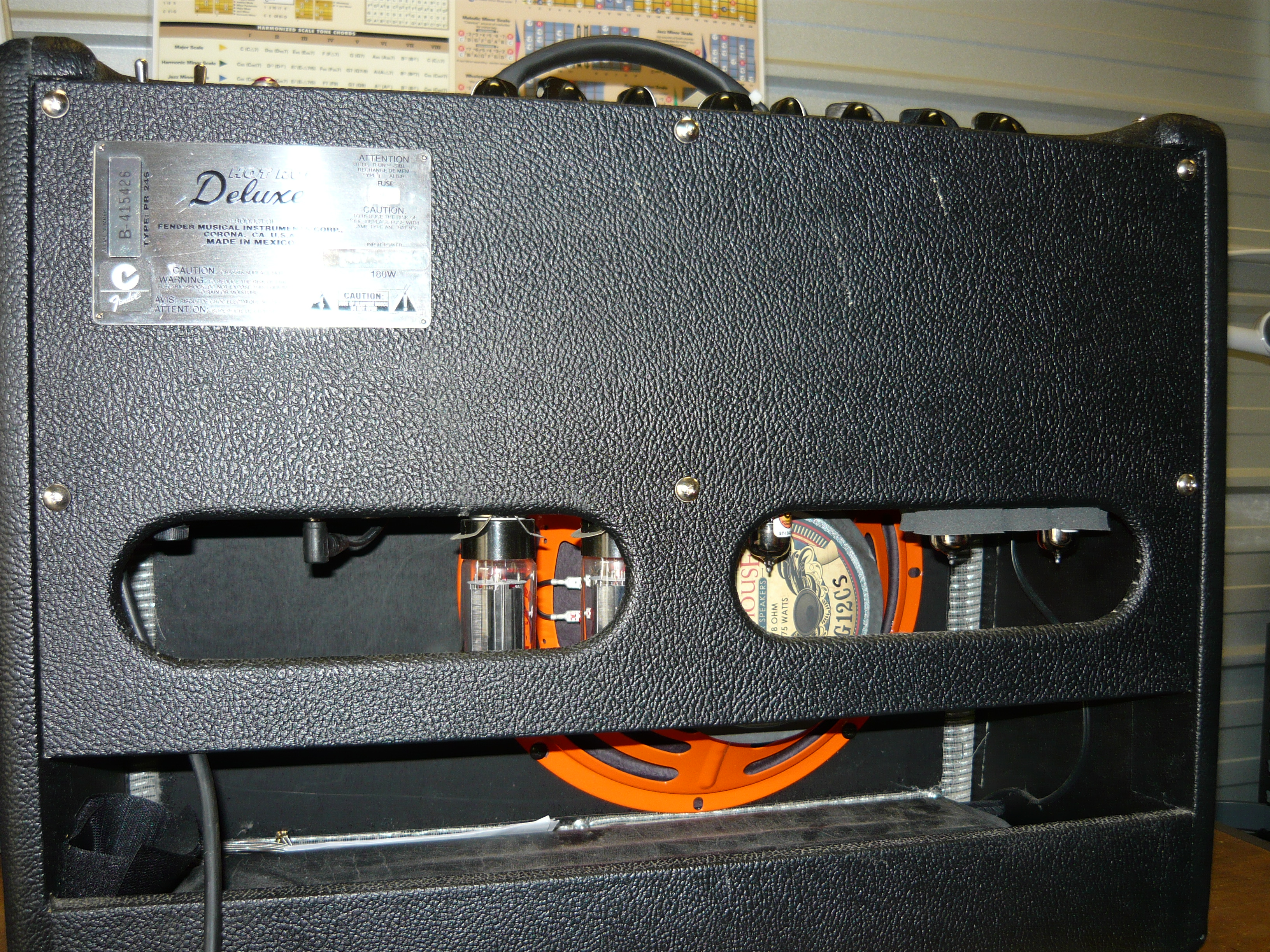
WGS G12C/S installed in a 'Hot Rod Deluxe'

WGS G12C/S installed in a ‘Hot Rod Deluxe’

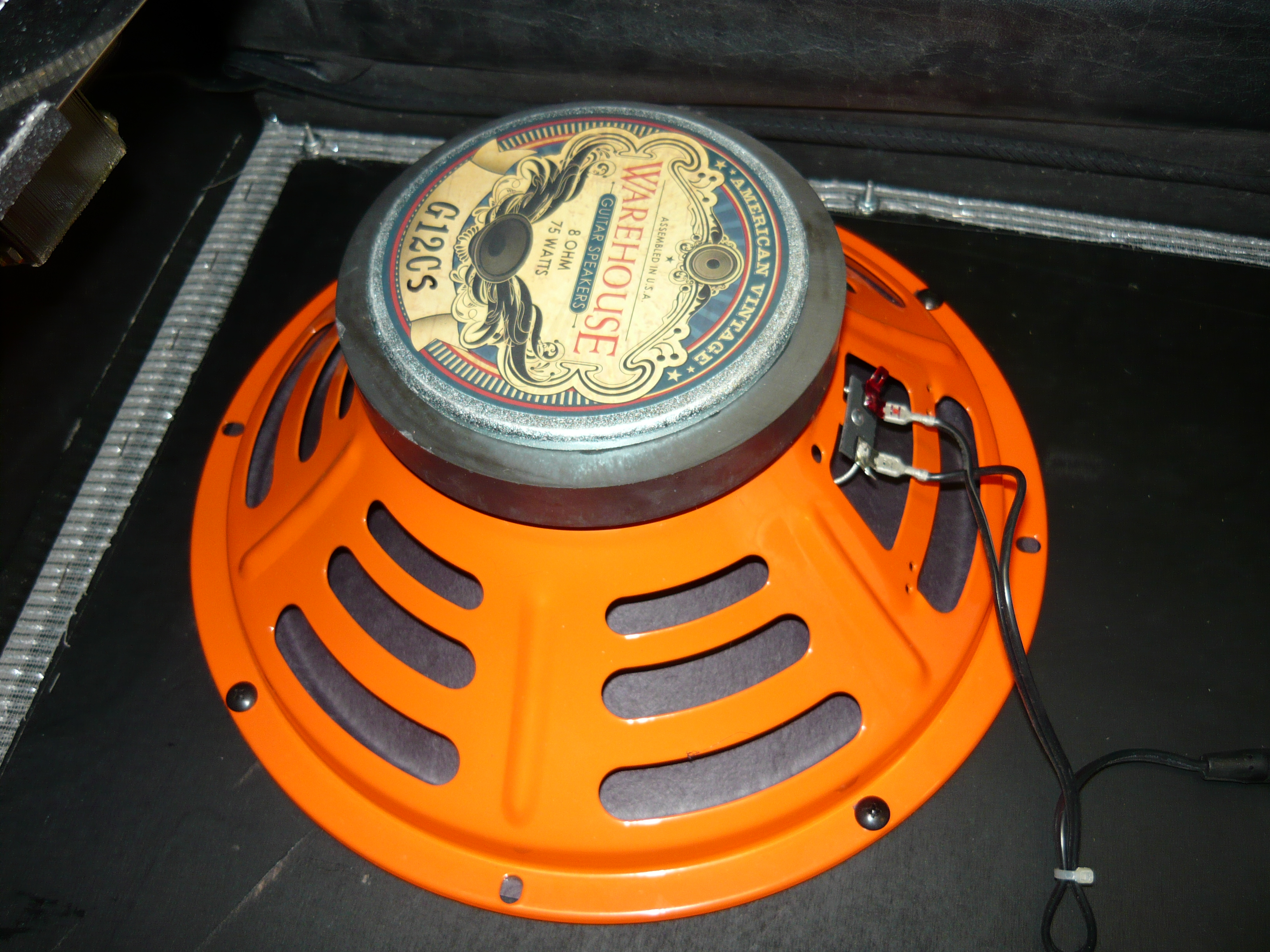
For this week’s blog we discuss an upgrade guitar speaker from the WGS [ie Warehouse Guitar Speaker] range – the G12C/S. This model is from the WGS ‘American Vintage’ range, and features a ceramic magnet, a smooth cone [hence the ‘S’ suffix], and a 75 watt power rating. We have been supplying Celestion and Weber guitar speakers for years now for our own Richards amplifiers, plus existing amp upgrades. But more recently we have additional upgrade speaker choices available from WGS.

WGS G12C/S loaded into a 'Hot Rod Deluxe'

WGS G12C/S loaded into a ‘Hot Rod Deluxe’

The G12C and G12C/S are obviously voiced for Fender style amps, and have that big American ‘clean’ sound, but with warmth and character. The smooth cone version is great for the brighter amps, and the seamed cone version is ideal for darker amps. This week we upgraded the stock Eminence speaker in a Fender Hot Rod Deluxe for new customer, Josh. The stock speaker is rather bland, as is often the case, and is rated for 50 watts only, which doesn’t allow a comfortable overload margin with a 40 watt valve amp.

Josh gives his upgraded amp the 'thumbs up'

Josh gives his upgraded amp the ‘thumbs up’

To say that Josh was pleased with the end result would be an understatement ! Josh plays a Gibson ES339 and is a jazz stylist and also plays a wide variety of styles in a church band. The improvement in tone, headroom and clarity from the upgraded amp was immediately apparent. That’s a Strymon Blue Sky reverb pedal sitting on top of the amp, and the leads are Dimarzio, also highly recommended.

Our all time personal favourite from the WGS range is the ET-65, which is their reinterpretation of the classic Celestion G12-65. It works amazingly well with both ‘British’ and ‘American’ voiced amps – very versatile. We have also recently tried the ‘Invader 50’, which is based on the famous Celestion ‘Greenback’ speakers, but beefed up to 50 watts, with more bottom end as well. WGS now have a distributor in Australia – our buddy Brad from The Speaker Factory in Brisbane. So now we can upgrade your amp with Celestion or WGS speakers ex-stock in Australia. Happy Easter 2014 ! IR.

the mighty HIWATT DR103

March 30, 2014
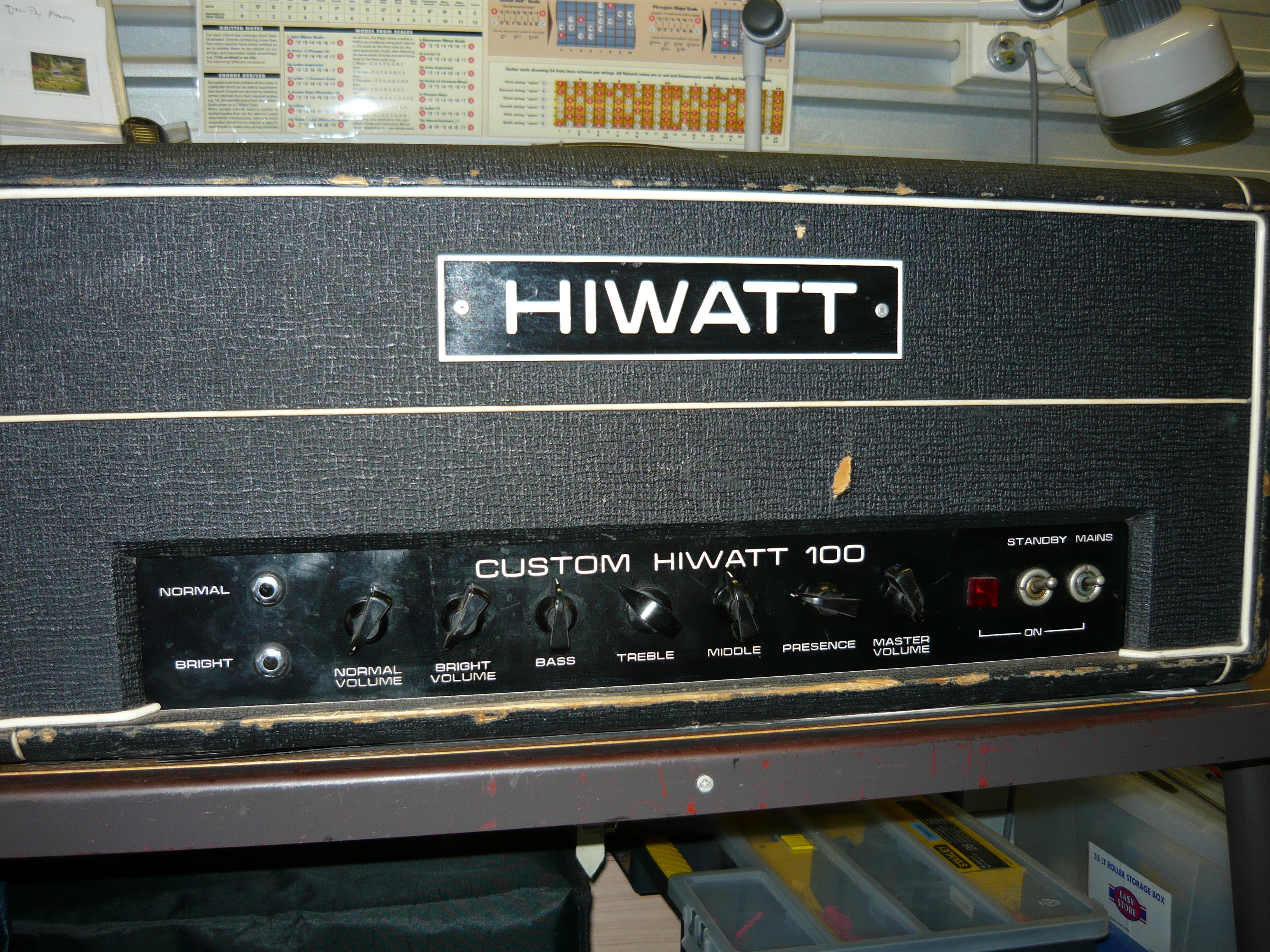
Hiwatt DR103 serial 12465 April 1978

Hiwatt DR103 serial 12465 April 1978

Hello & welcome back to our blog. We recently carried out service & repairs to a 1978 Hiwatt [UK] DR103 amplifier which obviously has had a long & hard working career in rock & roll bands. This DR103 is the 2-input model with active mixing of the normal & brilliant channels, as distinct from the late 1960’s/early 1970’s 4-input model with passive mixing of the two channels. We suspect that both versions of this model have their fair share of admirers.

DR103 front view of chassis

DR103 front view of chassis

This amplifier was working but had issues with microphony and very scratchy pots – some pots had dead areas on their sweep, so were barely useable. The amp had been modded by persons unknown further back in its history. The high frequency response of the brilliant channel had been boosted to ear-drum shredding levels, and was to all intents & purposes unuseable. Apparently the previous owner had only ever played on the neck position humbucking pickup of his 335 style guitar, hence the need for extreme high frequency pre-emphasis.

1978 Custom Hiwatt 100

1978 Custom Hiwatt 100

In addition to this problem, the amplifier had high levels of hum & noise. We started out by giving the chassis a quick clean up and tightened up a loose transformer. We checked the fuses, and as is so often the case in older amps, they were not offering any protection at all as they were the wrong values ! We installed new fuses, carried out an electrical safety check [PAT test], then moved on with the main part of the service.

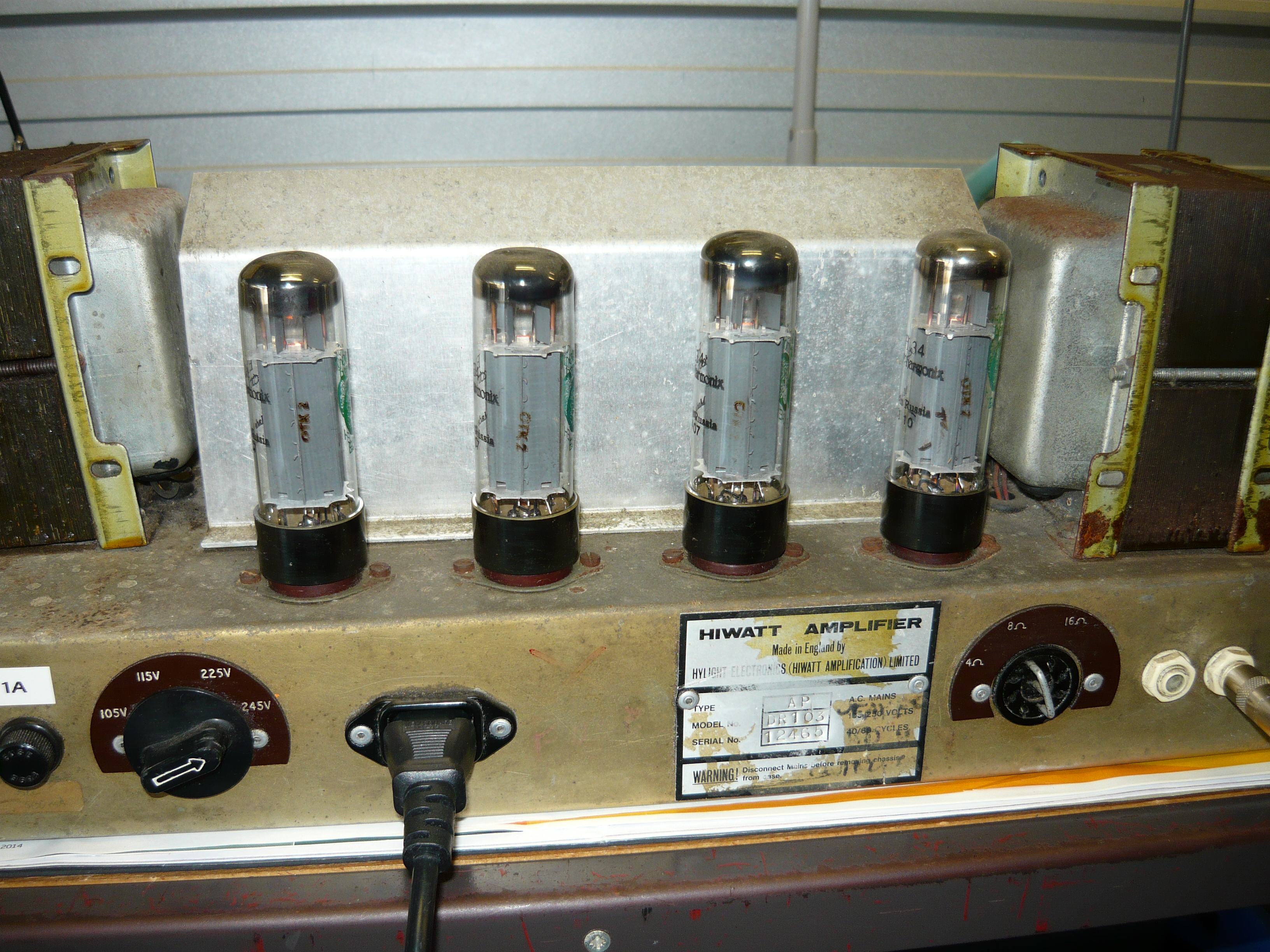
DR103 chassis rear view

DR103 chassis rear view

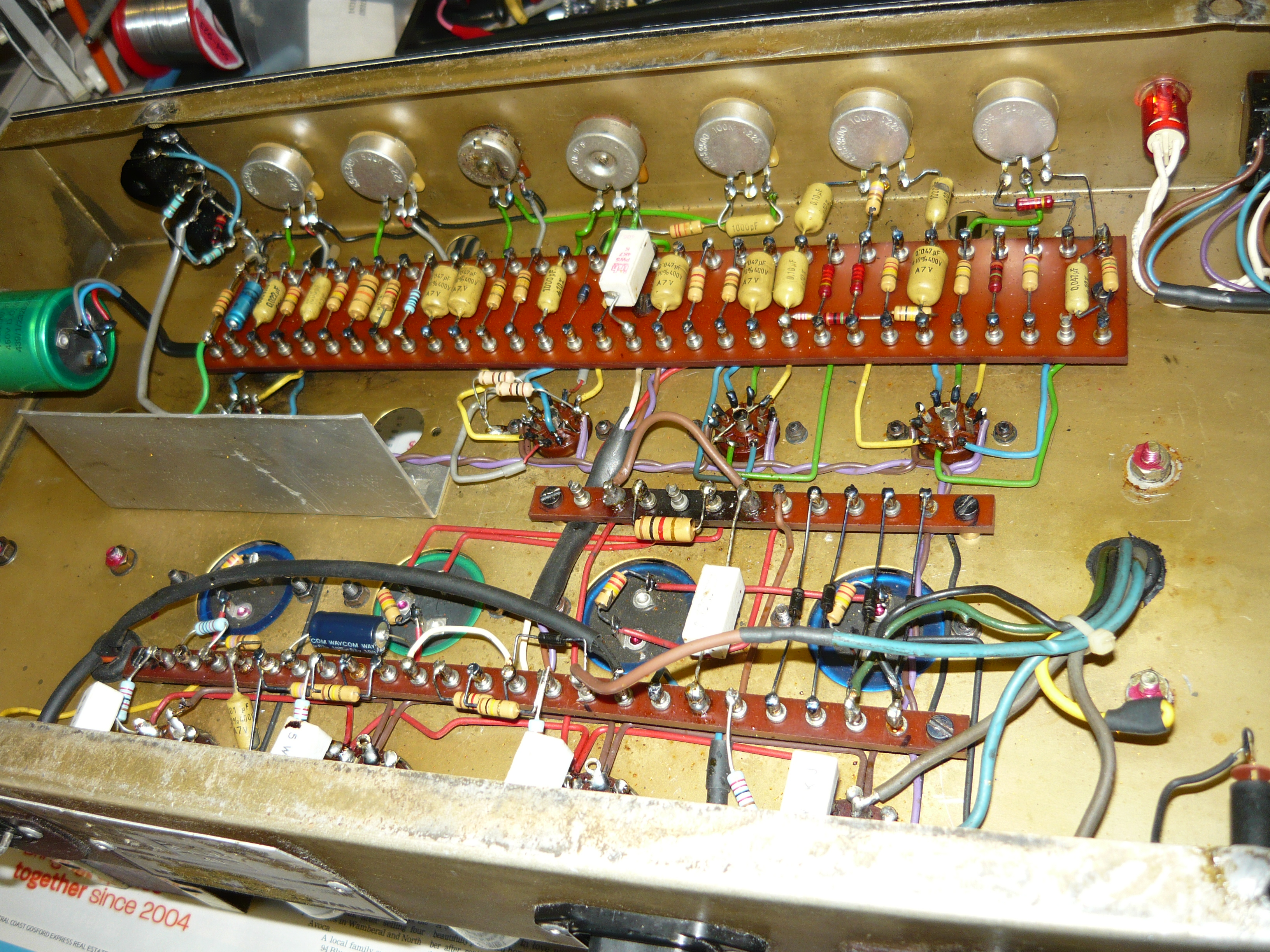
All pots [excepting bass & treble] were in very poor or damaged condition, so we replaced them with those excellent CTS pots. One source of unwanted noise came from the input jacks – they weren’t shorting to earth [ground] when the guitar lead jack plug was removed. We cleaned all input & output jacks, plus the 9-pin valve sockets with DeOxit, which corrected the remainder of the intermittent problems.

DR103 interior view of chassis after replacement of 5 x pots

DR103 interior view of chassis after replacement of 5 x pots

Two only of the preamp valves were tested as being faulty and/or microphonic, so we replaced those accordingly. All other valves, including the quartet of EL34’s tested OK. This amp has obviously been in regular use since manufacture in 1978, and the various electrolytic capacitors in the power supply still appeared to be serviceable. As the customer’s budget did not allow for complete replacement of electrolytics, we left them alone.

the DR103 nameplate tarnished by years of rock&roll

the DR103 nameplate tarnished by years of rock’n’roll

There was still a remaining source of hum within the amp, and this turned out to be a lack of earth [ground] reference for the 6.3V AC heater filament supply. The pair of 100 ohm resistors that provided a virtual centre-tap for the 6.3V AC looked perfect but measured O/C. We fixed this problem with the installation of a pair of 100 ohm 1 watt resistors. The final issue to be resolved was removing the MODs to the front end of the amp.


the mighty 1978 Hiwatt DR103

the mighty 1978 Hiwatt DR103

This DR103 already possesses a very bright voice, especially when plugged into the brilliant channel. The amp had been modded with a double layer of additional brightness, so the brilliant channel was unbearable with a Strat or a Tele. We restored the front-end circuitry to original spec, removing both MODs. How does this amp sound now ? Just fantastic, actually, although at 100 watts I would get thrown out of every gig we do these days, not to mention making my existing tinnitus problem even worse ! It’s just so British, with a warm & fat midrange, sweet & crisp top-end, and a tight but powerful bottom end. I love the balance of tone across the 6 strings of the guitar, but unfortunately for this amp to sound at its best, you have to play bloody loud.

So, we heartily recommend vintage Hiwatt amps as an investment for all you amp collectors out there – they were so well made in the first place, and are a pleasure to work on from the techo’s perspective. We are currently building several custom amps from 15 watts to 60 watts [to a customer order], that while not a carbon copy of the Hiwatt, are very strongly inspired by the Hiwatt and will deliver the classic British tonality at more sensible volumes. These amps are offered with a choice of EL34, KT66 or KT88 output valves. We also offer a single-ended KT88 model at 15 watts output.

Thanks for checking in again, and there’s plenty more amp talk to come. IR.
Service Centre for Jackson Ampworks in Australia

February 22, 2014
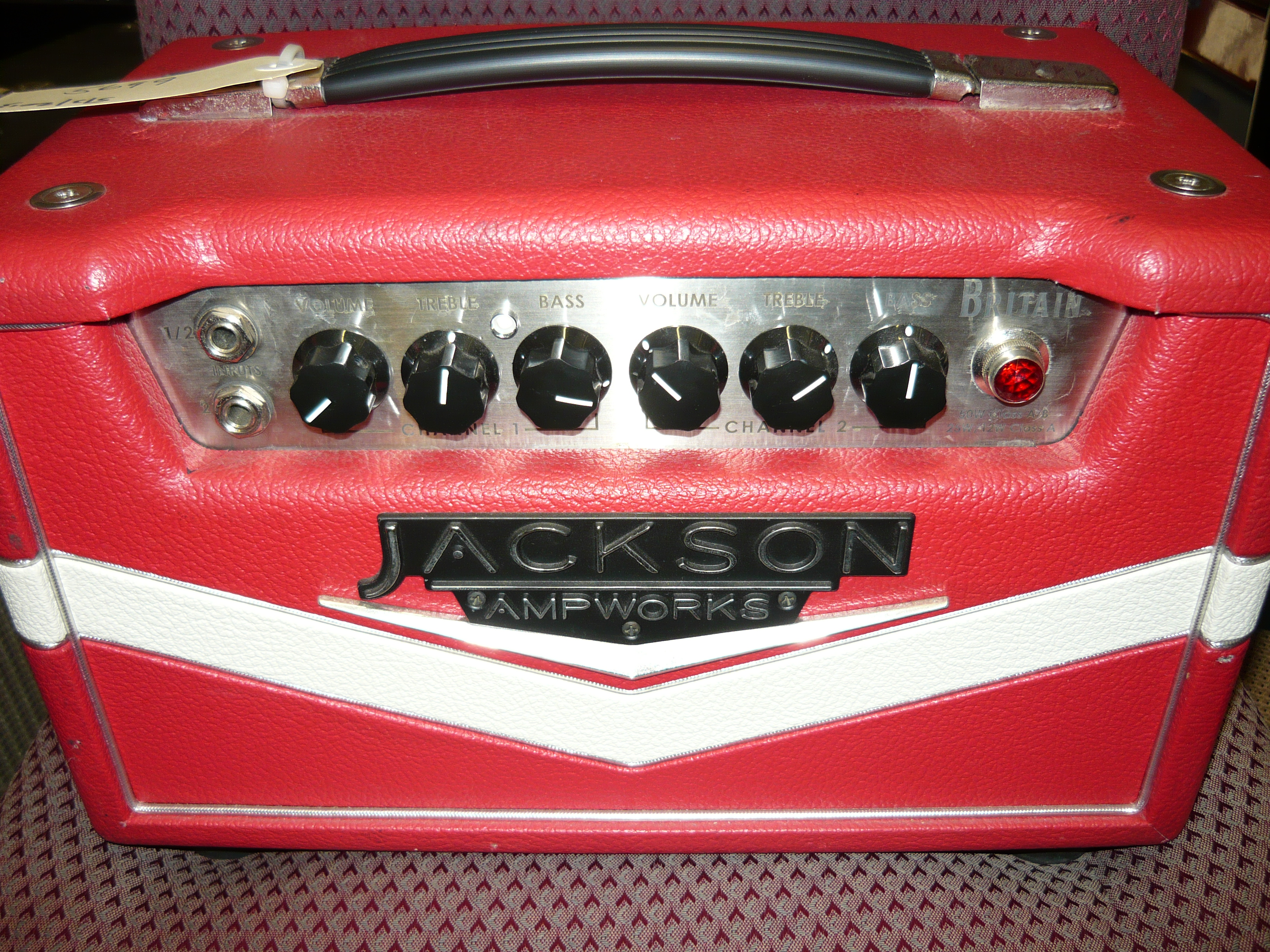
Jackson Ampworks 'Britain'

Jackson Ampworks ‘Britain’

Hello, welcome back to the blog. We are now offering world-class (non-warranty) service & repairs to the range of valve (tube) amplifiers from Jackson Ampworks of Keller, Texas USA. We should point out that we have no official relationship with Jackson Ampworks, so we cannot accept any warranty repair claims without the endorsement of their Australian distributor.

Jackson Ampworks 'Britain' amp head

Jackson Ampworks ‘Britain’ amp head

We recently serviced the Jackson ‘Britain’ amp for one of our customers, who is a guitar tutor and professional player – the amp is featured in the accompanying photos. The Jackson amps are built in Texas, but are British-voiced. The concept of the Jackson ‘Britain’ is broadly similar to our own Richards ‘Expressionist’ amplifier models – there are two discrete preamp channels, voiced as per vintage VOX amps.

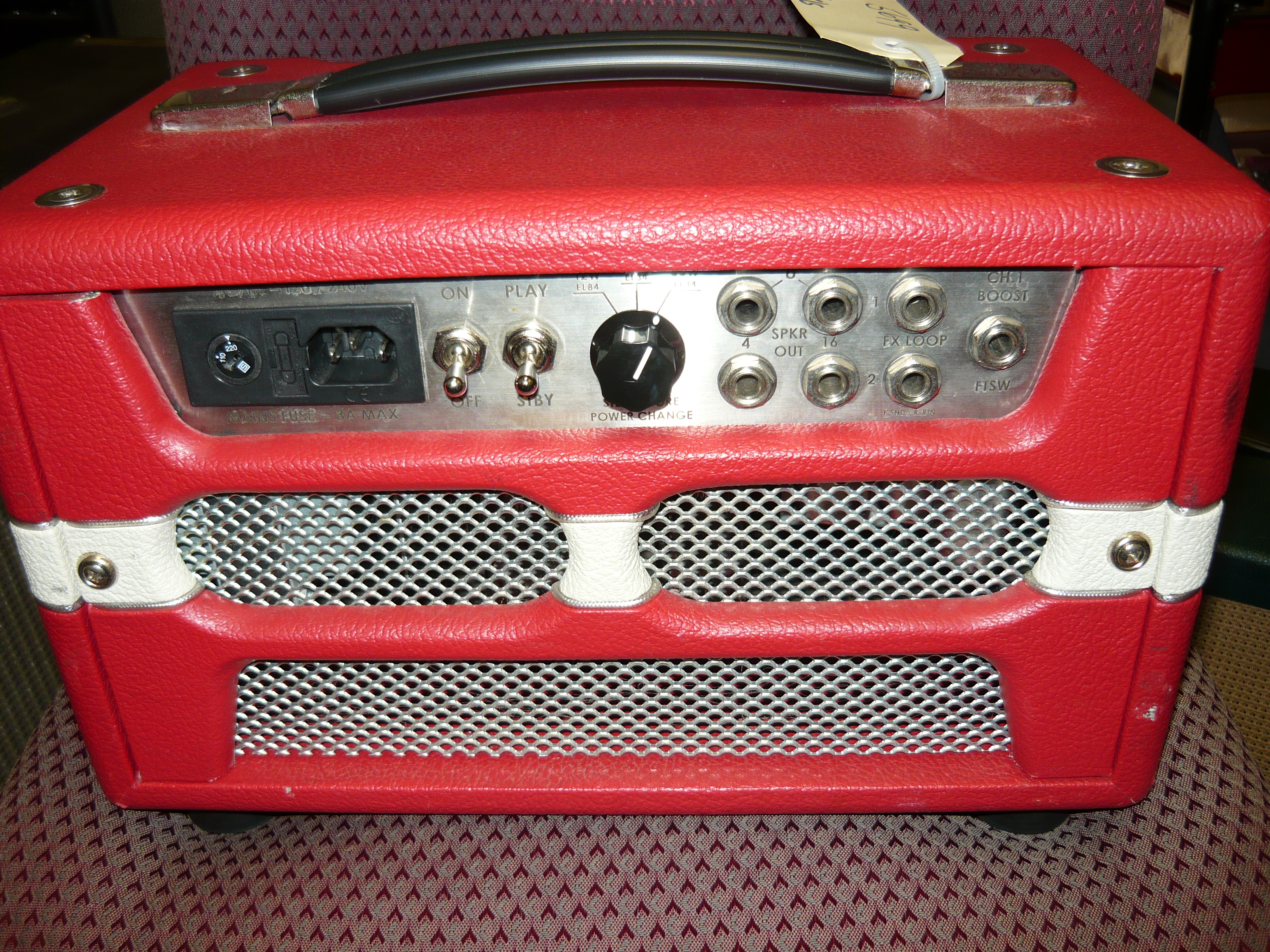
Jackson 'Britain' rear panel removed

Jackson ‘Britain’ rear panel removed

CH-1 is based on the EF86 pentode preamp valve (tube), and CH-2 employs the more familiar 12AX7/ECC83 valves and is effectively the top-boost channel. The EF86 is famously rather prone to microphony in guitar amps, but sounds absolutely wonderful in the right situation. The ‘Britain’ power amp section is switchable between a pair of cathode-bias EL84 valves for low power, and a pair of fixed-bias EL34 valves for full power.

Jackson 'Britain' chassis

Jackson ‘Britain’ chassis

The Jackson amp is very compact – about half the size of most comparable amps, ie amps in the 30 to 50 watt range. This amp depends absolutely on forced-air cooling for its survival, so if the fan ever stops working the amp needs to be serviced a.s.a.p. Some of the amp functions normally carried out by passive components appear to be implemented with the use of solid-state devices, which are mounted to vertical heatsinks, also in the forced-air cooling path.

'Britain' chassis: front view

‘Britain’ chassis: front view

Fortunately, for this service job there was nothing more serious than some noisy valves, which we replaced accordingly with a full check & test. The only problem we encountered was that the light aluminium chassis was quite resonant, at a frequency that was very close to the resonant ring from certain brands of EL34 power output valve that we tried in the amp. This was so noticeable that we substituted several brands before settling on the least resonant combination.

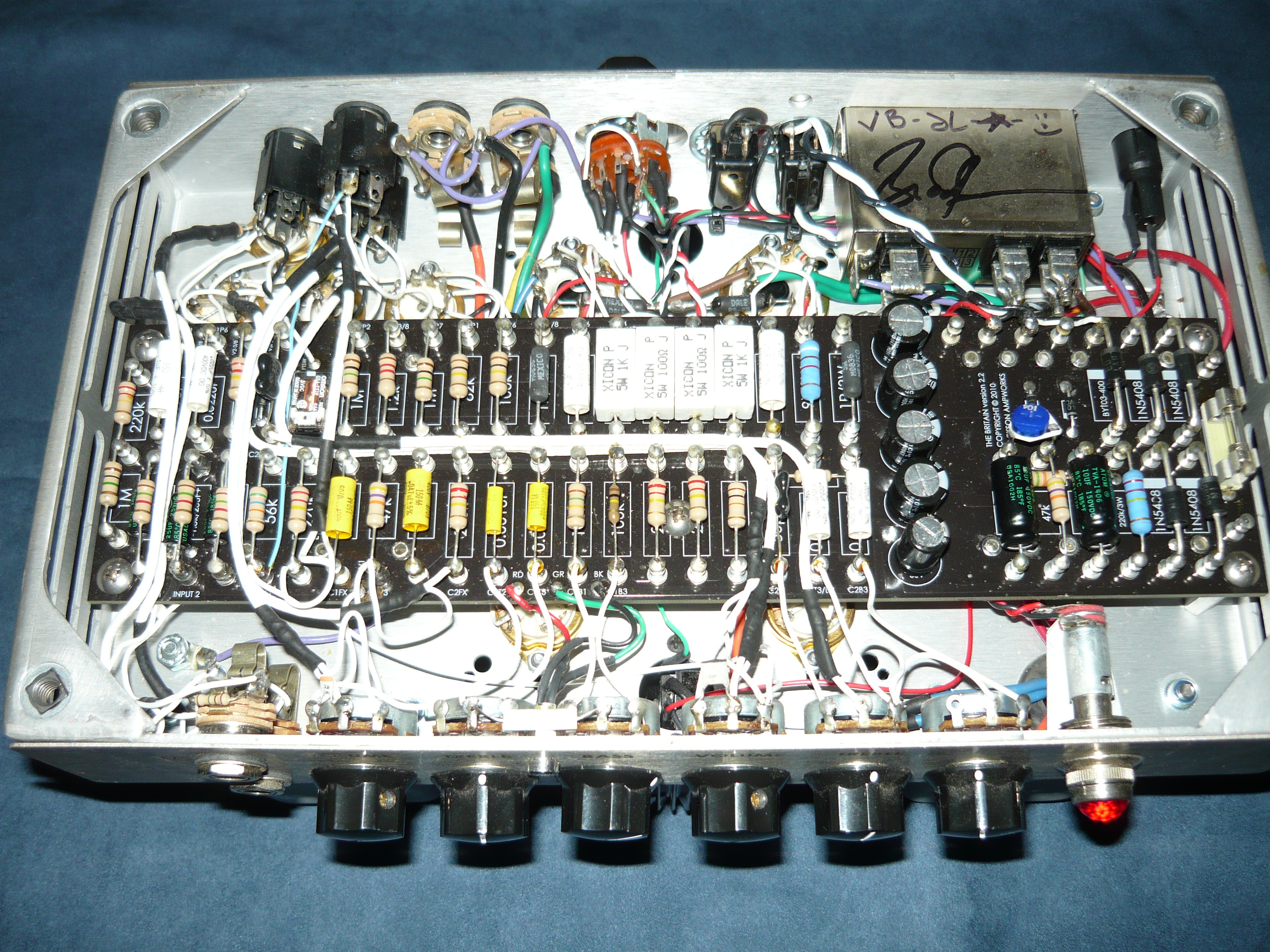
Jackson 'Britain' underneath the chassis

Jackson ‘Britain’ underneath the chassis

Finally, we were happy with the end result and our customer was pleased to get his amp back, working correctly again with unwanted noise at a minimum. You can see from the photo to the right that the amp is indeed hand-wired and the chassis layout is very tight indeed. Access to some components is limited or not possible at all without stripping out the electronics from the chassis.

Jackson 'Britain' chassis

Jackson ‘Britain’ chassis


Hardware components are by Carling, Switchcraft, Alpha and others – the standard of electronic components is also good. So there we have it – our very first experience of servicing the Jackson Ampworks product ! These amps look and sound great, but are relatively new to the Aussie music industry so we cannot pass any comments with ref to long term reliability issues. If you are in New South Wales and own a Jackson amp that needs servicing, please contact us @ ivan@ivanrichards.com

another Morgan amp in our workshop

January 27, 2014
Morgan RCA35

Morgan RCA35

Welcome to our first blog for the year 2014 ! Another Morgan amp came to our Wyoming workshop for repairs a while back – this time the RCA35 model. We previously discussed repairs to the Morgan SW50 back in January 2013. The RCA35 is voiced quite differently to the SW50, and is intended to be a ‘clean headroom’ amp, according to the Morgan website. A pair of cathode-biased 5881 output valves delivers 30 watts output @ the onset of clipping.

Morgan RCA35

Morgan RCA35

Our good customer, Josh, had purchased this amp about 6 months previously and advised us he was getting some very strange sounds, almost like an octave-fuzz pedal. At our first attempt to diagnose this, the RCA35 behaved perfectly so we were none the wiser. This situation happens sometimes ! After Josh got the amp back home again, of course it played up immediately, so he recorded the sounds on his ‘phone & sent them to us, and indeed the amp sounded like there was an octave fuzz pedal happening.

Morgan RCA35

Morgan RCA35

Back in the workshop, I strongly suspected that this degree of amp instability must surely be down to a faulty electrolytic capacitor (or capacitors) in the amp’s high voltage power supply. Josh was preparing to head off for a short tour in central western New South Wales with a band, so we couldn’t take the risk of leaving an intermittent fault in the amp. Therefore we took the decision to replace all four HV (high voltage) power supply caps, plus the cathode bypass cap for the output valves, just to be sure.

Morgan RCA35

Morgan RCA35

You can see from the photos that the original capacitors were of standard consumer electronics quality, and of recent production. There were no tell tale signs of leakage or faulty manufacture. We installed a set of those very fine F&T capacitors, bedded down in some silicone (neutral cure) for stability. Sprague ‘Atom’ capacitors would also be an ideal choice although their larger physical size sometimes limits their application in service work. The list of capacitors reads as follows: 2 x 30uF/500V, 2 x 22uF/500V plus 1 x 100uF/100V.

Morgan RCA35

Morgan RCA35

We also tightened a loose fuseholder and changed the fuse size from 2 amp to 1 amp as in Australia our mains power is obviously 240V (sometimes higher), and labelled the rear panel accordingly. The manufacturer and their local distributor really should have taken care of that particular issue. With the high voltage supply reading +430V DC, we measured 15.6V into 8 ohms = 30 watts @ the onset of clipping. We were pleased to hear that Josh got through his tour OK and there were no further problems with this amp !

Morgan RCA35 original HV capacitors

Morgan RCA35 original HV capacitors

Morgan RCA35 upgrade caps installed

Morgan RCA35 upgrade caps installed

Margan RCA35 after completion of repairs

Morgan RCA35 after completion of repairs

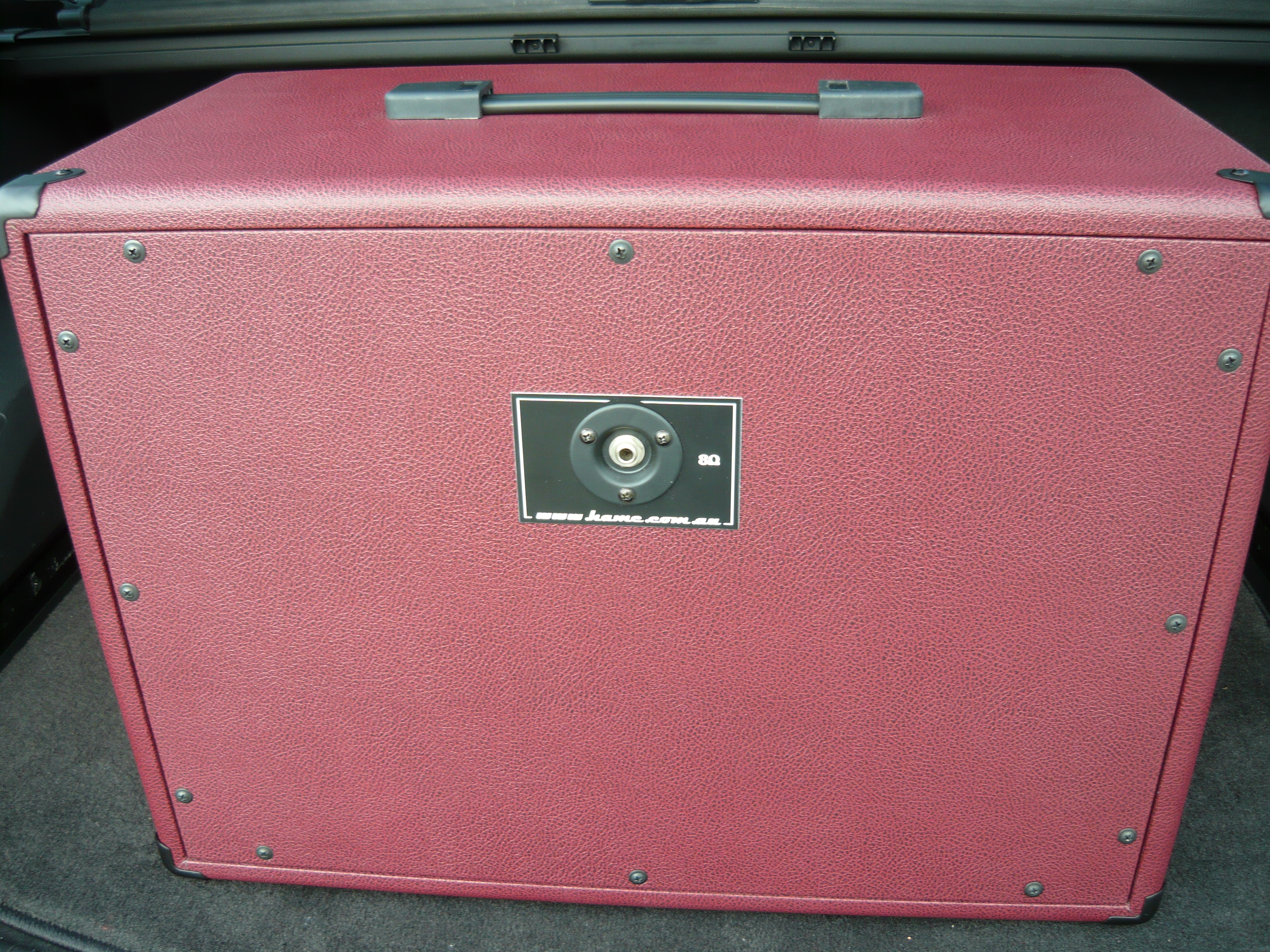
Ivan’s new Hame 1×12 cab

December 13, 2013
Hame 1x12 cab

Hame 1×12 cab

Hello & welcome back to our blog. Occasionally our customer amplifier projects require the input & support of a specialised cabinet builder, for work that is beyond our amp building workshop’s resources. For example, we have utilised the unique cabinet building skills of Mr Peter Davies (ex NSW Central Coast, now resident in Melbourne) several times for our exotic hardwood cabs.

Hame 1x12 cab

Hame 1×12 cab

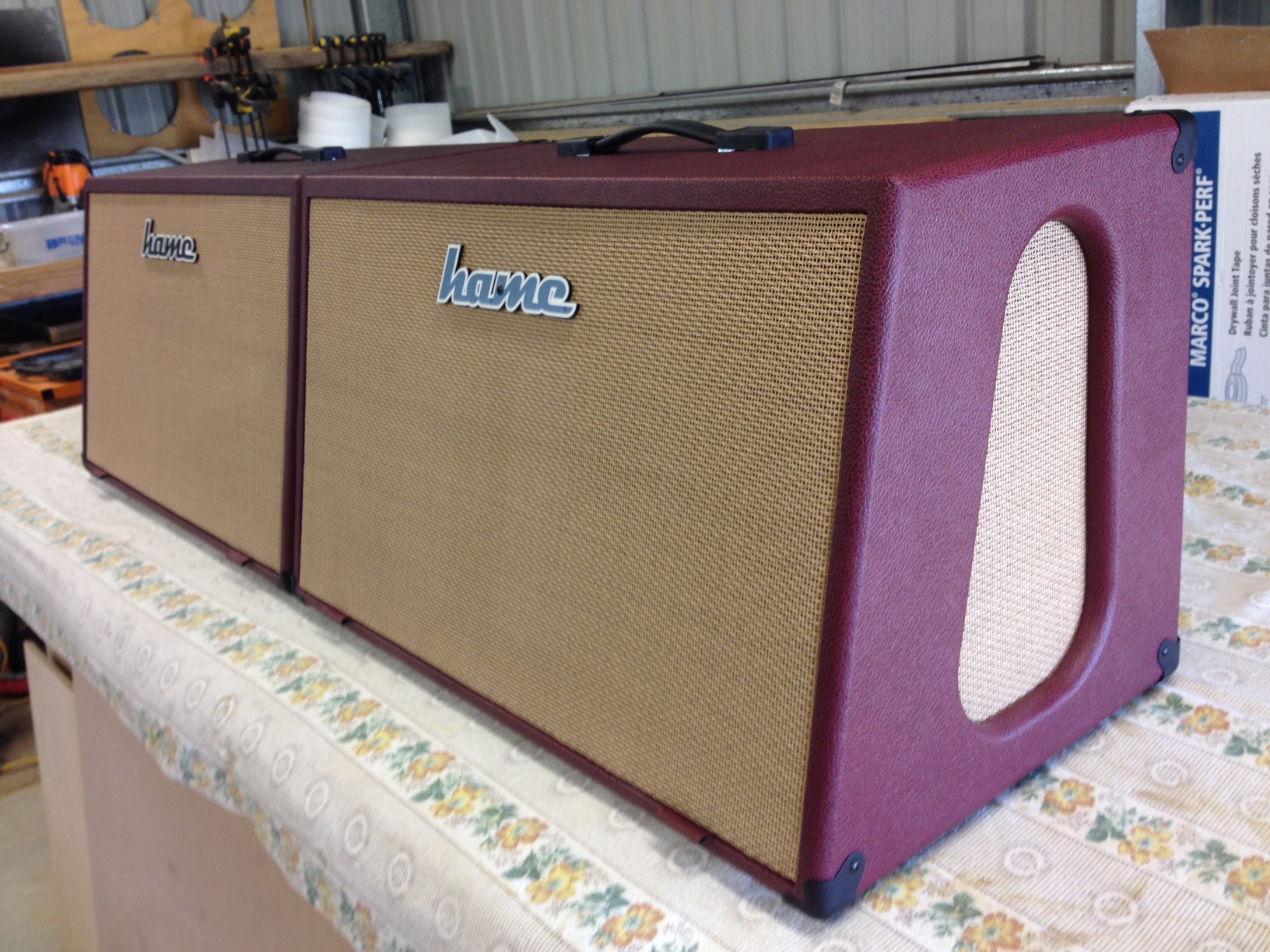
More recently we have enlisted the help of Mr Brandt Horrocks of Hame Speaker Cabinets (Wagga Wagga NSW) to produce a pair of specialised 2×12 cabs for baritone guitar stylist, Mr Chris Earle. As a spin off from that project, Chris also ordered a pair of somewhat more compact 1×12 cabs, one each for Chris & Ivan, for rehearsals & lounge gigs. We will look at the 2×12 cabs in greater detail in a later blog, as part of the broader Chris Earle project.

Hame 1x12 cab

Hame 1×12 cab

This 1×12 cab design is a much simplified version of the original 2×12 cab design, which included angled speaker baffles. In both cases, the cab design allows sound to pass through vents on either side of the cab. These vents are not tuned, as in a “bass-reflex” system (ie, the cab is “de-tuned”). Sound emanates from the sides of the cab much as it would from the rear of an open back cab, while providing better dispersion & more consistent tone from venue to venue. In the 2×12 cab design internal angled reflectors push the sound from the rear of the speakers to the side vents.

Hame logo

Hame logo

The end result is a speaker cab that is never “boxy” or “boomy”, with outstanding dispersion, clarity & a solid low-end. The intended companion amp for Chris Earle’s 1×12 cab is a brand new model from the Richards Amplifier Company – Australia: the KT88se, ie a single-ended/class-A KT88 amplifier. This amp will be part of the “British Lead” series, meaning that the front end is voiced as per some of the classic amps from the golden-age of British rock. This amp is the result of months of R&D during 2013, & will be the subject of a future blog.

the pair of 1x12 Hame cabs under construction

the pair of 1×12 Hame cabs under construction

Please take the time to check out these photos of the new cabs. Regards – IR.

under construction

under construction

completed

completed

completed

completed

completed

completed

2x12 cabs completed

2×12 cabs completed

MODs to the Marshall Class 5 amplifier

December 5, 2013
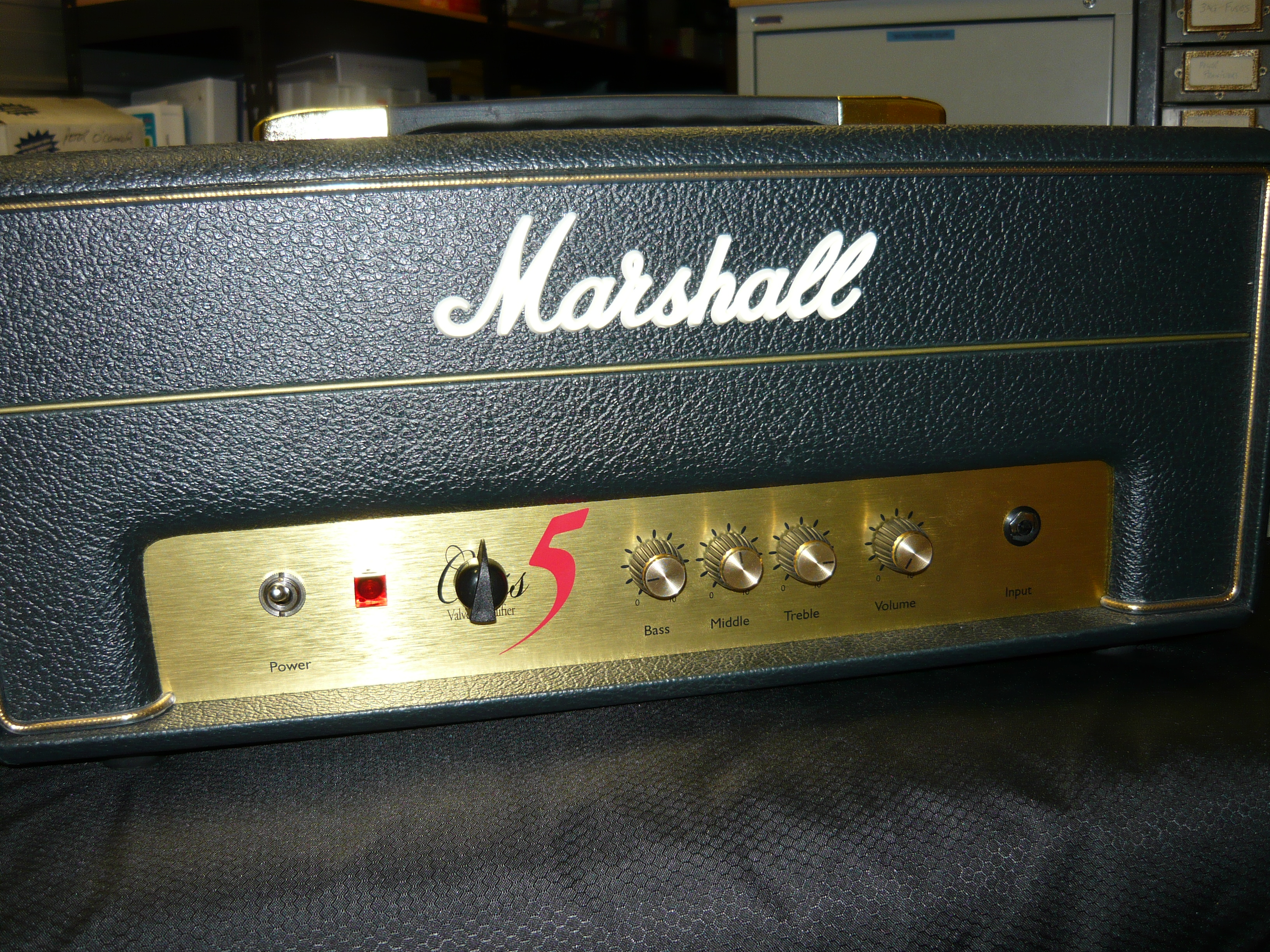
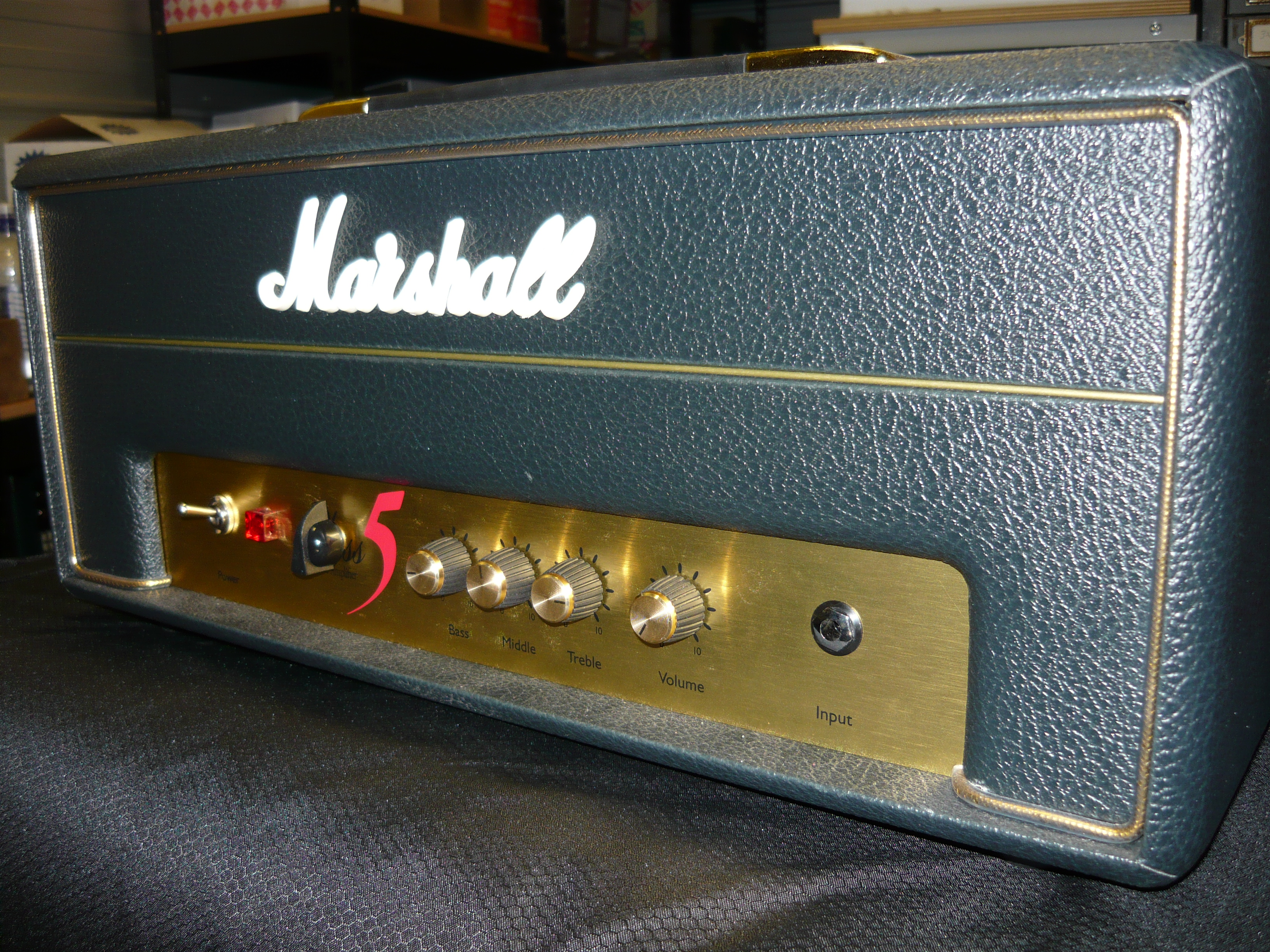
the modded C5

the modded C5

Welcome back ! Over the last couple of years, in our blog pages we have presented MODs to the Marshall JTM600/JCM600 amps, Peavey Valveking 100, Fender Pro Junior & Blues Junior, Laney LC30, amps by Rivera, bass amps by David Eden, plus wah wah pedal MODs. We offer all these MODs and more here in our Wyoming workshop.


Marshall Class 5

Marshall Class 5

In the coming weeks we will publish a blog re our home-grown MODs to the HIWATT 20H valve amp head, which is a seriously disappointing amp (sorry about that, HIWATT !). But our latest MOD project to present to you is the Marshall C5 amp. These amps have sold really well in OZ due to a very reasonable price point for a made-in-UK Marshall with an all-valve (tube) signal path.

Marshall C5

Marshall Class 5

Unfortunately, the C5 straight out of the box is not an amazing sounding amp. The 3-band tone controls do not seem to have a particularly effective sweep, and especially not at the frequencies you expect from a Marshall (ie, the “Plexi” or “Super Lead”), plus due to the absence of a master volume control or attenuator – 5 watts is still too loud in some home playing or recording situations.

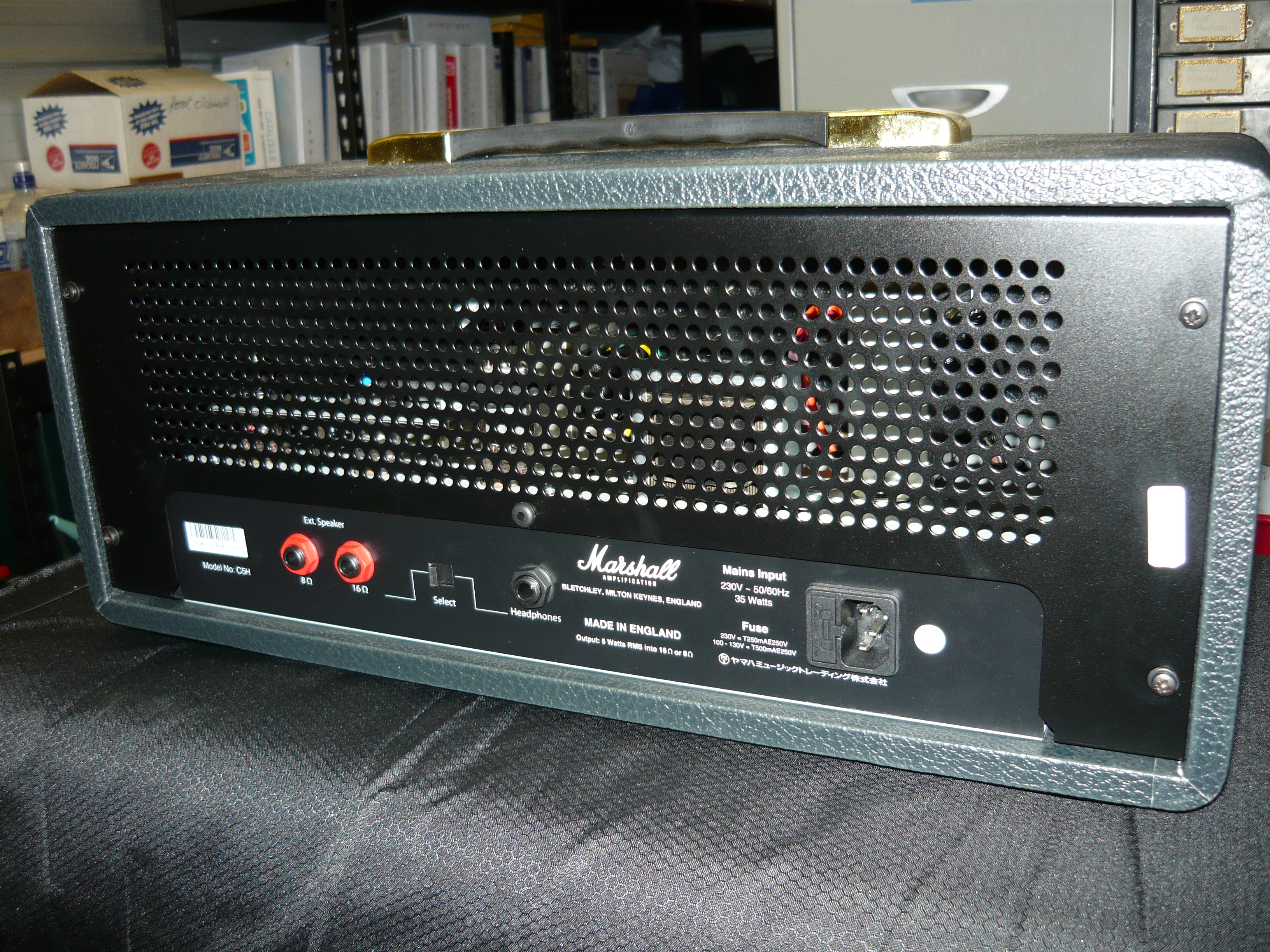
C5 chassis with original transformers

C5 chassis with original transformers

We agreed to implement the full range of possible MODs to this C5 for our customer, to transform the amp from a just OK unit into a high performance tone machine, with the option of turning down to conversation levels with the addition of an attenuator (controlled from the front panel).


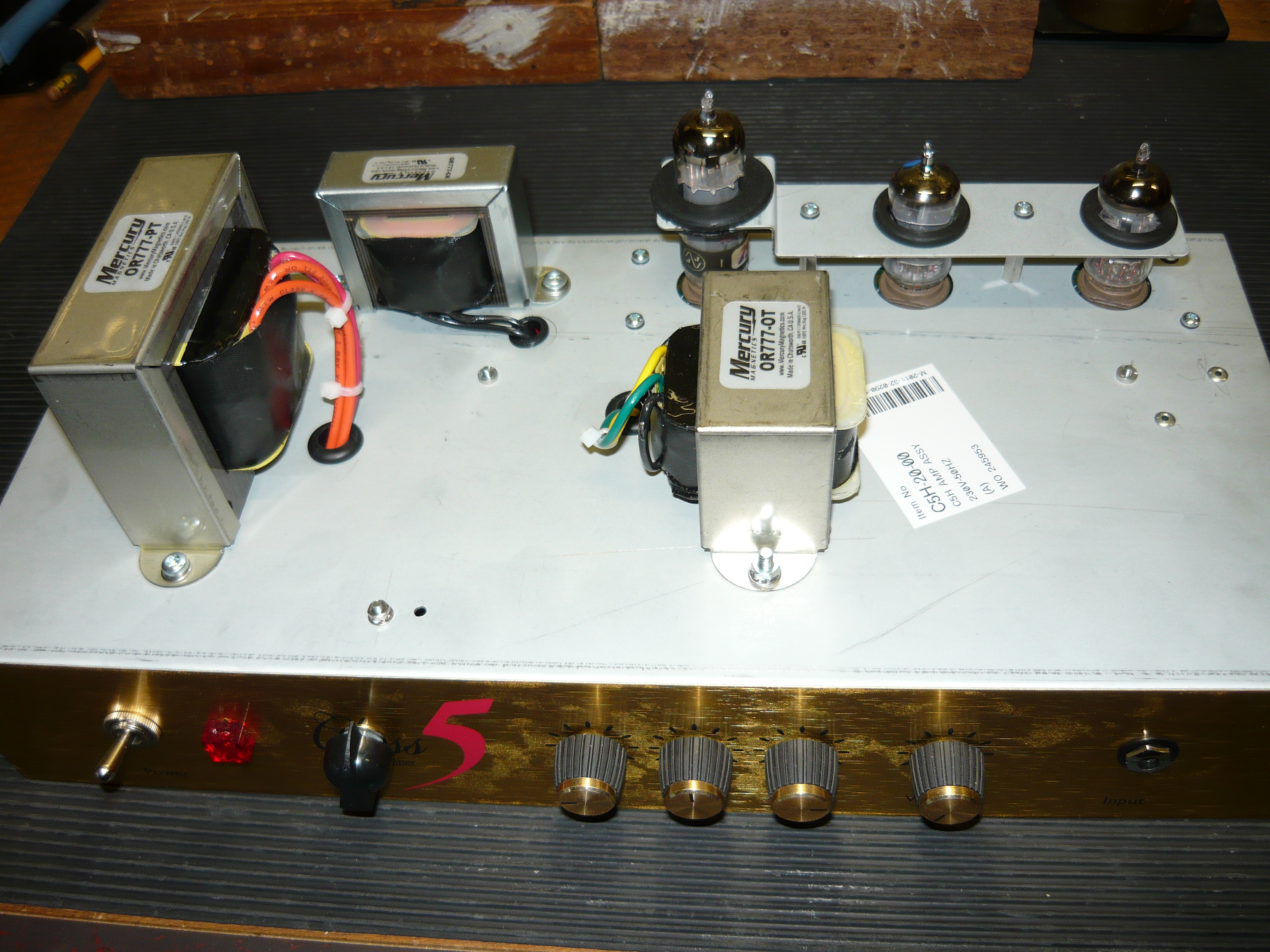
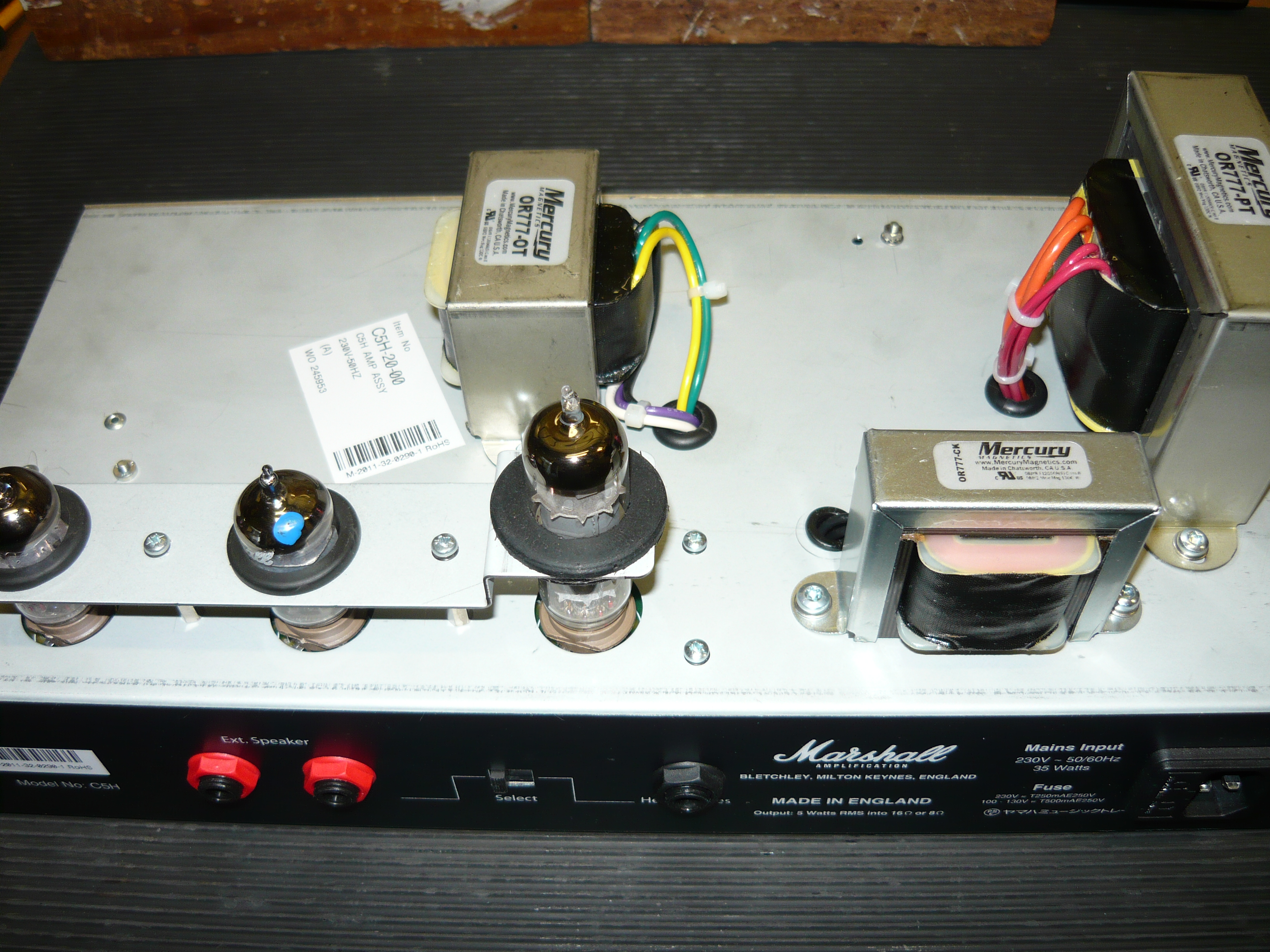
C5 chassis with mercury Magnetics transformer set installed

C5 chassis with mercury Magnetics transformer set installed

Mercury Magnetics have developed a transformer set specifically for upgrading the C5, which comprises power transformer, filter choke & audio output transformer. Our customer requested installation of the full set. The addition of a filter choke will improve the performance of this Class-A/single-ended design significantly.


C5 chassis after mods

C5 chassis after mods

Other C5 MODs that we recommend include (in no particular order): raise input impedance R20 & remove C10, change cathode bypass cap C8 for tighter/plexi lows, add a (subtle) ‘bright’ cap across VR1, change ‘bass’ EQ cap C20 to implement a useable (plexi) sweep, change ‘slope’ resistor R28 for a more balanced (plexi) sound, change signal path caps C2 & C5 for improved lows & low-mids.

C5 p.c.b. connections & installing the VVR module

C5 p.c.b. connections & installing the VVR module

There are several other potential MODs which will have a less significant effect. The law of diminishing returns starts to kick-in. Note that all the above modding requires removal of printed circuit boards (p.c.b.’s), and changes to p.c.b. connections. The final MOD to this amp is the installation of a VVR module, available commercially on-line, to compensate for the lack of a master-volume or attenuator on the C5.

C5 p.c.b. connections- looking to the rear of chassis

C5 p.c.b. connections- looking to the rear of chassis

The VVR (Variable Voltage Regulator) is a relatively simple circuit that when installed in an amp such as the C5, will make the high voltage DC supply (usually referred to as HT, HV or B+) continuously variable from the maximum normally available from the amp’s existing power supply, to a minimum level which is preselected by changing resistor values on the module. In other words, by electronically varying the high voltage supply within the guitar amp, we succeed in reducing the audio power output of the amplifier from its design maximum to a preset minimum.

the VVR module requires 2 x additional chassis holes

the VVR module requires 2 x additional chassis holes

The VVR module employs a high-voltage power Mosfet device such as the NTE2973. In most cases it will need a heatsink, and ref the C5 bolting the Mosfet to the chassis is quite adequate. Thus we will need to accurately drill/punch 2 x additional holes in the C5 chassis – 10mm for the VVR control mounted conveniently to the front panel, plus 3mm for mounting the Mosfet, which must also be insulated from the chassis.

C5 front panel - the VVR control installed

C5 front panel – the VVR control installed

It just happened that a convenient place to install the VVR control is right where the Class 5 logo appears. It doesn’t look too bad actually, and our customer was happy with that, however it is an issue to take into consideration. We didn’t have any suitable Marshall-style control knobs to suit, so we ended up using a small “chicken-head” knob from Cliff.

Any of the power amp attenuation devices such as the VVR or London Power Scaling (for example) will solve the problem of reducing power for playing in the home, as will speaker attenuators such as the THD Hotplate & so on, in the latter case the amp still runs at normal power levels but the output is attenuated before it reaches the speaker. In spite of all the hype about some of these devices, they DO have a quite noticeable effect on tone & performance – it’s inevitable ! By definition, reducing the available voltage to the valves (tubes) will impact on dynamics & tonality – the various types of output valves in common use in guitar amps will sound & behave differently at different B+ voltage levels. Lower voltages particularly impact on the low frequency response of a given amp design.

We are happy to install devices such as the VVR in your amp (where appropriate) – just keep in mind that there is a trade-off.

By the way – our customer just loves his upgraded C5 amp now ! IR.
Warning !

While the VVR described above is a simple circuit it is not a simple MOD to install. It should only be installed by a suitably qualified amplifier service technician.
Valves [vacuum tubes], transformers, capacitors, amplification circuits found within a guitar amplifier operate at high voltages that can cause permanent injury, disability or death. Never attempt to repair, modify, test, work on or touch electronic equipment unless you are trained or otherwise qualified to do so.

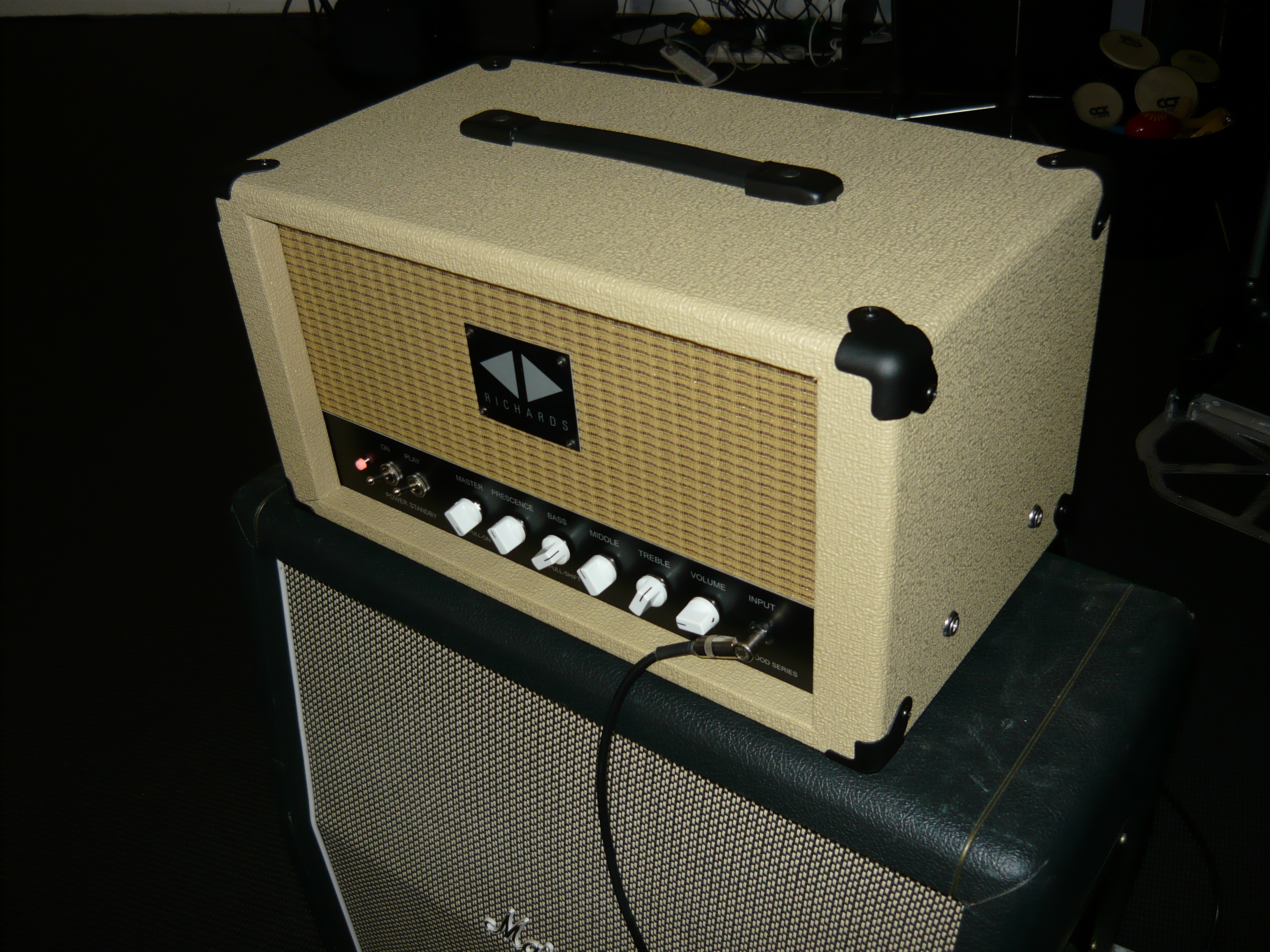
Brett takes delivery of his custom Blue Mood 30W EL34 head

December 1, 2013
Blue Mood EL34 head in rough blonde tolex

Blue Mood EL34 head in rough blonde tolex

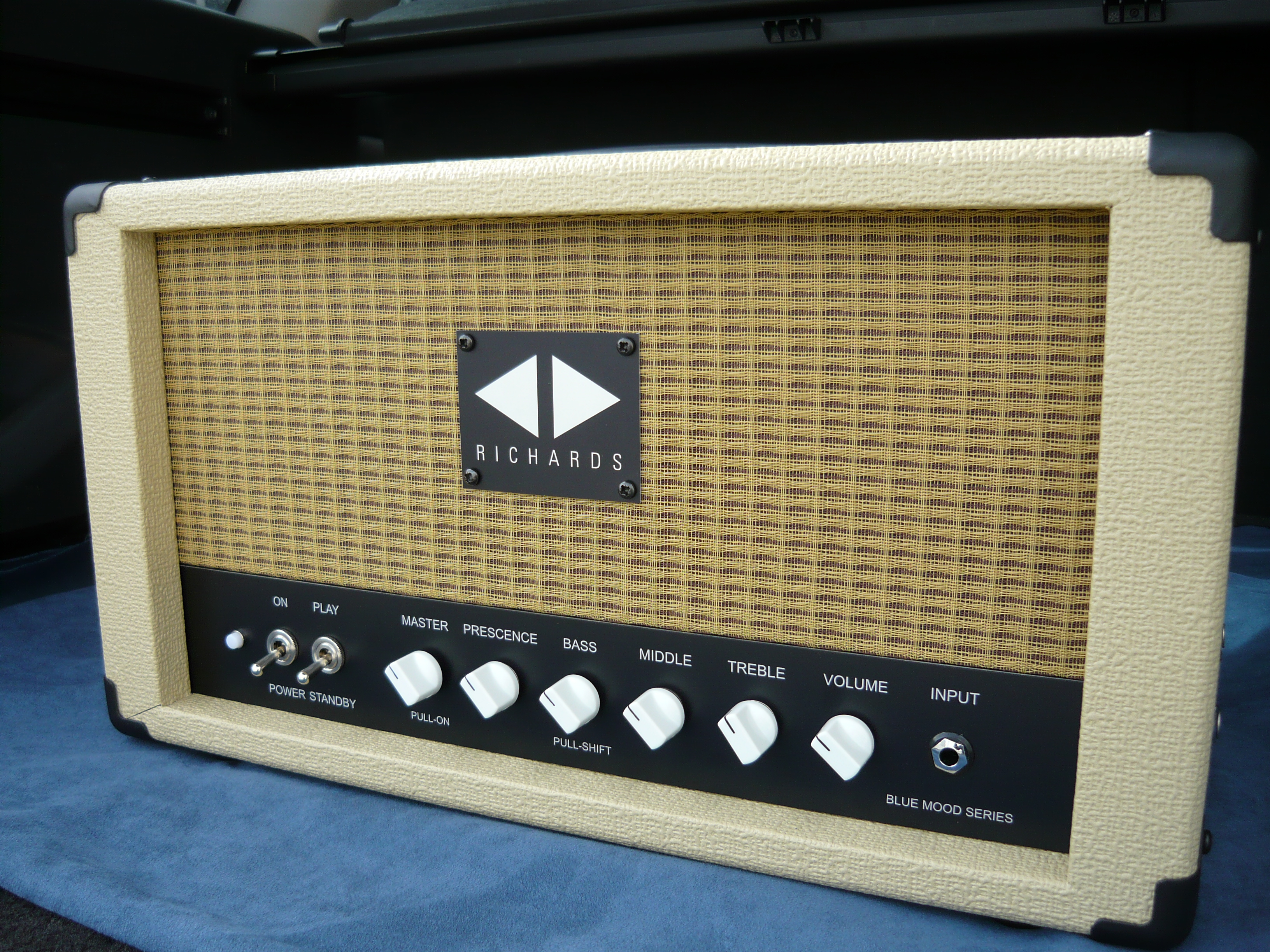
This blog showcases a customised “Blue Mood” series amplifier designed & built by the Richards Amplifier Company – Australia, for our good customer Brett Lowe. Brett has been playing guitar & bass on the local Central Coast (N.S.W.) scene for many years and was a pupil of the late, great Don Andrews, so he knows his stuff. When Brett was looking for specific voicing for his next amplifier acquisition, he came to us and we recommended a custom design based on our successful Blue Mood series amps.

Blue Mood 30W EL34 head

Blue Mood 30W EL34 head

Brett was looking for a hybrid Brit/USA voicing, so we kept the layout and gain structure of the Blue Mood amps, but substituted a pair of EL34 output valves (tubes) in lieu of the 6V6 & 6L6 family of output valves we would normally employ in this series of amps.

Blue Mood EL34 amp head

Blue Mood EL34 amp head

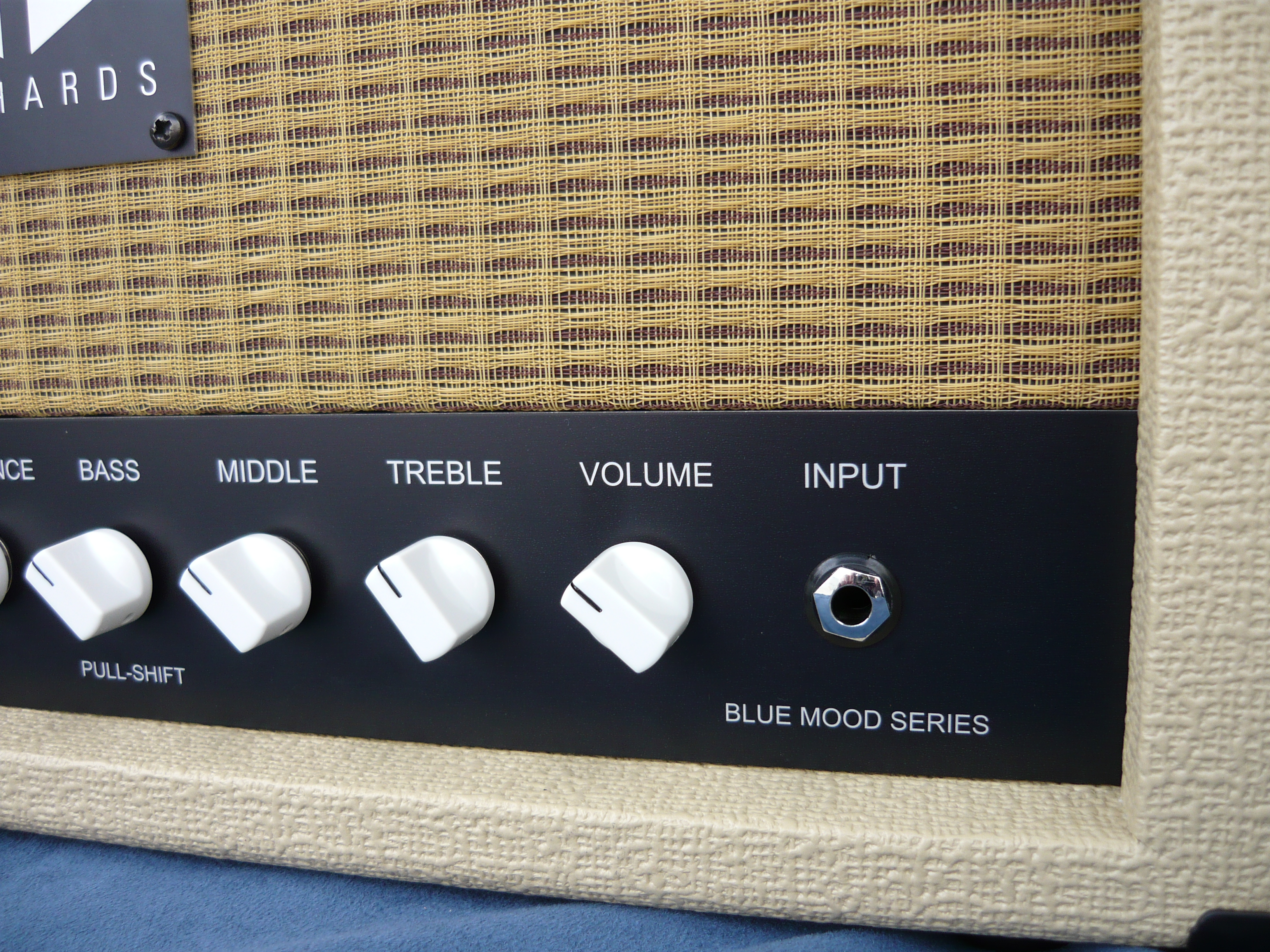
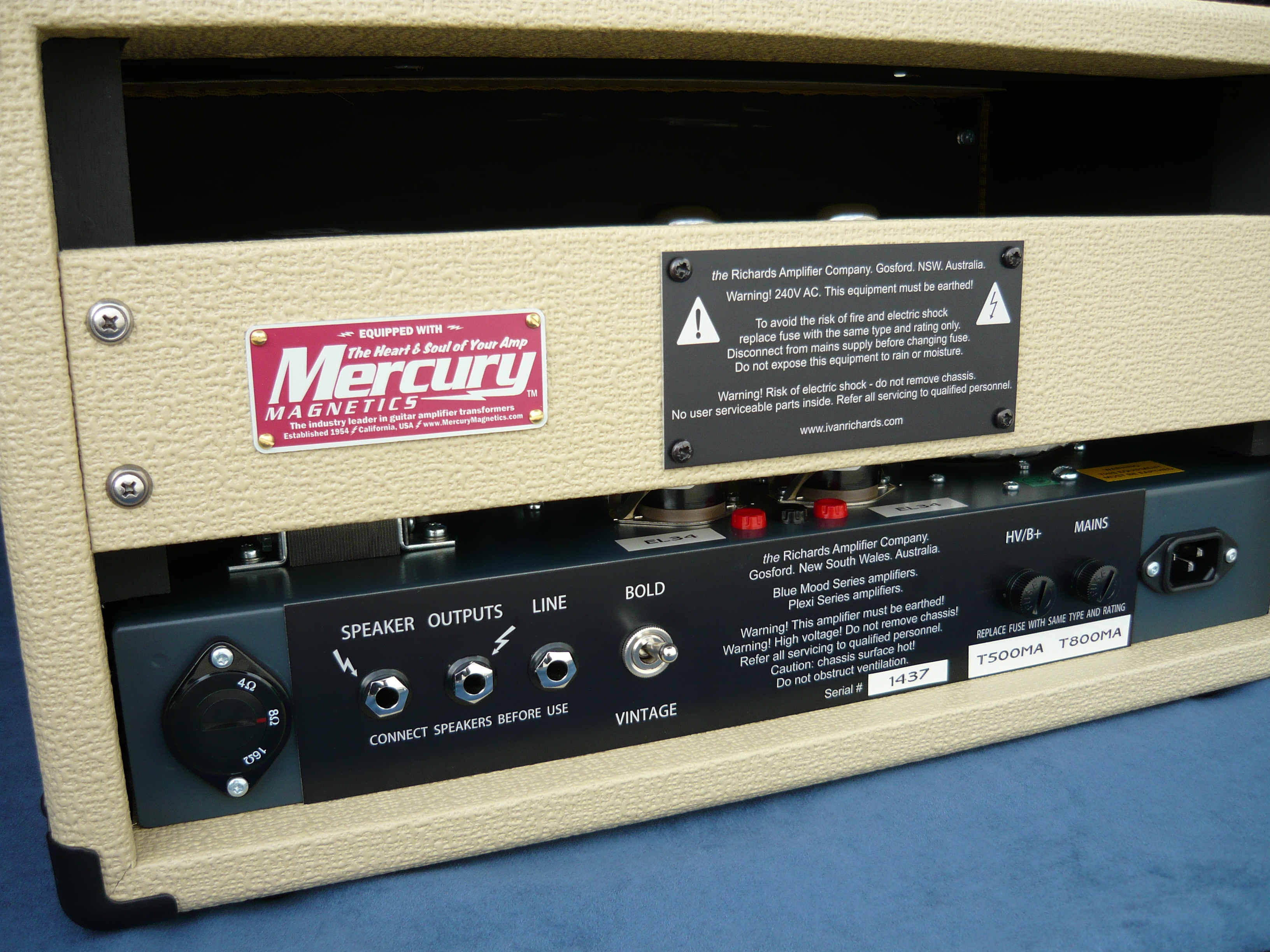
We rejigged the choice of output transformer and its primary impedance & also revoiced the 3-band passive EQ for a more Brit tonality, all of which contributed to the final result. The amp retains the Blue Mood features of a bypassable master-volume, and a pull-shift on the bass control for fine tuning of the bottom end, plus a “bold/vintage” switch on the rear panel to reconfigure the EL34’s to cathode-bias operation for a nominal half-power output.

Blue Mood 30W EL34 head

Blue Mood 30W EL34 head

Brett chose “rough blonde” tolex & “wheat” grille cloth to match one of his speaker cabs. Brett has acquired (and sometimes moved on) many amps over the years, including DR-Z, Swart, Bad Cat, Budda & so on, ie many of the top boutique names in the business – but his band mates are of the opinion that this is the best sounding amp he’s ever owned. We love to hear that !

rear panel - Blue Mood

rear panel – Blue Mood

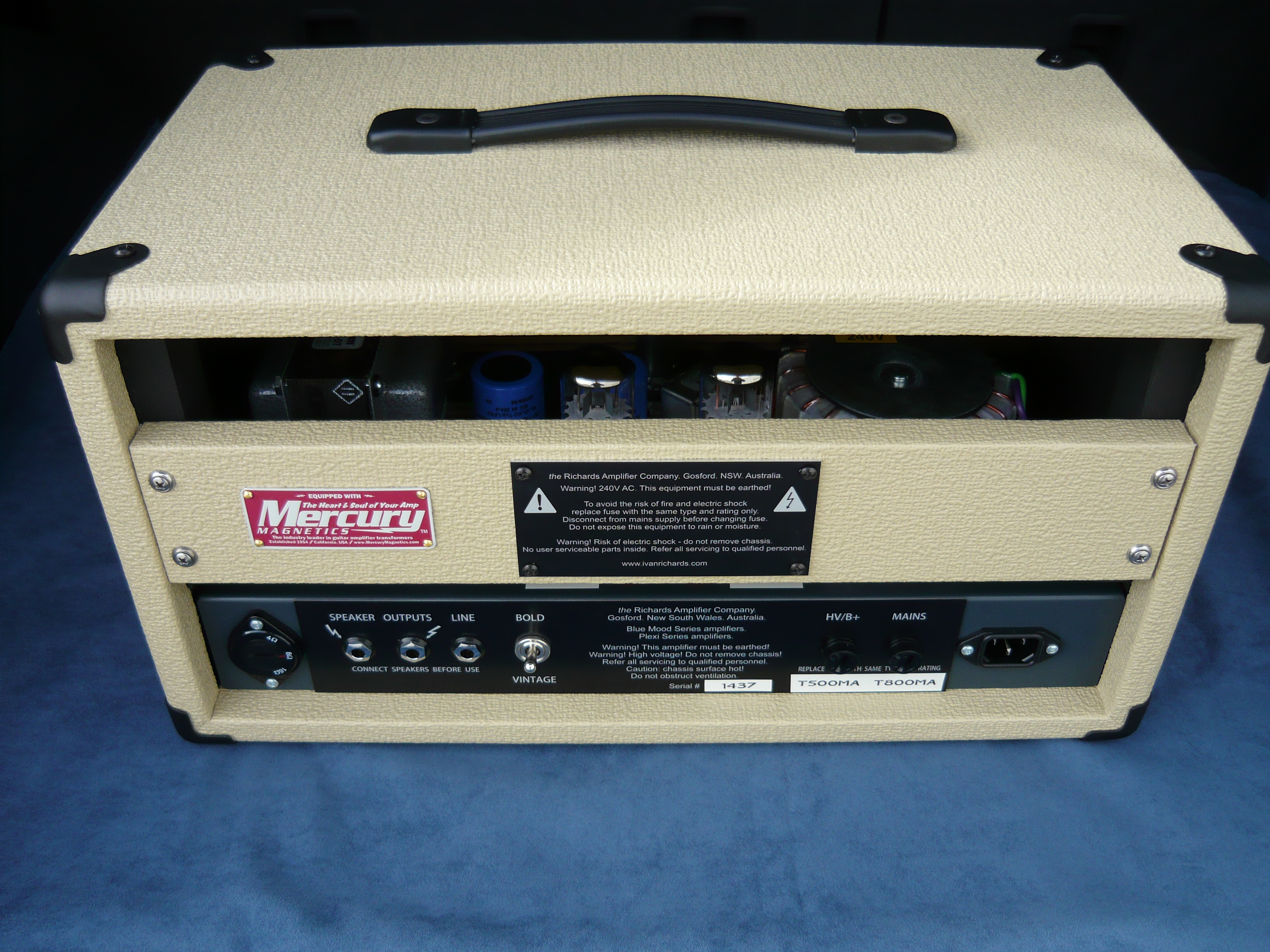
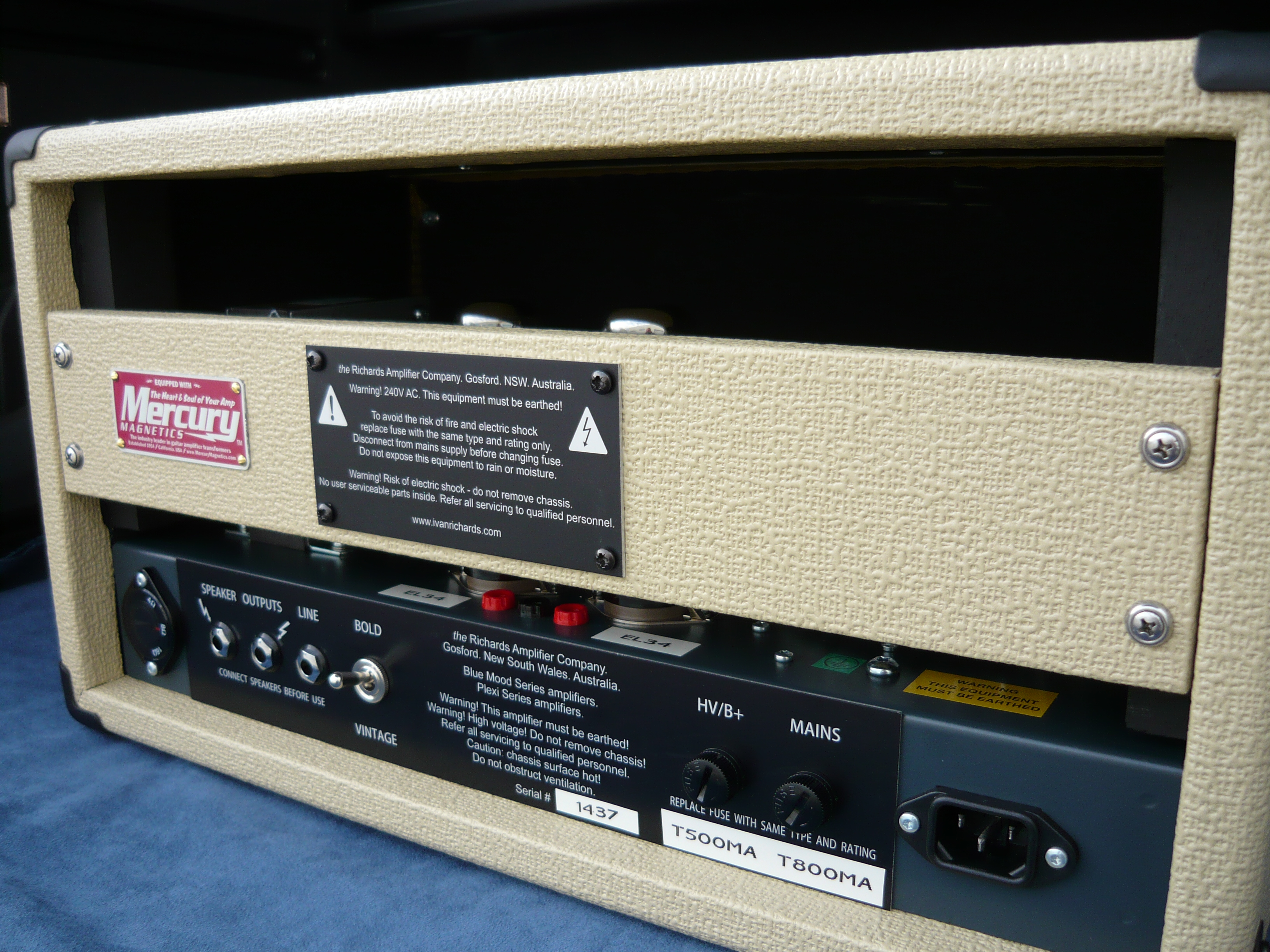
You can see in the photo opposite, we have employed an output transformer by Mercury Magnetics – we are one of their recommended installers, by the way. The choice of output transformer was a key ingredient in the design of this amp. Our next project for Brett will be a replica of the “Brownface” 2×10 Vibroverb amp of 1963, once again employing transformers & choke by Mercury. We will report on this success of this project in a few weeks. Regards – Ivan.

rear view - Blue Mood

rear panel – Blue Mood

rear panel - Blue Mood

rear panel – Blue Mood

burn-in test @ the Rock God Music School Wyoming

burn-in test @ the Rock God Music School Wyoming

burn-in test @ the Rock God music school Wyoming

burn-in test @ the Rock God Music School Wyoming