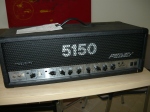
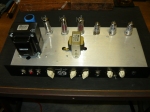
the 5150 head after the big clean up
We recently received at the workshop one of the original Peavey 5150 dual channel high gain amps, which were the result of Mr Eddie Van Halen partnering with Peavey amps to produce his own signature model. In more recent times, Eddie has chosen to collaborate with Fender to launch his very own brand: EVH. This particular example of the 5150 reached us in very poor condition, with virtually no level from the rhythm channel and very low level from the lead channel. No serious service work had been carried out on the amp for years.
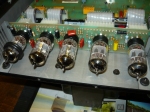
a total of five 12AX7 preamp valves (tubes)
After a big clean up we removed all valves for testing and assessment. Most of the pots (potentiometers) were extremely scratchy and cutting in & out at certain points on their sweep, ie not at all useable, so we gave them a thorough cleaning with FaderLube. Only two of the five pre-amp valves (tubes) tested satisfactory, the others testing low gain and very microphonic. In the 5150 design, there is so much gain in the circuitry, far more gain than most styles of guitar playing would ever require, that wideband noise & microphony become major issues. Therefore, we have to carefully select the 12AX7 valves to be installed, and perhaps also select specific valves for specific positions in the signal path, ie V1 to V5 inclusive. You will notice in the photograph that we added rubber rings to V1 to provide additional dampening. The pre-amp valves are accessed by removing a cover on the rear panel.
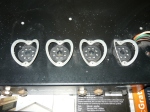
octal sockets ‘pop riveted’ to chassis
Only two of the quartet of Sovtek 5881 output valves tested satisfactory, but we were able to match up a quartet of 5881’s using a pair ex-stock. The wafer base Sovtek 5881 valves work quite well in amps like the 5150, as the tone of the amp is really being produced in the high gain pre-amp. Carrying out a quick power output test with our matched quartet of 5881’s installed, we observed a very asymmetrical waveform on the oscilloscope, indicating that possibly one 5881 was not contributing to the output. The next logical step would be to remove the output valve board from the chassis to examine it for damaged PCB tracks, octal sockets or associated components. We discovered that the board is fastened in place by ‘pop riveting’ the octal sockets to the chassis. HUH ?? It’s bad enough that the output valves are mounted to a PCB, but the only way to remove the PCB is to drill out the ‘pop rivets’ with the obvious danger of small bits of metal going everywhere under the chassis. This really is bad design practice (not Eddie’s fault though) !
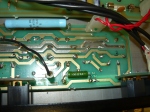
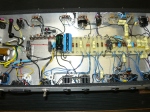
the underside of the output valves PCB
Fortunately, in this case we were able to prove that the screen grid resistor for one single 5881 had gone O/C (open circuit) and it just so happened to be on that area of the board which was easily accessible from the ‘copper’ side of the PCB. In other words, we could replace this failed component without removing the PCB. You have to get lucky once in a while ! We chose to install a 100 ohm 7 watt ceramic body resistor designed for harsh conditions, as per the photo.
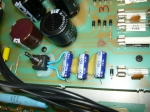
creating an adjustable bias supply
OK – so far we have cleaned the cab & chassis, inspected inside the chassis, cleaned the scratchy pots, replaced valves as required, corrected a fault on the output valve PCB & replaced a damaged 240V 3-pin plug. The remaining tasks are rebias the output valves, final power output test & electrical safety test. With this quartet of 5881’s, the amp is way overbiased with each 5881 only drawing about 12ma. Unfortunately the bias voltage is fixed at the factory at an arbitrary level which makes little sense. HUH ?? The only plausible explanation I can come up with for this decision is that Peavey marketing wanted you to buy their branded sets of output valves for these amps.
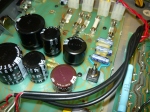
the 5150 power supply
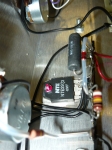
Consulting the 5150 schematic revealed that we could replace the final (fixed) 15K resistor in the bias supply (R68) with a 25K trimpot. R68, for whatever reason was covered in the hot glue applied at the factory, so we had to clean up that area of the main board, to enable us to snip off the resistor leads. Then we could connect leads from the trimpot to the final bias filter capacitor, before bedding down the trimpot in a blob of silicone. We set the trimpot to about 14K, ie slightly less than R68 measured, which was a good starting point for rebiasing the amp to a reasonable current draw. Power output was measured at over 100 watts into 16 ohms @ the onset of clipping.
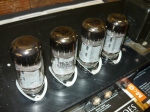
5150 loaded with 5881 valves (tubes)
We last discussed the 5150 series of amps in our blog do we cater for the metal head ? published Sept 2011. At that time the 5150 II was the model generally given the thumbs up by our metal addicted customers. Our favourite MOD for these models is the installation of a 10 Henry filter choke in the +500V DC power supply, manufactured by Mercury Magnetics, which cleans up the DC power very effectively. We no longer carry out warranty work on Peavey products, but we will continue to provide world-class service & repairs to your favourite old Peavey EVH amps and the Classic 20/30/50 series of amps. Thanks for checking out our blog. IR.


 ivanrichards