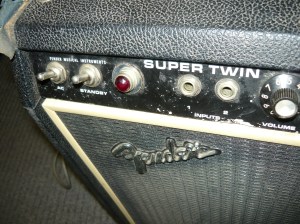
 Howdy there folks – welcome back to the world of valve (tube) amps. This week we look at servicing and especially modding a (relatively) rare Fender amp introduced in the mid-1970’s: the 180 watt (!) Super Twin 2×12 combo. The marketing people at Fender must have decided that higher power amplifiers were the way of the future as several models were redesigned for an increased power output during this time, including the “Twin Reverb” and the “Bassman”. The Super Twin employs a sextet of 6L6GC output valves, with a HT voltage of over 500V DC, in ultra-linear configuration, to achieve the rated 180 watts output. This amp is not recommended for anyone with a bad back – it is seriously heavy !
 The design of the Super Twin features an elaborate EQ system that includes the conventional Fender 3-band passive EQ located between two 12AX7 preamp stages as per the Twin Reverb, plus a 5-band graphic EQ and a presence control, both active, driven by a 12AU7 valve. This is not a parametric EQ as is sometimes suggested on user forums. The EQ is also footswitchable. The power amplifier is driven by a conventional long-tailed pair 12AX7 phase-inverter stage, followed by a 12AT7 cathode-follower stage to provide a low impedance drive to the sextet of 6L6GC output valves. There is also a distortion control which uses both halves of a 12AX7 valve, which is so awful that nobody ever uses it.
 Unfortunately, this amp is just too loud to be of any practical use for most guitarists. It would make a great bass amp if it was a bit more powerful. The amp stays clean until you reach the rated power and the overall tonality is rather glassy. BUT, we have a solution to offer which halves the output power and warms up the tone somewhat. Our standard MOD for these amps is to rewire 4 out of the 6 output valve sockets to reconfigure 2 pairs of 6L6GC to triode mode of operation. The remaining pair stay wired as tetrodes. At 90 watts this amp will still be very loud, but useable with a warmer, more musical sound.
We have implemented this MOD recently for Heath Crawley of Aussie indie bands Children Collide and Vanuatu Scalps, and for Nash Chambers, well known as a music producer and artist manager. In both cases there were numerous other issues to be addressed, as might be expected in a 40 year old guitar amp. General servicing includes replacing the high voltage electrolytic filter capacitors, replacing noisy and microphonic preamp valves, cleaning of pots, jacks and valve sockets, electrical safety compliance, and noisy or leaking capacitors in the signal path, including the graphic EQ which employs inductors and capacitors in five series resonant circuits.
It has been suggested on some user forums that the Super Twin was designed by Paul Rivera, but this is definitely not the case. Thanks for checking in to the blog, and we offer world-class service, repairs, restorations and upgrades to most Fender musical instrument amplifiers. I.R.




 ivanrichards