Archive for December, 2012

Dean takes delivery of his Blue Mood 18W custom amp

December 10, 2012

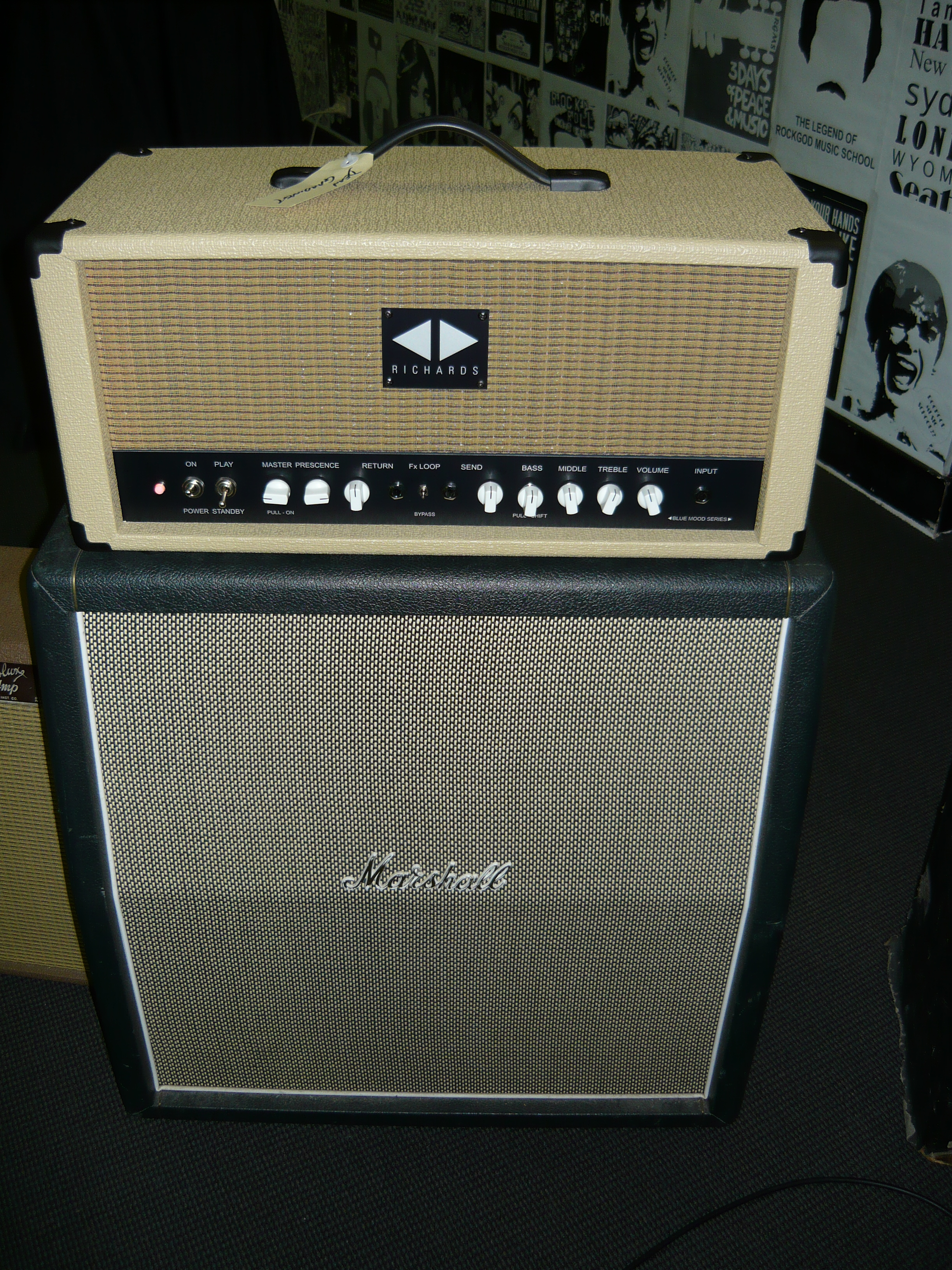
Mr Dean Gardiner, the brother of Jonny Gardiner (proprietor of the Rock God Music School, situated around the corner from us here in Wyoming NSW), recently took delivery of his Blue Mood 18W 6V6 amp head, by the Richards Amplifier Company – Australia. Naturally, when the day came for Dean to pick up his new amp, we took it around to the music school auditorium, so the two brothers could give it a good blast.


Dean Gardiner 18W Blue Mood 002The photos show Dean’s new Richards amp sitting on top of Jonny’s favourite well played in Marshall 4×12 speaker cab, but we demo’d the amp through a variety of differently voiced speakers. Some amps only sound at their best when connected to specific models of speaker, but this amp sounded great connected to any speakers we had access to. We originally discussed the assembly and design concepts of this amplifier in some detail in our earlier blog dated July 17th, 2012. There are two important details that differentiate this example of the Blue Mood series amps from other custom orders, apart from the choice of 6V6 output valves.

Dean Gardiner 18W Blue Mood 003Firstly, this amp includes the optional extra of a valve-driven FX Loop, please see the original blog. Secondly, Dean chose the Mercury Magnetics reproduction of the original Fender “Brownface” DeLuxe 6V6 audio output transformer. This transformer has only a single 8 ohm secondary winding, so there is no impedance selector on the rear panel as per most models. However, this limitation is more than compensated for by the trademark Mercury sound that is smooth, exceptionally musical, warm and balanced. Sweet, rich, detailed and seductive !

Dean Gardiner 18W Blue Mood 004So………………what is the intention of the Richards Blue Mood series amps ? To equal or surpass the tones of the great late 50’s tweed and the early 60’s blonde and brownface guitar and bass instrument amplifiers. The Blue Mood gives you finer control over your tones and less power supply noise than the originals. The amps are designed around 6V6 or 6L6 power amp stages, although we do also build a 30 watt EL34 model with a more ‘British’ voicing, as a tribute to the great TW style amps. In the latter case, the control panel and chassis layout remains unchanged. The EL34 model will be the subject of a forthcoming blog. Regards – Ivan R.
Steven and Peter: custom amp build progress

December 9, 2012

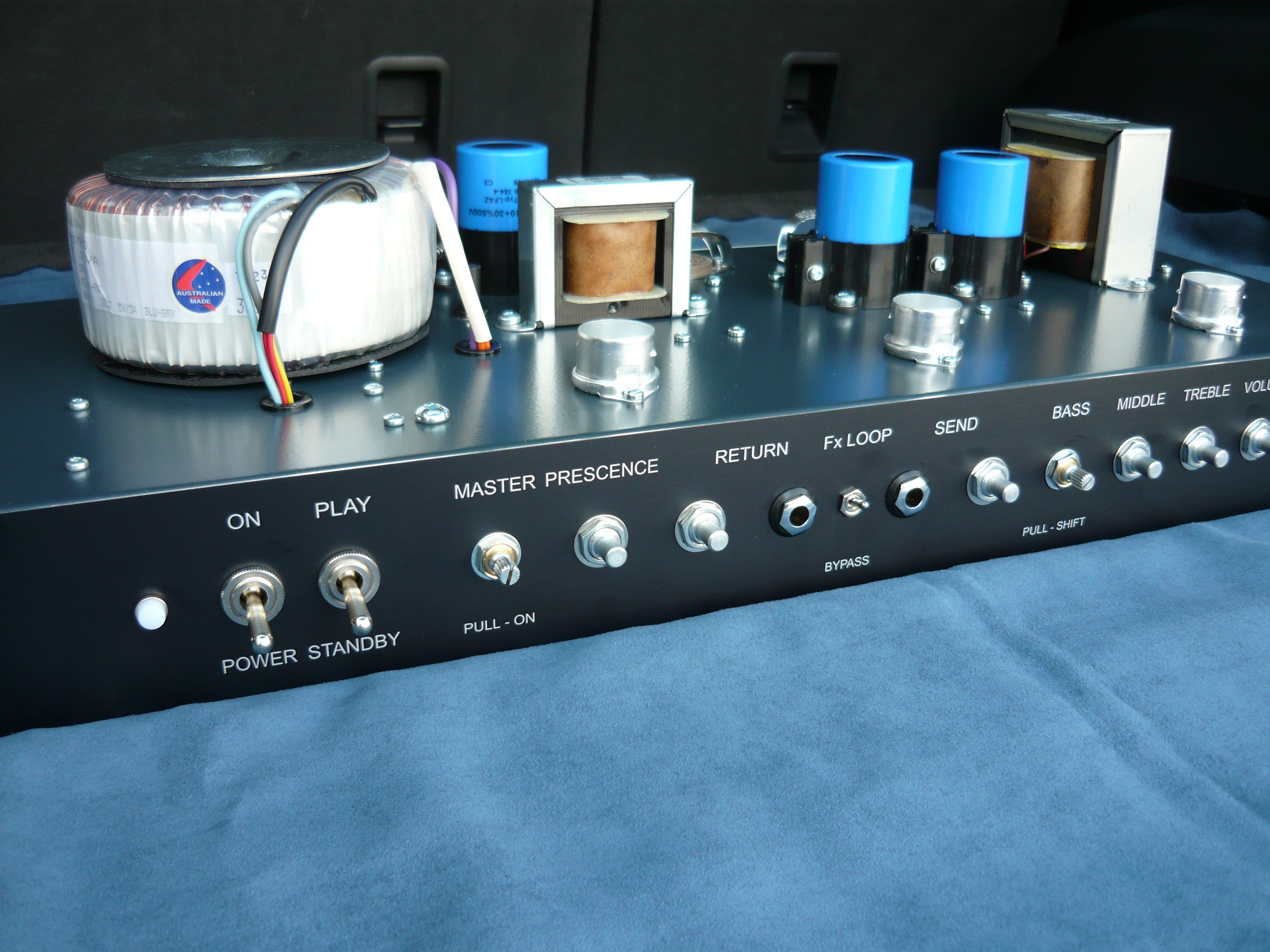
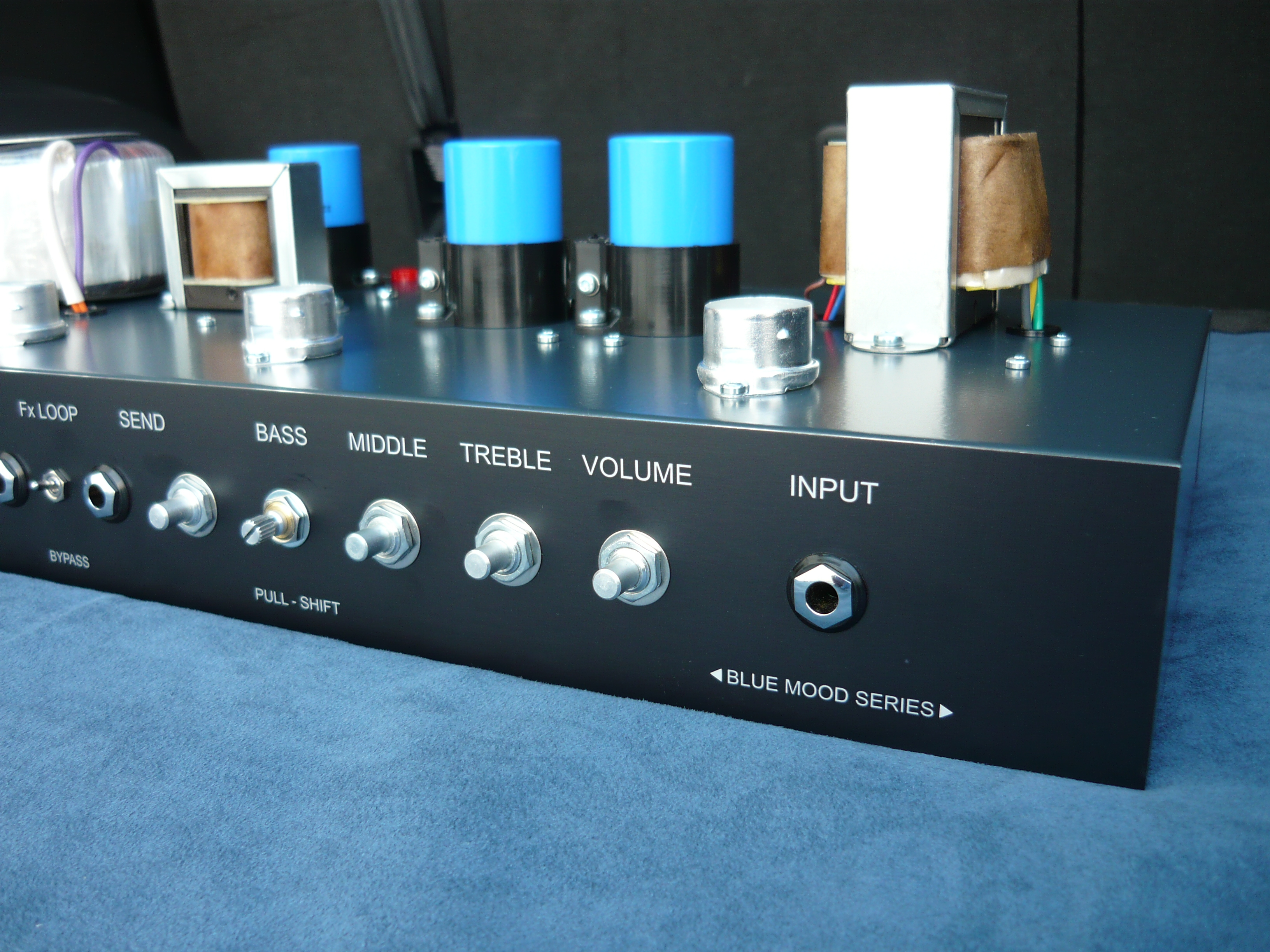
Here is another in our occasional series of blogs where we publish a visual progress report of a custom-order amp build. In this case we have two customers, Steven and Peter, who have ordered exactly identical amps and cabs, except for the choice of speaker grille material.

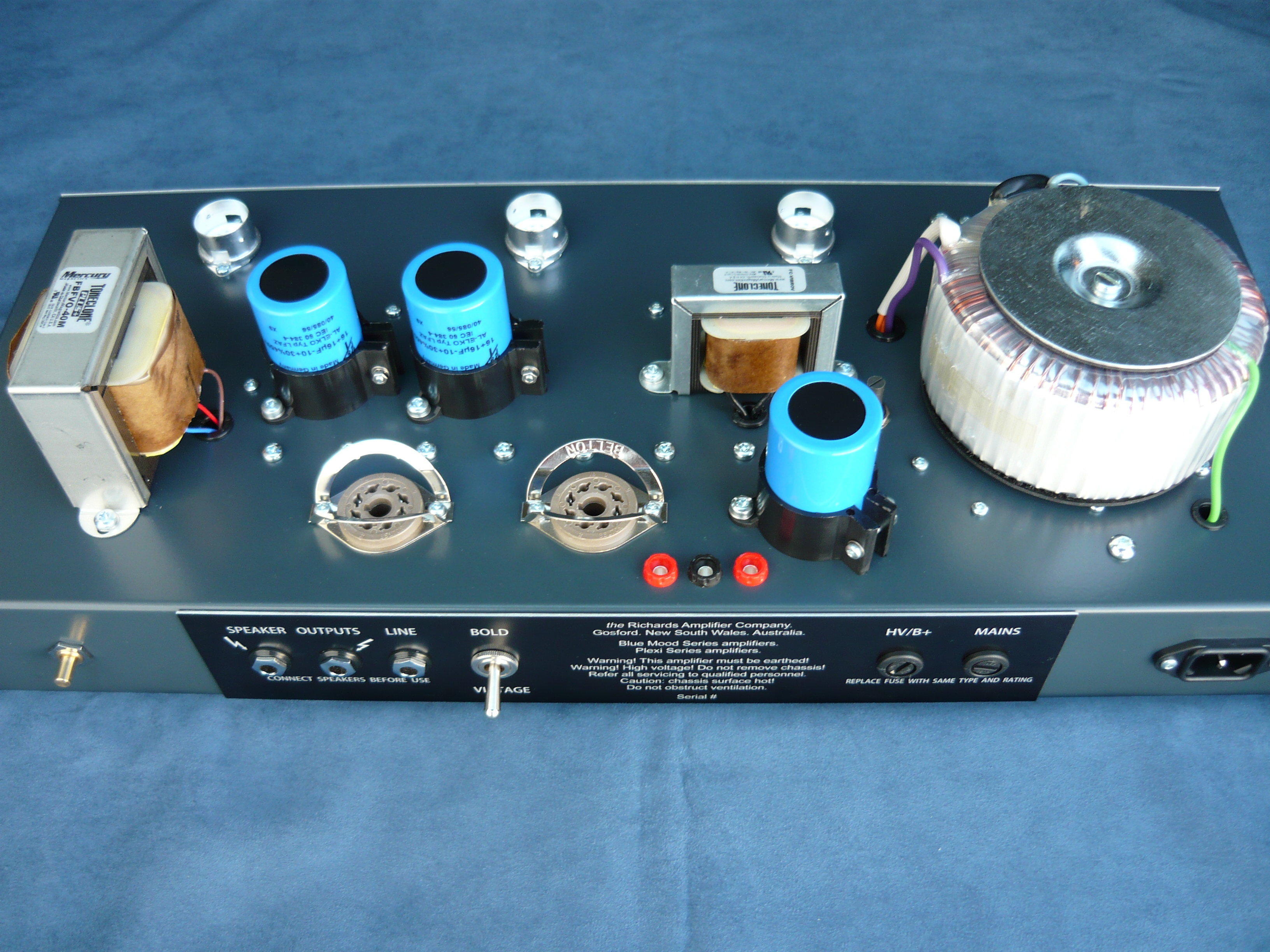
The photos show a Blue Mood series amp chassis being assembled, this time rather than 6V6 output valves and a power output of 12 to 18 watts, we are building a pair of amps of about 40 watts output, employing the 6L6GC output valves as reissued by New Sensor under their Tung Sol brand.

These amps are a customised variation on the Blue Mood concept, with the addition of fully-featured valve (tube) driven FX Loop. The Loop features separate Send and Return level controls, as well as separate Send and Return buffer stages. Obviously the Return buffer stage can be configured as an additional gain stage, or purely just to balance the wet signal against the dry signal.

The FX Loop can be activated or bypassed by means of a toggle switch mounted on the front control panel. There is no need to be messing around at the rear of the amp in the middle of a gig or session. This Loop switch provides true hard-wired bypass for maximum transparency. The Loop can also simply be patched back into the Return jack for use as an additional gain stage.

We can draw on 20+ years experience retrofitting valve-driven FX Loops to JCM800’s and 4×10 Bassman reissues, for example, when designing a custom amp as shown here. This might be a good opportunity to outline our philosophy on FX Loops in guitar amplifiers. We choose to implement a valve (tube) driven Loop over the alternatives every time ! The primary issue when designing a Loop, apart from achieving the desired levels of transparency and headroom, is obtaining broadly the same tone from the amp, regardless of whether the Loop is in use or not.

Mercury Magnetics ToneClone transformers & chokes

Mercury Magnetics ToneClone transformers & chokes

This is what most players would expect – most players don’t want a different sounding amp when the Loop is in use, from when the Loop is not in use – they don’t want some radically different tone. Our philosophy is that the design of the FX Loop, and therefore its tone or sound, really should be an extension of the design and sound of the preamp itself, and not a departure from it.

Blue Mood 1x12 cab in blonde with oxblood grille

Blue Mood 1×12 cab in blonde with oxblood grille

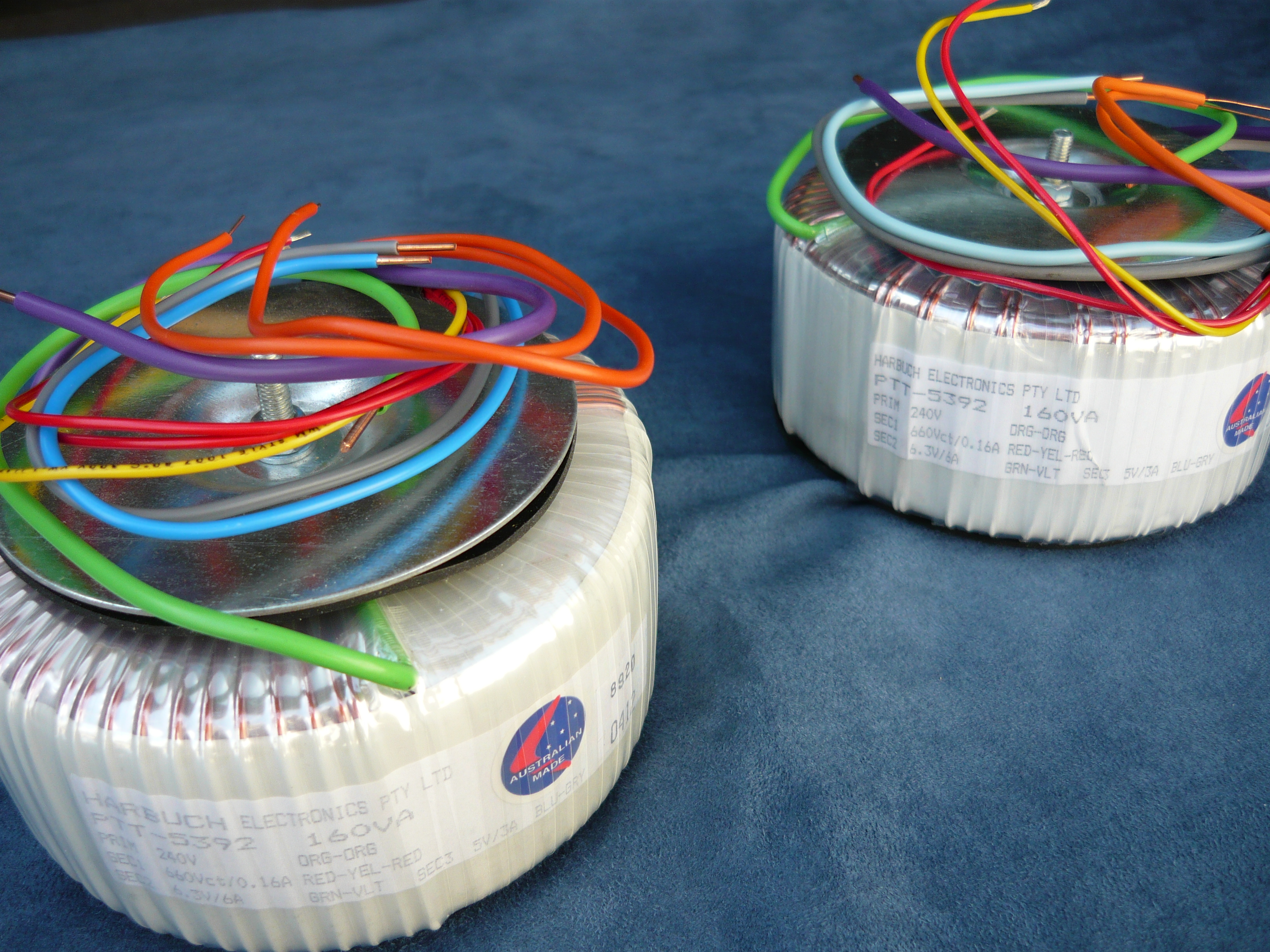
You can see from the photos that we have installed toroidal power transformers by the great Harbuch company of Sydney, for less weight and less radiated noise, plus ToneClone filter chokes and 40W audio output transformers from Mercury Magnetics, arguably the world’s best known supplier of specialist guitar amp transformers.

Blue Mood 1x12 cab blonde with wheat grille

Blue Mood 1×12 cab blonde with wheat grille

Our final photos show the matching 1×12 Tone Cabinets as supplied with these two amps. As we said at the beginning, both customers ordered cabs covered in blonde tolex, but whereas Peter favoured the oxblood grille material, Steven favoured the wheat grille. Both customers requested alnico-magnet 12-inch speakers by Weber, and these are actually the perfect speaker for these amps.

Blue Mood 1x12 cab in blonde (rear)

Blue Mood 1×12 cab in blonde (rear)

Well, in closing we should probably remind you that we are in fact from March 2012 an authorised Mercury Magnetics Service Centre, meaning we are factory authorised to supply and install all Mercury Magnetics products in your amp. We are also happy to install MM transformers as supplied by you.

Blue Mood 1x12 cab in blonde (rear)

Blue Mood 1×12 cab in blonde (rear)

Mercury Magnetics designs and builds the largest selection of both replacement and upgrade guitar amp transformers in the world. So we are now in a position to assist with the choice of a suitable transformer and provide fastrack tech support, plus you have the reassurance that your new transformer will be installed to the highest electrical safety standards. If you have any questions re our amps or MM transformers, please contact us at: info@ivanrichards.com

VHT Pittbull Classic

December 7, 2012

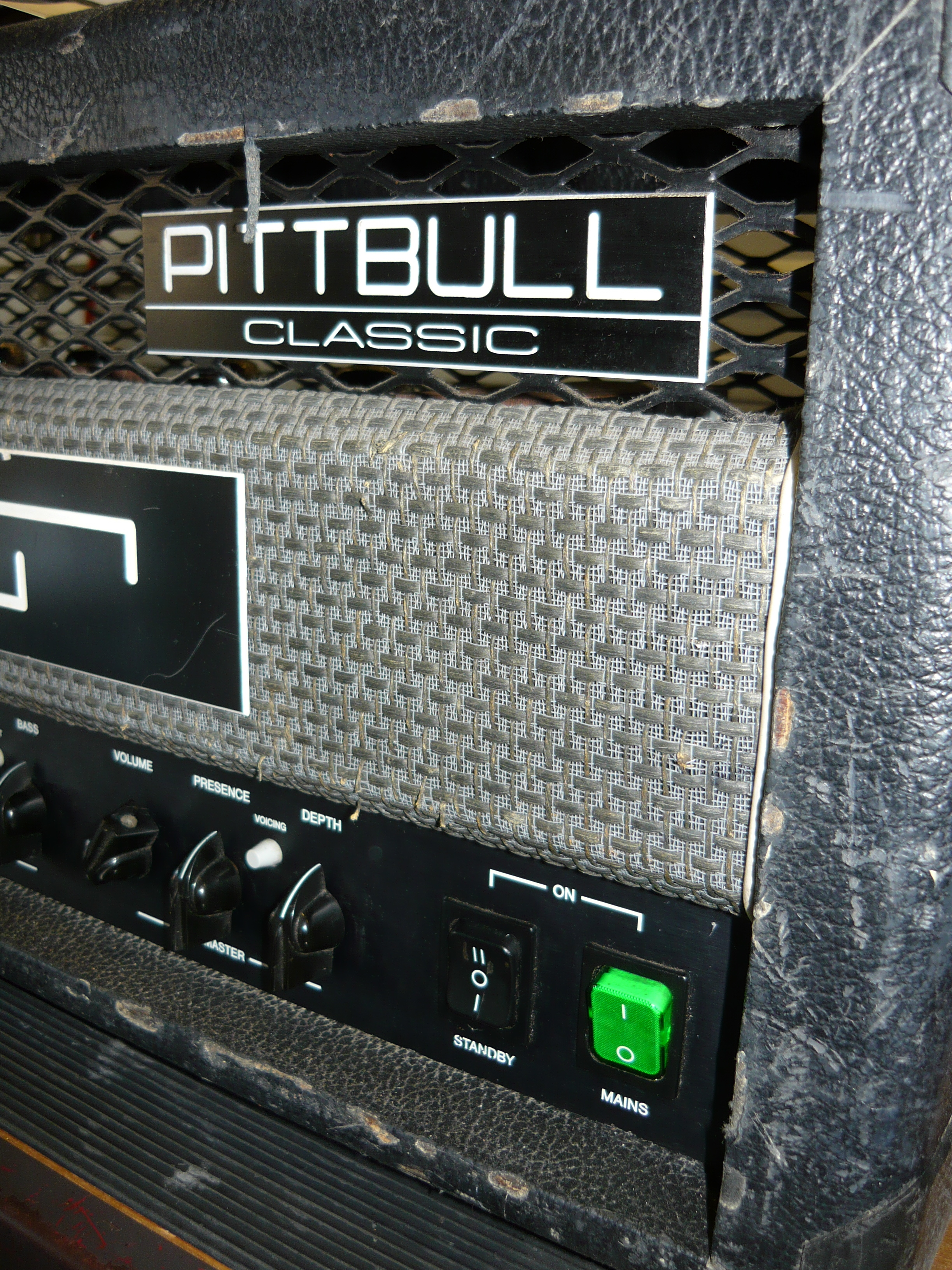
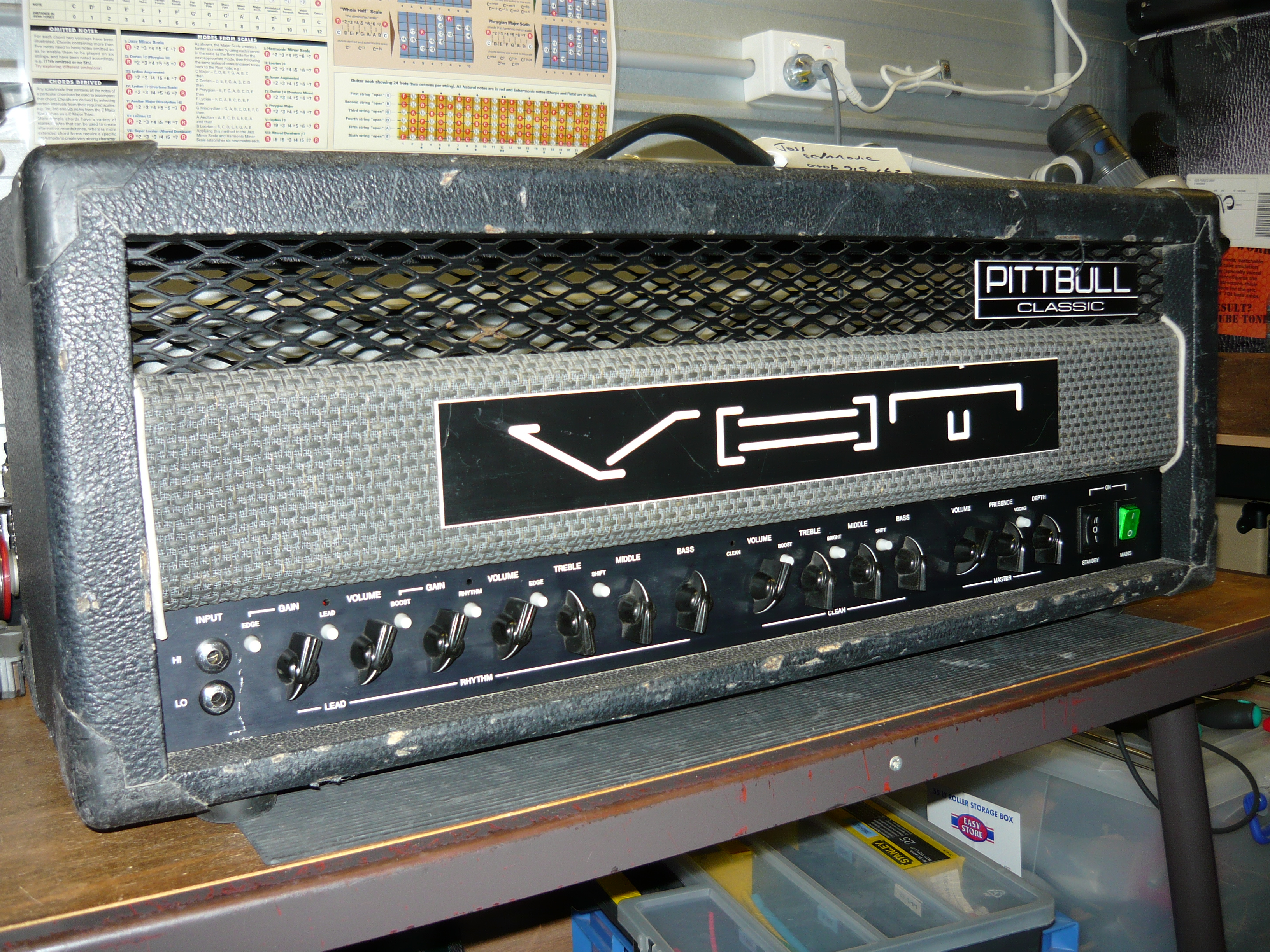
Hello and welcome back to the blog after a break of several weeks. This time we are looking at a classic hard rock guitar amplifier from the USA, manufactured back in the early 1990’s: the VHT Pittbull amp. This example has obviously had a hard working life, and our repairs actually started with the cabinet, which was beginning to fall apart. The stated fault from our customer was there was a pop, then nil output. No fuse had actually blown, and all the valves tested OK, so the problem was in the circuitry itself.

All of the circuitry in the Pittbull is mounted on two large printed circuit boards (p.c.b.’s) which run pretty much the width of the chassis. Unfortunately, they overlap and things are complicated by the board mounting arrangements, so it is a very time consuming job removing these boards for repairs, plus it’s fiddly, with the ever present danger of introducing additional faults that weren’t there in the first place. Even worse, the status LED’s that indicate which channel is active, are mounted below the boards where your fingers can’t get to them to line them up with the holes in the front control panel.

Examination of the boards didn’t reveal any obvious component failure, but a check of the DC conditions with a DVM indicated problems with the low-voltage (LV) power supply, ie the +/- 18V DC rails (regulated). Apparently the signal path includes some solid-state circuitry, hence the complete loss of signal, and there is also some switching/control circuitry which is IC based. Unfortunately all the device identifiers have been intentionally rubbed off the IC’s ! The original VHT company definitely didn’t want to make servicing their products any easier than necessary. This is a design approach that we have never ever understood or endorsed.

VHT Pittbull 004A silicon diode, part of the bridge rectifier for the LV supplies, had gone short-circuit, also causing the failure of filter capacitors and a regulator IC. We replaced the identified components, and also upgraded a few electrolytic capacitors while we had the board out. The LV supplies were now completely functional. As part of our routine electrical safety checkover, we noticed the mains fuseholder was wired incorrectly – strange to find such a basic error in a modern amplifier. We reversed the fuseholder connections and carried out a PAT test, and this amp now complies with Workcover NSW electrical safety standards.

VHT Pittbull 005Having reassembled the chassis and reloaded the valves as supplied (with a very necessary rebias of the output stage – running too hot), the amp was given a power output test. This amp is quite a monster, with 540V DC supplied to the anodes of the EL34 output valves (like some very old Marshalls). We measured 35V into an 8 ohm dummy load which equates to 150 watts ! This is pretty impressive, considering the amp claims to be 100 watts. A burn-in test revealed no further problems, and the final play test showed this amp to be a much more versatile beast than you might have assumed.

VHT Pittbull 006As a sweeping generalisation, we have found the “clean” channel in multi-channel switching amps to be a real disappointment, with all the emphasis placed on the high-gain performance at the expense of clean and crunch tones. In this Pittbull Classic model, the three channels each offer two modes or gain levels and all the settings are useable. The “lead” and “crunch” channels do admittedly share the same EQ, but the very useable “clean” channel, with its own dedicated EQ, more than makes up for this compromise. Rock on ! Many thanks to Joss for supplying us with the subject matter for this blog. IR.