Archive for August, 2011

A bass player’s testimonial to the Rich Drive pedal

August 21, 2011

Hello readers ! This testimonial was supplied by Peter Stojkovic, a bass player from Sydney, Australia, who also has an interest in audio engineering.

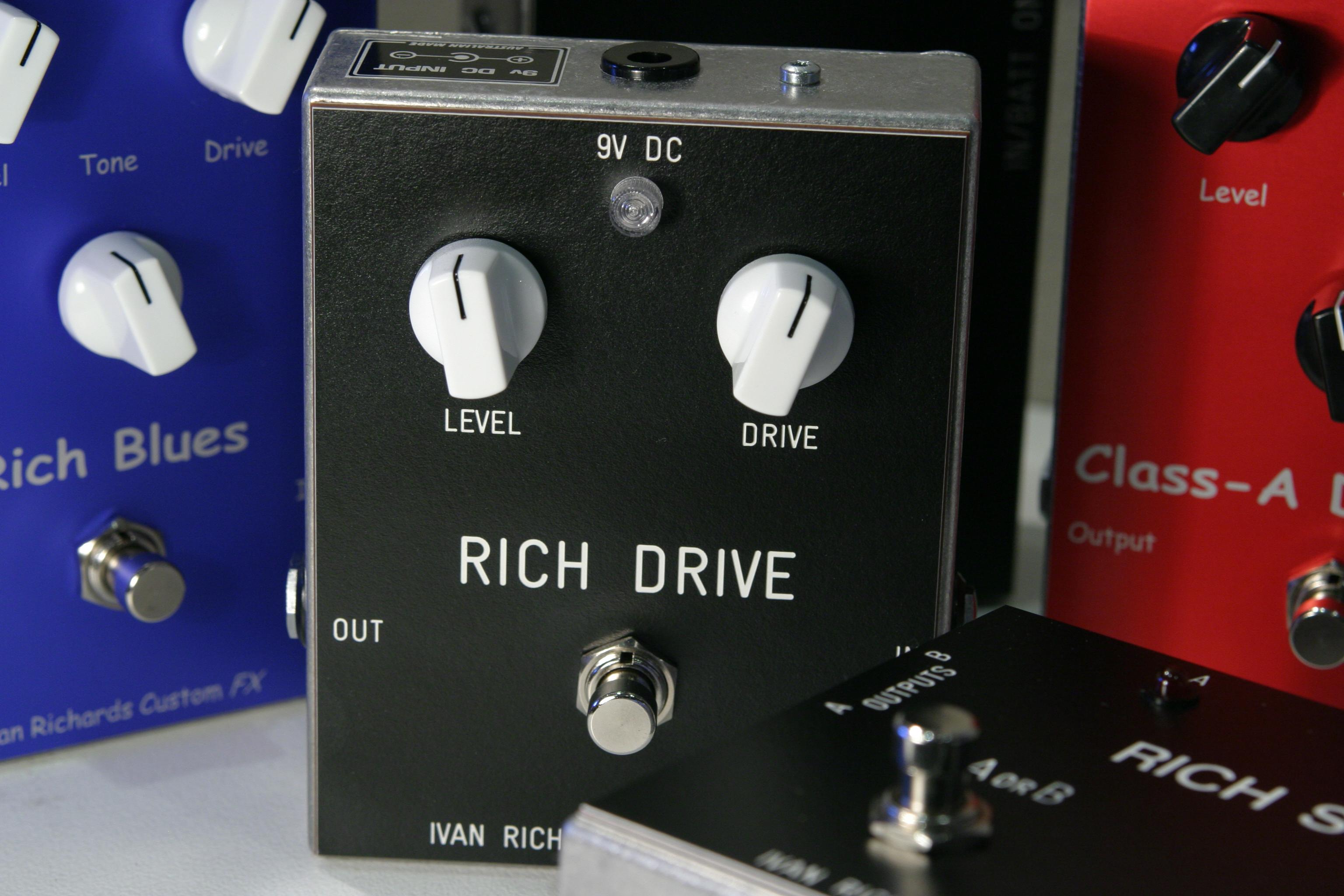
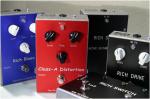
HI Ivan, my band mates purchased me one of your Rich Drive pedals for a birthday gift a few years ago. I have used the pedal constantly and love everything about it. I run a Warwick Thumb Bass (4-string) through it, and it sounds like pure evil ! (We’ll take that as a compliment – IR).

I should mention that I have A/B’d the Rich Drive against a few others and there’s no comparison – for example it was put up against a Big Muff, a Rat, a Sansamp, a Boss DS1 and a crappy digital thingey I don’t recall the name of, and the Rich Drive achieves a very distinct flavour. I find that while a lot of distortion pedals destroy the detail of my bass, the Rich Drive gives it another dimension altogether.

Another trick is to turn the drive control to zero, but keep the pedal on – it begins to sound like a preamp that gives an extra warmth that’s more than just a minor tonal change (I would liken the tone to that of an old SSL channel strip). I must thank you for creating such a great pedal.

Many thanks to Peter for contributing to our blog. The Rich Drive pedal was originally created for guitarists (like me) who were fed up with overdrivers that destroyed their tone and dynamics, but has been adopted by many Aussie bass players for similar reasons. Since 1997, the Rich Drive has been purchased by the creme de la creme of Aussie music talent, including Bob Spencer, Dave Leslie, Mark Lizotte, Thirsty Merc and many more, plus sales to individual guitarists in the USofA and Japan.

More about signal splitting

August 20, 2011

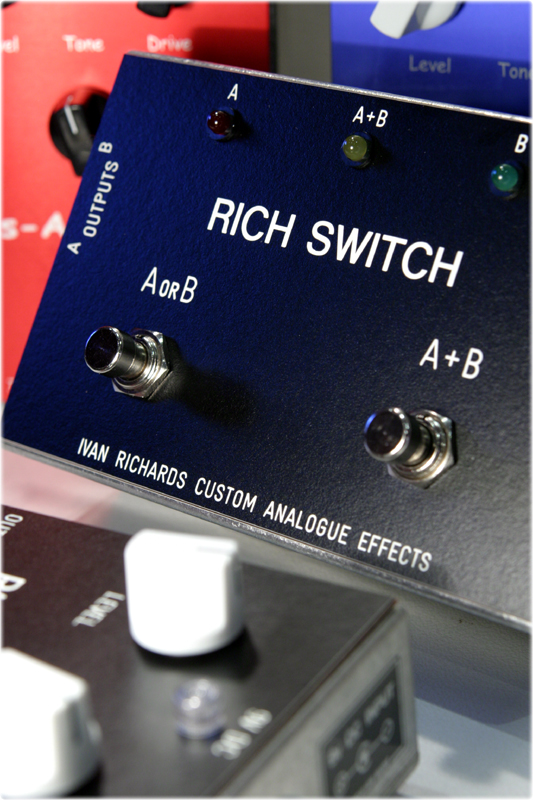
Hello ! Thanks for checking in again – this blog follows on from previous blogs re the Rich Split and Rich Switch signal routing pedals, with more suggestions especially for home-recording guitarists.

While the primary intention of the Rich Switch pedal is to switch between and/or combine a pair of amplifiers in either a stage or studio situation, the Rich Split pedal has potentially many applications. The guitarist can run FX processors in parallel with the primary guitar signal (which may be, for example, a mic’d up amp or a direct preamp), route the guitar signal to a pair (or more) of amps for tonal complexity, and keep a tuner on-line, yet out of the audio path, as running your guitar through a tuner is a sure-fire recipe for lifeless tone. No more unplugging your guitar between takes to tune up, and you’ll be forever spoiled when you experience the no compromise tone achieved by having the tuner out of your signal path.

Once you’ve experienced the lush sounds of layered processing, it will be difficult to remain satisfied with the standard effects-in-series approach ! Some real world examples of how parallel processing can work in a home studio situation, as well as on-stage for live performance:

* plug your guitar into the Rich Split pedal; connect one of the outputs to your choice of valve (tube) amplifier that powers a remote, mic’d up 1×10 or 1×12 speaker cab tucked away in a closet, etc; connect another output to your tuner; connect outputs (as required) to your choice of FX processors; connect a mono out from each processor to its own mixer channel input; including the mic’d up speaker, this provides multiple channels complete with EQ, to blend and pan;

* such a multi-signal scenario offers several choices – in one pass you could record an amp track plus an FX track, buss all the signals to one composite track, or pan them into a stereo submix; whichever routing you choose, however, the resulting sound is huge; you get the full-on guitar timbre plus layered FX – a noticeably richer sound than passing one signal through a series of stompboxes !

* for those of you experimenting with the latest guitar amplifier, guitar speaker and microphone emulation software, the Rich Split is one device you cannot live without; simultaneously record your favourite amp’s DI’d output, its mic’d speaker, and your guitar’s pickup only output; through your software, you can then easily manipulate any or all of these; this means that you have a purely analogue sound back-up, and are no longer bound by recording one option only;

* if you have an old-school 2-channel amp, you can run a direct signal to one channel and FX to the other channel, and mix the two at the front panel; the volume control of the second channel works as a parallel FX return (with EQ); the results will be dramatic – more lush and dynamic than what you’d get going through the processor into a single channel;

Important Notes !

* when you try parallel processing, remember to set your FX processors to 100% wet

* always ensure your amplifiers are reliably earthed (grounded) via the 3-pin plug to the 240V AC mains earth (Australia); have this checked at regular intervals by a fully qualified electrician or service technician;

* whenever you run multiple amps, check for earth (ground) loops and also hazardous electrical conditions; for example, some persons have been known to disable the earth pins on all but one of the amp’s 240V AC plugs to prevent multi-amp earth loops; however, it is highly dangerous, massively stupid and also illegal to disconnect the earth wire either at the 3-pin plug or within the amplifier; if you injure yourself or someone else whilst doing this, you may be legally liable; think about the consequences ! the preferred solution is to resolve earth loops by inserting high-quality isolation transformers between switcher or splitter and amplifiers; this is what is achieved by using the Rich Switch or Rich Split;

* when using more than one guitar amp there is a reasonable possibility of any two models of amp being out of phase with each other, rather than in-phase; when you add the second amp, the overall volume should increase slightly, and have a much fuller tonality; if there is an immediate reduction in level, or especially a loss of low frequencies upon connecting the second amp, then it is reasonable to assume the two units are out-of-phase relative to each other; please consult your service tech, your supplier and/or Ivan Richards Audio for recommended solutions.
Service Centre for David Eden and Nemesis bass amplification

August 8, 2011

Hey folks – just a reminder that we also service the needs of working and recording bass players, which includes not only valve (tube) amplification, which always has been and always will be our specialised area of interest, but also solid-state amplification. We have long been an authorised service centre for Ampeg and Peavey amplification, and also Marshall, Laney and Hartke. We provide non-warranty repairs to many other brands of bass amps, for example Fender, Orange, SWR, Labsystems, and more recently the products of David Eden and their budget off-shoot brand, Nemesis. We do not provide service to amps with switched-mode-power-supplies (SMPSU), or switching amps in general. Check with us first, if in doubt.

Recently a David Eden WT800C bass amp was delivered to our Wyoming workshop for repair by Grove Studios, a Central Coast (NSW) recording facility formerly owned by Gary Beers of INXS fame. Grove Studios have become a regular customer in recent times, as amps quite often choose the worst possible time to develop a fault, ie in the middle of a recording session. We always strive for the best possible turn-around time in these situations, depending on availability of parts, as required.

The WT800C in question was blowing fuses, which after initial investigation was found to be a melt-down in the left-hand power amplifier. The power amp board had some short-circuit (S/C) output devices plus some other smaller collateral damage, and worst of all there was damage to the printed circuit board (PCB), with some destroyed tracks and solder pads. This PCB damage appeared to be from a previous unknown repair and not from this particular incident. Another example of heavy-handed soldering/de-soldering technique (or lack thereof).

I had to order in the output devices which were 3 each of the Sanken 2SA1492/2SC3856 complementary pairs, which unfortunately held up progress of the repair for a few days. To ensure equal load sharing between the output devices, I never mix and match new and old devices, or different brands of the same device. That way, I know the repair will hold up under rawk’n’roll conditions. It’s also important for the same reasons to clean up the forced-air cooling system. After replacing the output and driver devices, plus diodes, etc, and repairing the damaged PCB the best way I could, ie, with wire links to replace the blown tracks, etc, etc, we powered up and readjusted the bias setting as per the sevice manual. The amp passed its power output test, burn-in test and electrical safety test with flying colours ! With one channel only driven at a time, this amp puts out approx 500 watts into a 4 ohm load, and therefore potentially delivers over 800 watts with both channels driven.

Many thanks to Markus Salisbury of Grove Studios, and Eric Grothe of Shinobi.

A Dr-Z MAZ38 (Senior) major repair completed

August 6, 2011

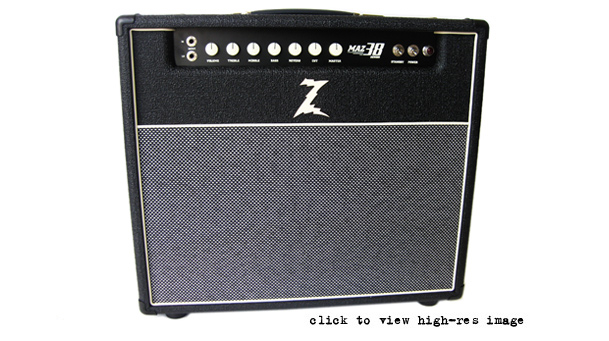
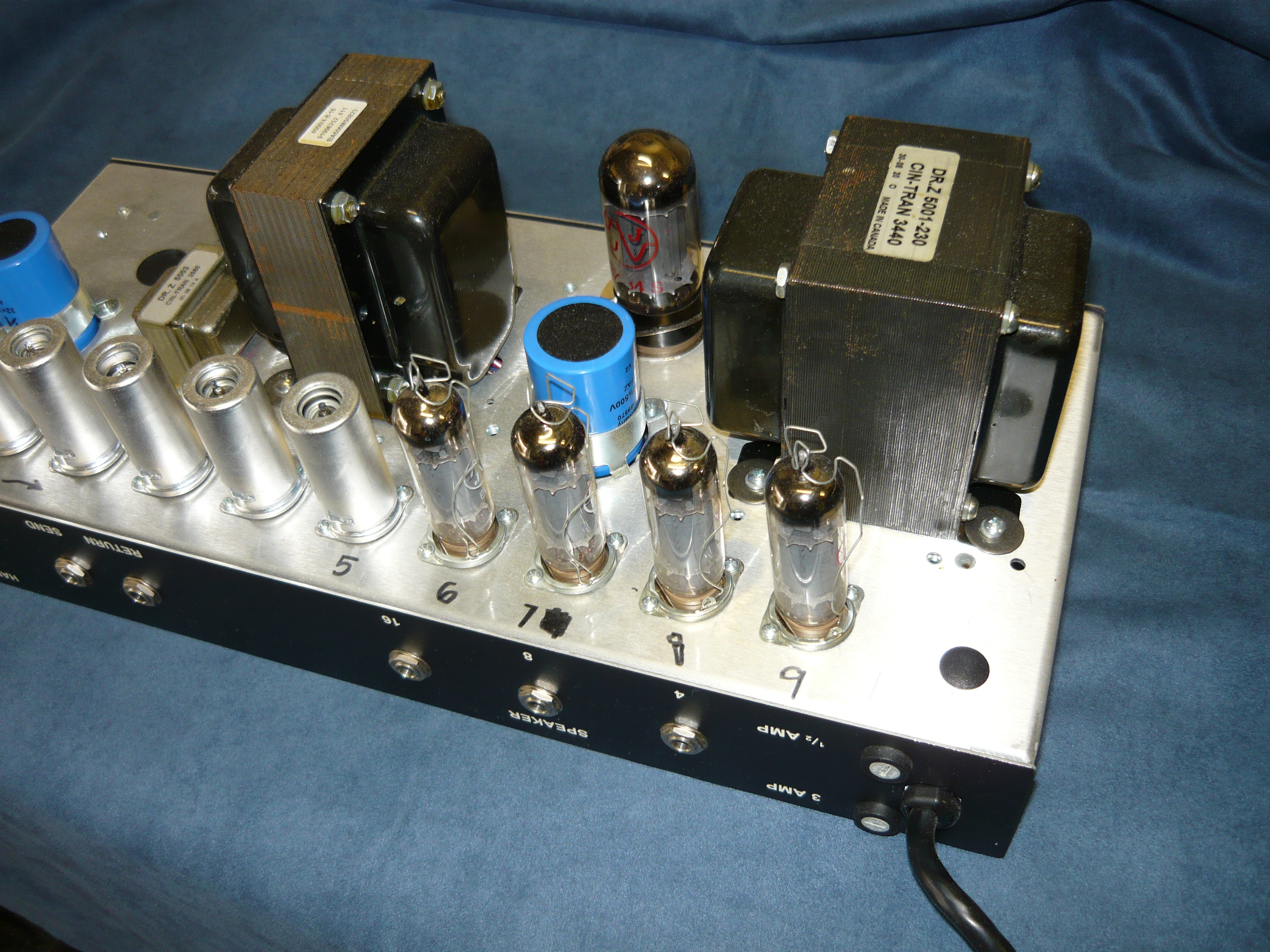
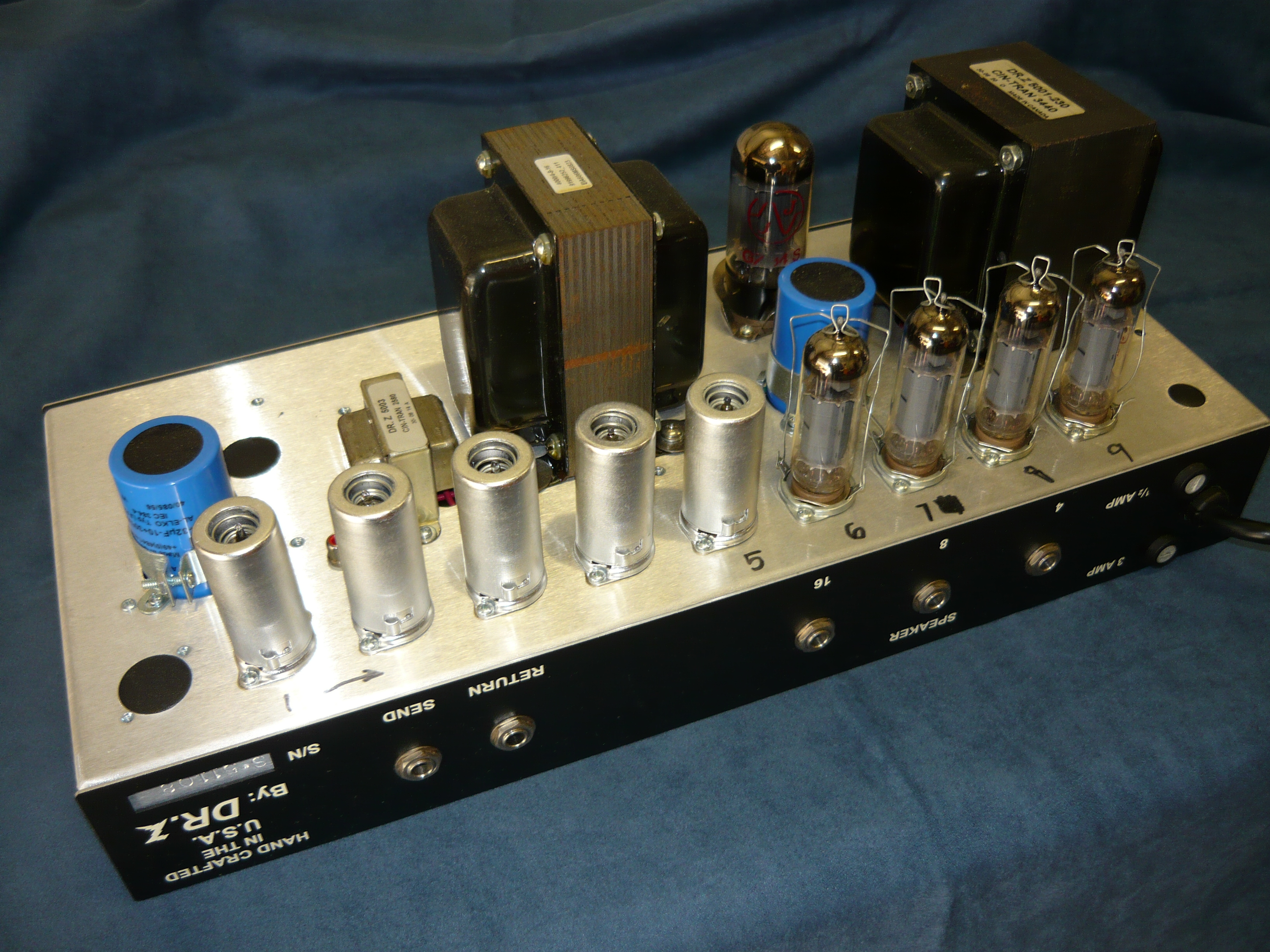
Yes, we specialise in the service & repair of boutique, ie hand-wired, all-valve (tube) musical-instrument amplification, including Dr-Z from the USofA. The subject of this week’s amp repair blog is a Dr-Z MAZ38 (Senior) 2X12 reverb combo, shipped up to our Wyoming (NSW) workshop from Sydney by a regular customer.

This particular MAZ38 was blowing fuses. There are actually two fuses fitted on the rear panel, one is the 240V mains fuse, the other is a secondary fuse for the high voltage supply, and would normally be around the 0.5A (500ma) value. In this case the mains fuse was blowing, although when I examined the HT fuse I found an 8A fuse rather than a 0.5A fuse, which would result in negligable protection.

The fact that the mains fuse was blowing tends to suggest a fault in the power supply, and this proved to be correct. The fault was isolated in a series of diagnostic steps to the power transformer itself, which had developed an internal short-circuit. The quad of EL84 output valves was still serviceable, but the GZ34 rectifier valve was definitely short-circuit. Was the GZ34 the original problem, or the transformer ? We shall never know, but this was developing into an expensive repair job for the customer.

Removing the faulty transformer and installing a replacement was going to be a tricky operation, as access to where wires need to be disconnected and subsequently reconnected is limited. Most of the internal space within the chassis is taken up by a single large board holding the majority of the resistors and capacitors, with hand-wired connections from both sides of the board. The standard of construction as well as components is high, as you would expect, but access to some components for service is poor.

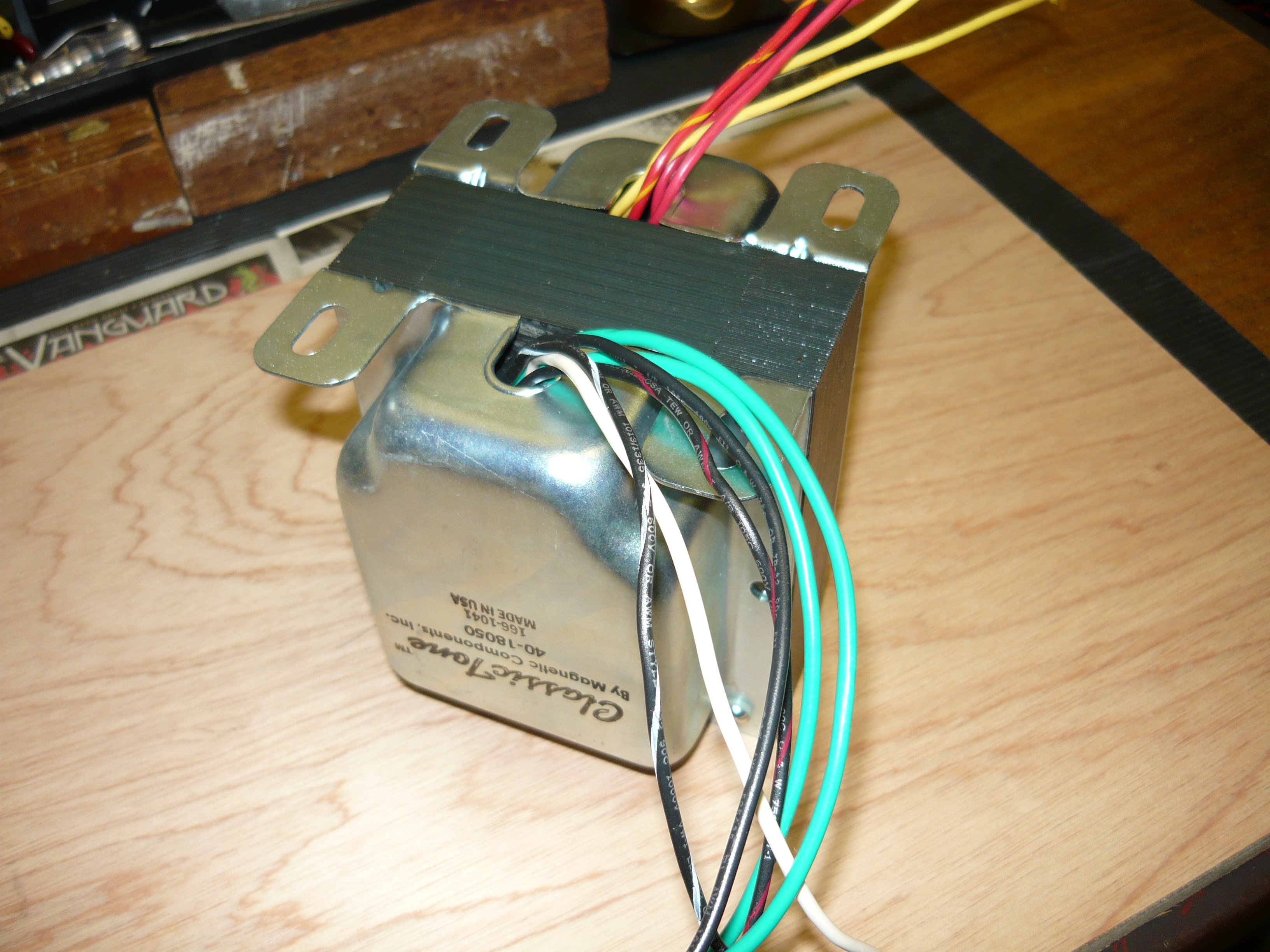
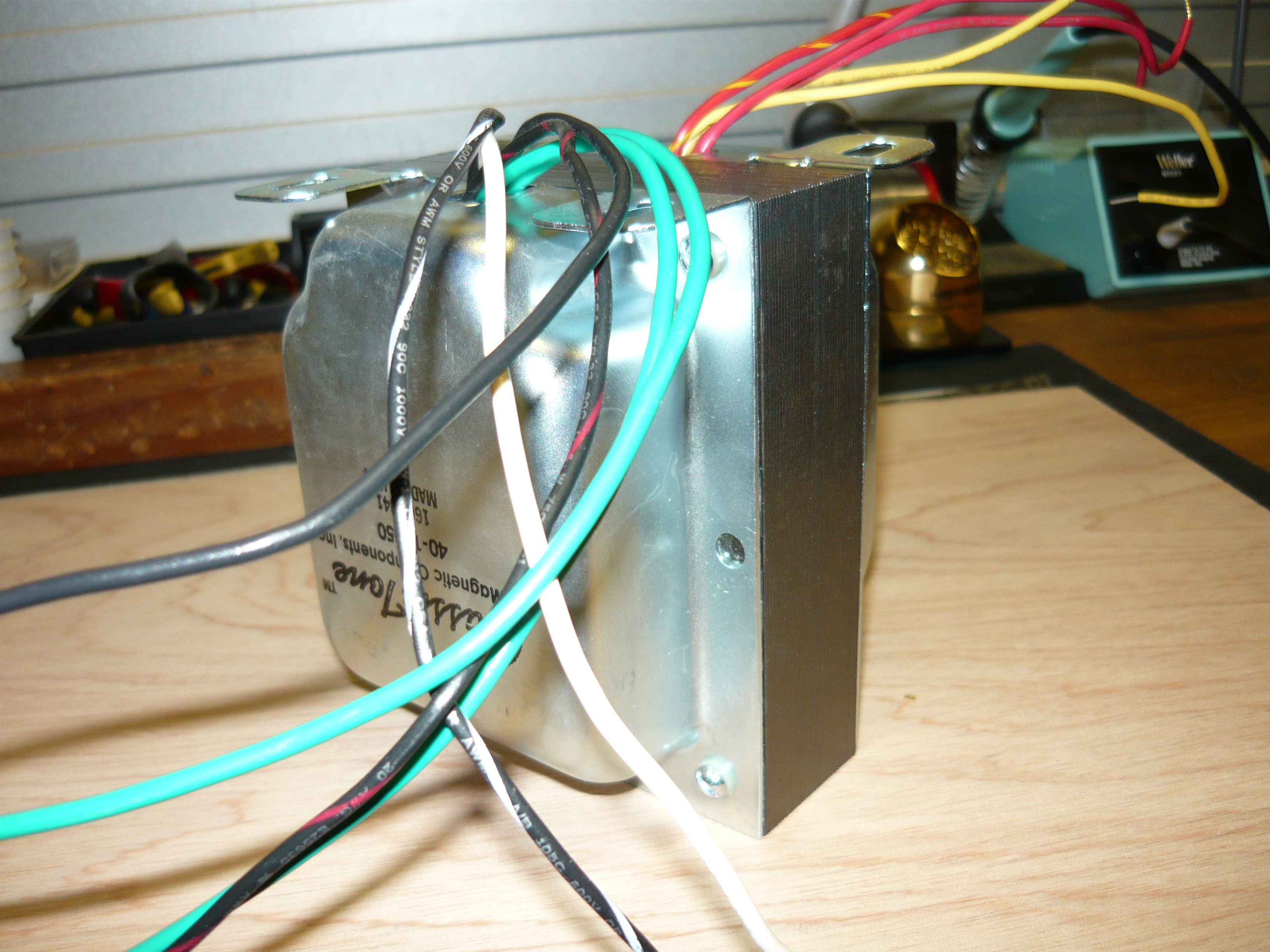
It turned out upon investigation, that the power transformer is rated at 230V AC. But, here in OZ our mains voltage is actually 240V nominal, but is often quite a bit higher than that, especially over in W.A. There was going to be a delay sourcing the original transformer from the factory anyway, and we wanted to move quickly on this job, so at the customer’s suggestion I selected an after-market replacement power transformer. I chose to install a Vox AC30 replacement manufactured in Chicago, Illinois USofA, by Magnetic Components Inc, and marketed under their “Classic Tone” series. I have sourced a transformer from this manufacturer previously with success, so I had no hesitation to use them again.

I originally read about Magnetic Components in TQR, by the way. Check out the transformer photos ! This monster is spec’d as per the original Vox AC30’s, but most importantly it is rated for 240V AC, by means of connecting the two 120V primary windings in series. In spite of the imposing bulk of this transfmr, I was able to locate it on the existing MAZ38 chassis, with a couple of additional mounting holes, and nylon grommets to feed the wires safely through the access holes. After making all the necessary connections, which included adding a pair of 100 ohm resistors to provide a centre-tapped ground connection for the 6.3V AC heater supply, and also installing a new JJ GZ34 rectifier valve (tube), we powered up the amp without any further dramas.

The amp chassis was subjected to the usual range of quality-control testing: power output test into a resistive load, burn-in test, electrical safety test (to Workcover NSW standard), and final play test into the amp’s own speakers. I was pleased to find that the new power transformer remained relatively cool during all this, one obvious advantage of bulky 50’s/60’s spec’d units with a lot of iron !

Many thanks to Shane for his continued custom and for providing us with this week’s amp repair blog. Please visit us again soon for more amp and pedal blogs, we try to create a fresh blog every week, time permitting.

Regards, Ivan.