 Hello and welcome back to the blog. This week we discuss an upgrade project for Sydney indie band guitarist, Cameron Birt. Cameron and the boys have built their guitar sounds around the Chinese-built VOX AC50 and AC100 amp heads, but they are well aware that these amps could be significantly improved from stock with some important component upgrades.

We put together an upgrade project scope and quotation for the band, which would deliver maximum results for the $$$$ spent. Our recommendations were accepted and orders placed to source the agreed upgrade components.

Our agreed upgrades were as follows: output valves – current production Mullard EL34, a pair for the 50W and a quartet for the 100W, suitably matched and the amp rebiased accordingly. Preamp valves – current production Mullard 12AX7 (‘large plate’) for the V4/PI stage positions, and Mullard 12AX7/CV4004 (‘short plate’) for positions V1 to V3 inclusive, in both amps. At the time of this project, Evatco (Queensland) had a good stock of these valves. Transformers – replacement of output transformers and filter chokes in both amps. Power transformers left in situ.
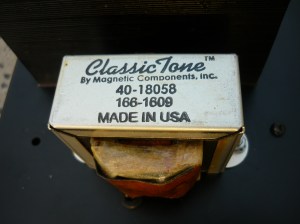 While we install and recommend Mercury Magnetics transformers for their lush tone, for this project we chose to use transformers and chokes by Magnetic Components of Chicago, USA, marketed as ‘Classic Tone’. This choice achieved a cost-effective solution. The chosen transformers provided the closest physical dimensions as well as the required electrical specifications.
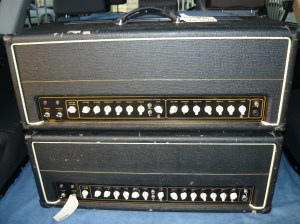 For the 50W head, we installed the Classic Tone part # 40-18025, and for the 100W head the part # 40-18026. The latter is the same transformer used in the Landry made in USA boutique grade heads, previously discussed in this blogsite. For both heads we installed the part # 40-18058 filter choke, which required the drilling of new mounting holes.
We avoided the complication of replacing capacitors in the signal path for this project – upgrading components on double sided boards is time consuming and not much fun at all. Apart from that, there is insufficient space allowed for our favourite caps. Magnetic Components provide detailed dimensions, etc, on their website which is of great assistance with these projects. Never underestimate the impact that a good filter choke can have on an amp’s performance. We have installed the Marshall style 3H (3 Henry) choke by either Mercury Magnetics or Classic Tone in many many projects now, always with positive results (yes, even the dreaded Marshall JTM600/JCM600 series amps).
We should point out that the recent production (China) VOX AC50 and AC100 have absolutely nothing in common with the famous amps of the 1960’s that the British Invasion groups conquered the world with. The current amps are definitely ‘modern’ designs with multiple gain stages and channel switching, more akin to a Marshall amp than a VOX. The end result on these two amps was a big “thumbs up” from Cameron and the boys with the VOX amps sounding great and exceeding expectations. We offer world-class service/MODs/upgrades on all VOX amps in 2016 and beyond ! Thanks for checking in to the blog – see you next week. IR.


 ivanrichards