 Welcome back ! Hopefully we are now back into a routine of publishing a fresh blog every week. In this week’s blog, we discuss a major upgrade project recently completed for the (Fender) ’65 Deluxe Reverb Reissue, which we will refer to as the DRRI. The guitarist in one of Sydney’s best loved and longest surviving blues bands has been playing through a Twin Reverb for decades, but decided to downsize to a lighter amp for the smaller rooms, which makes complete sense, and invested in a new (2015) DRRI.
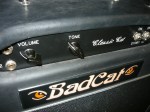
 As you can see from the photos, this particular Limited Edition DRRI looks very smart indeed, with the early ’60s Brownface amps cosmetics. Also included in the Limited Edition package was a Jensen (new production) speaker. All other aspects of this amp were identical to the standard edition DRRI.
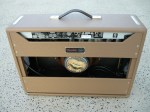 Unfortunately, the tonality presented by this amp was very thin and rather shrill. Overdrive characteristics when the amp was turned up (no pedals) were actually pretty awful. We attribute a lot of this to the choice of speaker. Just as critically for our customer, the lack of headroom with this amp and speaker combination defeated the whole purpose of investing in this particular amp, as it was virtually unuseable even for the smaller gigs.
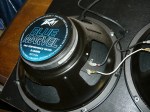
 The first step in this project was to upgrade the speaker, as is so often the case with combo amps. Choosing a speaker is not as easy as it sounds – there are a bewildering number of specialist guitar speaker options out there now. WGS offer some excellent choices at very reasonable prices, and we ended up choosing the G12C from their American Vintage range. We could just as easily have chosen the G12C/S for a smoother, softer top-end, but this model does seem to complement the DRRI voicing and adds a couple of dB in efficiency which will help with the headroom problem. Most importantly, the G12C fills out the missing lows and mids of the DRRI and behaves itself very well under overdrive conditions. The 75 watt rating of this speaker allows a healthy overload margin.
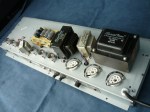 Having restored the basic tonality of the amp with our new speaker, in consultation with the customer we devised a major upgrade project to increase the headroom available by implementing a conversion from the existing 6V6GT output valves to the larger 6L6GC output valves. To take full advantage of the larger valves we also replaced the existing transformer set.
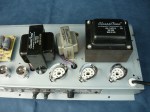
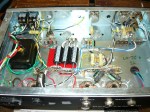
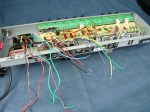 The available space and the need to allow clearance for the 12-inch speaker restricts our choices somewhat, but by re-orientating the output transformer and choke just slightly, we could install the power transformer, filter choke and output transformer set as per the 60’s Vibrolux/Tremolux series 6L6 amps. Such a reproduction transformer set was available at very reasonable pricing from Magnetic Components of Chicago, USA, although the cost of shipping adds quite a bit these days.
 Such an upgrade will increase the power output of the amp to between 30 and 40 watts, as per the original amps of the abovementioned series, without a huge increase in the weight of the DRRI. It will be necessary to modify the bias circuitry slightly (one resistor) to increase the range of the bias adjustment to accomodate the 6L6 output valves. We also upgraded the main high-voltage filter capacitor to the good quality F&T brand.
 This was not an inexpensive project by any stretch of the imagination, but much, much cheaper than selling the amp on and reinvesting in a more suitable amp. We have replaced the shrill and brittle tonality, as presented by this example, with a very warm, full sound, still characteristic of the best examples of the Fender Deluxe Reverb, and increased the headroom significantly. This is now a fine performance amplifier which will serve our customer well !










 ivanrichards